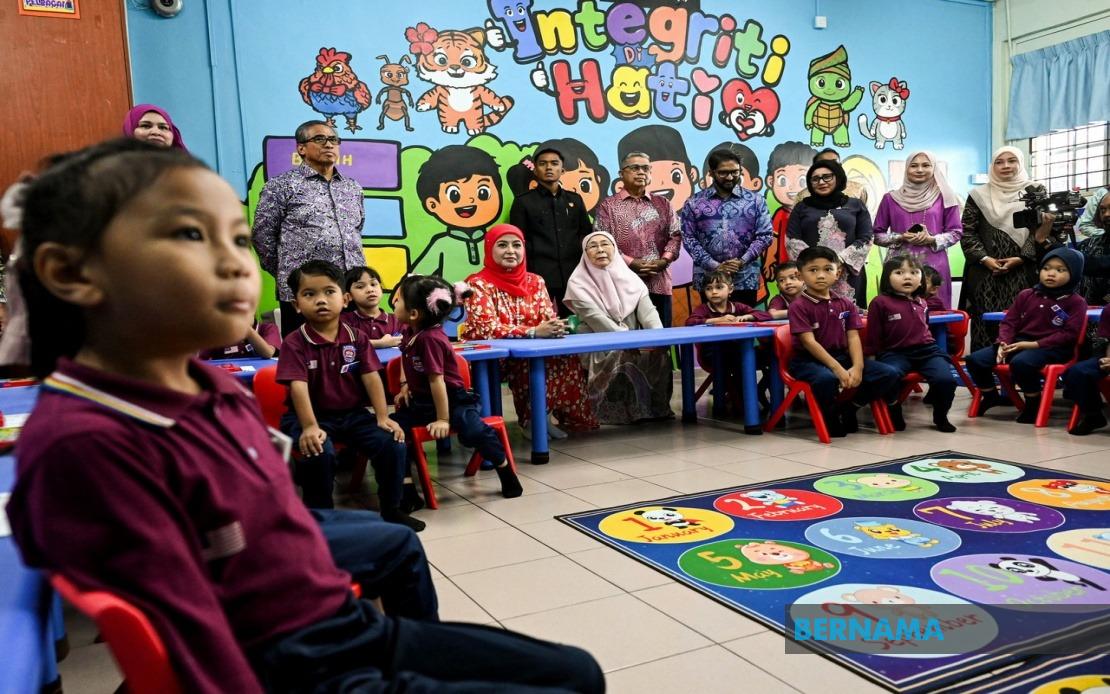
Her Majesty Queen Raja Zarith Sofiah today inaugurated the Children's Integrity Module (MIKa) at Tabika Perpaduan Taman Bukit Cheras in Kuala Lumpur, signalling the monarchy's commitment to fostering moral development in Malaysia's youngest learners. The launch, attended by senior government officials including National Unity Minister Datuk Aaron Ago Dagang and Chief Secretary to the Government Tan Sri Shamsul Azri Abu Bakar, represents a concerted push to embed ethical principles within the foundation years of childhood education across the nation.
The initiative underscores a growing recognition among policymakers that integrity and moral behaviour must be cultivated early, rather than imposed through enforcement later in life. By targeting children in the critical two-to-six age bracket, the MIKa programme attempts to establish trustworthiness and honesty as intrinsic values rather than external obligations. This developmental approach aligns with contemporary educational psychology, which emphasises that foundational ethical frameworks formed during early childhood often persist into adulthood, shaping individual character and societal norms more effectively than punitive measures introduced at later stages.
The Malaysian Institute of Integrity, chaired by Tan Sri Shamsul Azri Abu Bakar, spearheaded the module's development over the past year in collaboration with thirty-five early childhood education specialists. This multidisciplinary approach ensured that the curriculum reflects best practices in pedagogy whilst addressing Malaysia's specific cultural and social context. The involvement of multiple government ministries, higher education institutions, and civil society organisations demonstrates the cross-sectoral consensus that integrity education requires coordinated effort beyond any single institution.
Ambitions for the programme are notably expansive. Officials have articulated plans to implement MIKa across more than 31,000 childcare centres, kindergartens, and preschools throughout Malaysia by 2030. This decade-long trajectory suggests a phased rollout, beginning with early adoption in urban centres and metropolitan areas before extending into more remote regions. The scale of this undertaking positions MIKa as one of Southeast Asia's most comprehensive early-stage integrity education initiatives, potentially influencing regional approaches to character development in the formative years.
Chief Secretary Shamsul Azri articulated the philosophical foundation underlying the module during the launch ceremony, arguing that authentic integrity cannot be legislated or enforced through regulatory frameworks alone. Instead, he contended that ethical behaviour becomes sustainable only when internalised through habit formation, particularly during the malleable years of early childhood. His remarks reflected a departure from purely legalistic approaches to combating corruption and misconduct, positioning integrity as a cultural value to be nurtured rather than merely a compliance obligation.
The educational content of MIKa extends beyond theoretical instruction in moral principles. During the launch, Queen Raja Zarith Sofiah observed classroom simulations demonstrating how the module translates abstract integrity concepts into age-appropriate learning activities. This experiential dimension proves critical for young children, who absorb values through observation, interaction, and play rather than abstract reasoning. By embedding ethical lessons within familiar pedagogical frameworks that early childhood educators already employ, MIKa maximises accessibility and implementation consistency across diverse institutional settings.
The timing of this initiative carries particular significance for Malaysia, which has sustained considerable public discourse around corruption, accountability, and institutional trust in recent years. By focusing anti-corruption efforts on childhood education rather than exclusively on adult enforcement and oversight, the government signals a long-term commitment to systemic cultural change. This preventive approach potentially reduces demand for reactive anti-corruption mechanisms by establishing populations with internalised ethical standards from formative years onward.
Parental involvement emerges as a critical complementary component in the MIKa framework. Officials emphasised that childcare centres and schools cannot singularly bear responsibility for integrity development; parents must function as role models whose daily conduct reinforces lessons taught in educational settings. This recognition reflects evidence that children internalise values most effectively when observing consistent ethical behaviour across multiple trusted adults in their lives. The module's success therefore depends partly on engaging families and communities in understanding their role within this broader educational ecosystem.
For Malaysia's early childhood education sector, the MIKa launch presents both opportunities and implementation challenges. Educators across 31,000 institutions must receive comprehensive training in the module's pedagogical approaches, requiring substantial investment in professional development programmes. Moreover, assessment frameworks must be developed to evaluate whether children internalise integrity values, avoiding scenarios where the curriculum becomes mere compliance theatre. Quality assurance mechanisms will prove essential to ensuring consistent programme delivery across urban and rural contexts, private and public institutions, and varying socioeconomic communities.
The initiative also positions Malaysia within broader regional and global conversations around education's purpose beyond academic achievement. As Southeast Asian nations grapple with development challenges rooted partly in institutional weaknesses and governance deficits, investment in integrity-focused early education offers a distinctive pathway to systemic change. The approach resonates with international best practices whilst remaining grounded in Malaysia's constitutional monarchy and multicultural foundations, creating a model potentially adaptable to other contexts within the region.
Looking forward, the success of MIKa will likely influence how Malaysian policymakers conceptualise anti-corruption strategy more broadly. If early implementation yields measurable improvements in ethical orientation and social cohesion among programme participants, expansion and replication across other developmental domains may follow. The initiative thus represents not merely a curriculum intervention but a potential inflection point in how Malaysia approaches the relationship between education, character formation, and institutional integrity across generations.

