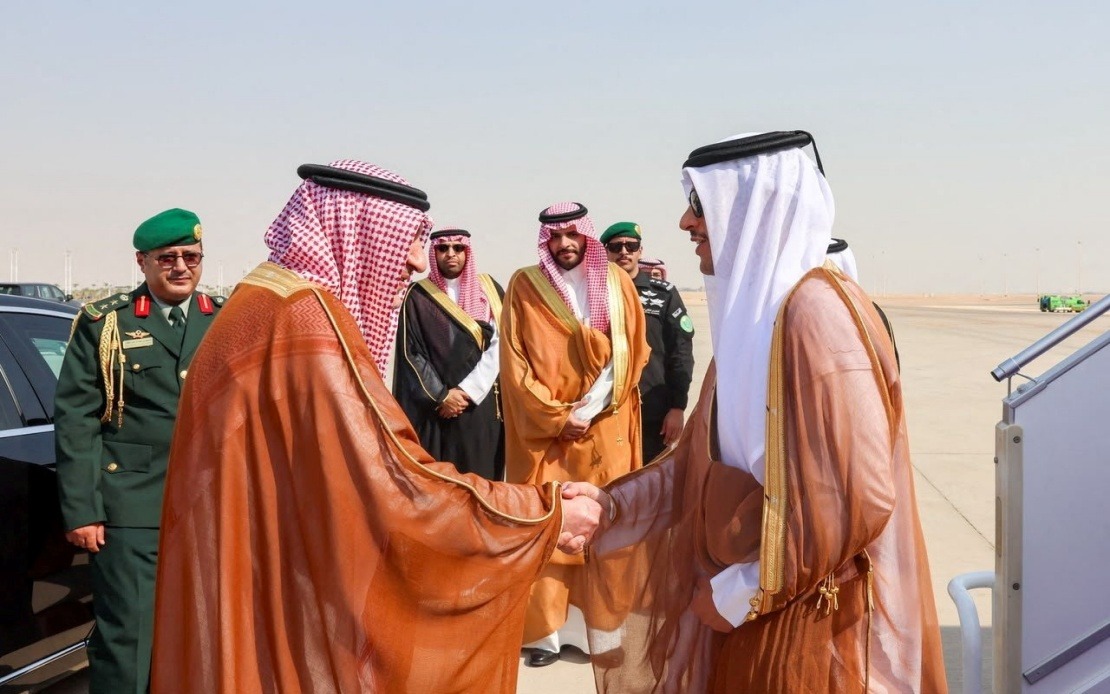
Qatar's Prime Minister Sheikh Mohammed bin Abdulrahman bin Jassim Al Thani touched down in Saudi Arabia's capital Riyadh on Wednesday for a state visit focused on easing geopolitical tensions across the Middle East. The high-level engagement reflects the Gulf's continuing effort to navigate an increasingly volatile regional landscape shaped by proxy conflicts, maritime disputes, and the strategic competition between major external powers. The Qatari leader's presence underscores how closely the smaller Gulf states monitor developments that could destabilise their collective security and economic interests.
During his time in Riyadh, Sheikh Mohammed held substantive discussions with Saudi Foreign Minister Faisal bin Farhan covering both bilateral relations and the wider regional picture. According to Qatar's Foreign Ministry, the two ministers exchanged views on diplomatic initiatives aimed at lowering tensions and strengthening the foundations for long-term security and economic stability. The emphasis on diplomatic channels rather than military posturing signals a shared commitment among Gulf leaders to pursue conflict resolution through negotiation, a principle that has gained prominence following previous periods of tension between regional actors.
A central theme running through the talks centred on bolstering collaborative mechanisms to address disputes peacefully. Both officials reaffirmed their conviction that dialogue represents the most viable path for resolving outstanding disagreements between nations. This rhetorical alignment is meaningful in a region where historical grievances, sectarian divisions, and competing claims over resources have repeatedly triggered confrontation. The explicit commitment to diplomacy suggests Gulf capitals remain invested in institutional frameworks for managing conflict.
Preserving freedom of navigation emerged as a critical concern in the bilateral conversation. The Arabian Gulf and Red Sea have become focal points in global trade, with massive quantities of oil, liquefied natural gas, and containerised goods transiting these waters annually. Any disruption threatens not only Gulf producers but also economies throughout Asia, Europe, and beyond. Saudi Arabia and Qatar both recognise that maritime security directly affects their prosperity and geopolitical standing. Recent incidents, including attacks on shipping and military posturing near key waterways, have heightened anxieties about whether commercial traffic can move without hindrance.
The Qatari Premier's dual role as Foreign Minister amplifies the diplomatic weight of his visit. His presence signals that Doha places high priority on managing ties with its much larger neighbour and fellow Gulf Cooperation Council member. Saudi Arabia's regional influence stems from its oil wealth, military capabilities, and strategic location; maintaining alignment with Riyadh on fundamental security questions gives Qatar greater leverage in addressing threats that could affect its own territory and interests. The personal involvement of such senior officials underscores that these conversations go beyond routine diplomatic courtesy.
Saudi Deputy Foreign Minister Waleed bin Abdulkarim Al-Khereiji received Sheikh Mohammed upon arrival, a gesture reflecting Riyadh's respect for the visit's importance. The hosting arrangements, though not disclosed in detail, follow established protocol for state visits and indicate both countries view this engagement as significant. The absence of announced timelines for the visit suggests the discussions may extend beyond a brief courtesy call, possibly encompassing working sessions on technical details of bilateral cooperation.
The timing of this engagement coincides with heightened regional volatility centred on the longstanding Iran-United States rivalry, in which Saudi Arabia has positioned itself as a steadfast Western ally. The Kingdom's strategic alliance with Washington shapes its foreign policy calculus across multiple domains, from military procurement to diplomatic positioning. For smaller Gulf states like Qatar, navigating between major-power competition while protecting narrow national interests requires careful calibration. The visit provides an opportunity to ensure Qatar and Saudi Arabia maintain alignment on responses to developments they cannot fully control.
Regional tensions have spiked repeatedly over recent years due to various triggers including drone and missile attacks, naval incidents, and proxy conflicts in Yemen, Syria, and Iraq. The Arabian Peninsula and surrounding waters have become venues where different state and non-state actors pursue competing objectives. Qatar's diplomatic initiative reflects awareness that even wealthy Gulf nations face constraints when confronting larger regional powers or dealing with transnational militant organisations. Building consensus among Gulf capitals on principles for restraint and dialogue therefore becomes essential.
The emphasis both officials placed on coordinating regional and international responses highlights recognition that Gulf security challenges often require inputs from actors beyond the immediate region. International maritime security arrangements, for instance, involve naval forces from multiple continents. Diplomatic efforts to reduce Iran-United States tensions inherently depend on decisions made in Tehran and Washington. By stressing coordination, Qatar and Saudi Arabia signal they understand their influence operates within broader international structures and frameworks. This perspective, though sometimes frustrating for regional actors, reflects strategic realism about power distribution in contemporary international relations.
From a Malaysian perspective, developments affecting Gulf stability carry significant implications. The region supplies crucial energy resources, hosts important trade routes, and represents a substantial market for regional manufactures and services. Escalation in the Gulf could disrupt supply chains, raise commodity prices, and create humanitarian crises that affect countries across Asia. Malaysia's own diversified engagement with both Saudi Arabia and Qatar, combined with its role in Southeast Asian forums, means stability in the Gulf contributes indirectly to broader Asian security and prosperity. The Qatari Premier's visit to Riyadh thus merits attention not merely as a bilateral event but as part of the ongoing struggle to prevent regional crises from spilling beyond the Middle East.
Looking forward, whether such high-level exchanges translate into concrete mechanisms for managing disputes and reducing misunderstandings remains uncertain. Diplomatic statements often express ideals that implementation struggles to match. Nevertheless, the fact that Qatar's leadership chose to invest time and political capital in strengthening dialogue channels with Saudi Arabia indicates that at least some Gulf actors remain convinced that escalation serves no one's interests. This conviction, fragile though it may be, provides a foundation upon which future stability might be built.

