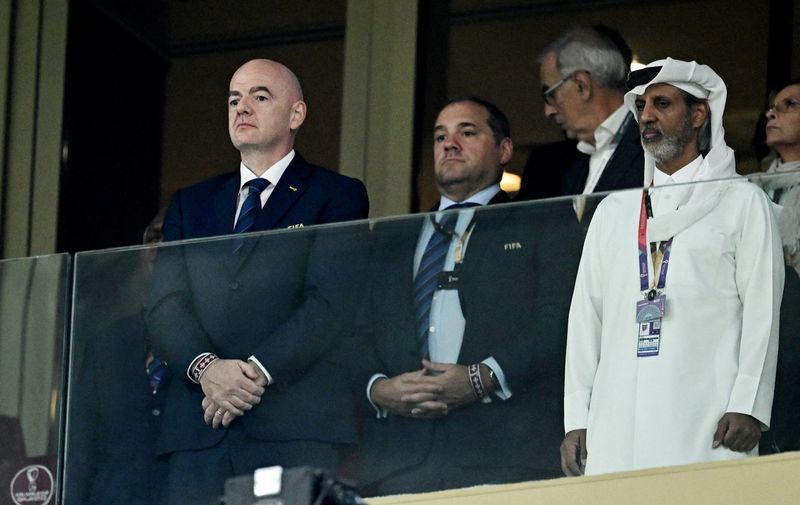
The governance crisis engulfing Asian football has intensified as the Qatar Football Association pressed forward with a formal challenge to the AFC leadership's authority, laying bare deep institutional tensions at the continental body. In a pointed third letter in an increasingly public dispute, QFA President Hamad bin Khalifa Al-Thani took aim at AFC President Sheikh Salman bin Ebrahim Al-Khalifa for signing an open letter alongside UEFA and CONCACAF that criticised FIFA President Gianni Infantino's conduct and leadership. The exchange marks an extraordinary break in protocol for the AFC, an organisation that typically insulates its leadership disputes from public view and conducts sensitive matters through discrete diplomatic channels.
At the heart of the confrontation lies a fundamental question of institutional authority and democratic process. Al-Thani's latest missive asserted that Sheikh Salman acted beyond his mandate when he appended the AFC's name to the critical statement without seeking approval from the confederation's 47 member associations or even consulting the AFC executive committee beforehand. This procedural objection strikes at the legitimacy of the entire intervention, positioning the Qatari complaint as one rooted in organisational governance rather than substantive disagreement with the letter's content. The QFA president argued that Sheikh Salman's response to the initial complaint effectively conceded that no genuine consultation mechanism was activated, despite the AFC chief's insistence that he possessed the authority to act unilaterally.
Infantino's political position has grown precarious following the abortive FIFA Forward Enterprise proposal, which sought to inject private capital into World Cup operations. The plan triggered unusual dissent from multiple continental confederations, who objected to being bypassed in favour of direct engagement with FIFA's 211 member associations. The AFC's public criticism of the FIFA president's methodology therefore represented a significant rebuke from Asia's football establishment, yet its legitimacy now rests on uncertain ground given questions over whether the continental body's constituent members genuinely endorsed the move. Qatar emerged among a small cohort of AFC members who declared early support for Infantino during the turbulence, positioning themselves alongside the embattled FIFA president as his reelection campaign approaches.
Sheikh Salman had pushed back forcefully on Tuesday, declaring that he bore both the constitutional authority and institutional responsibility to defend Asian football's interests without seeking prior authorisation. The Bahraini administrator characterised the QFA's focus on procedural technicalities as a distraction from substantive questions about football governance, arguing that previous AFC statements on major issues—including the confederation's backing for Qatar's 2022 World Cup hosting—had similarly emanated from the presidency without member-by-member approval. This invocation of precedent reveals the genuine complexity underlying the dispute, since confederations have long operated on the assumption that presidents may issue statements on matters deemed strategically important without exhaustive consultation processes.
Yet Al-Thani's rebuttal effectively dismantled this historical comparison by distinguishing between statements reflecting the AFC's institutional interests as an organisation and those expressing positions on FIFA governance matters that conceivably extended beyond the confederation's proper sphere. The Qatari official contended that prior AFC statements, particularly on World Cup hosting, reflected decisions about Asian football's own prosperity and legitimacy as a continental stakeholder in the global game. By contrast, he suggested that Sheikh Salman's intervention in internal FIFA leadership disputes represented a departure from customary practice and demanded a different standard of member consultation. This interpretative disagreement cuts to the heart of what authority means within football's international structure and which decisions qualify as sufficiently significant to warrant broader institutional input.
The Qatari position gains institutional weight from Al-Thani's seat on the AFC executive committee as a member of the FIFA Council, positioning him as a figure whose authority to question confederation decisions rests on documented standing within the governance hierarchy. His assertion that presidents' rights to act independently are circumscribed by executive committee parameters suggests that, under the AFC's own constitutional framework, unilateral action on sensitive matters may indeed exceed established bounds. The escalating exchange therefore raises fundamental questions about how Asian football's institutional structures actually function in practice versus how they are formally constituted, and whether the AFC presidency has operated with assumed powers that lack explicit constitutional grounding.
The unprecedented public nature of this dispute underscores its seriousness. Confederation officials are accustomed to handling disagreements through confidential channels, preserving public unity on matters of continental concern. The fact that all three letters have circulated widely and been examined by international media outlets signals that neither party regards the dispute as resolvable through traditional diplomatic quiet, and both seem willing to accept reputational costs for their positions. This breakdown in institutional discretion reflects genuine irreconcilability between the parties' views on authority, legitimacy, and the proper decision-making procedures for continental football bodies.
For Southeast Asian football stakeholders and readers across the region, this institutional crisis carries tangible implications. The AFC's internal cohesion directly affects how effectively the confederation can advocate for Asian interests within FIFA structures, negotiate broadcasting rights, and manage continental competitions. A weakened or internally divided leadership diminishes the confederation's leverage on global football matters, potentially disadvantaging member associations from Malaysia, Vietnam, Thailand, and other Southeast Asian nations when negotiating with FIFA on regulatory or commercial matters. Moreover, the visible rupture between Qatar and the broader AFC leadership raises questions about how the confederation navigates geopolitical tensions among its membership, particularly given Qatar's recent transition from World Cup host status to a more conventional member association role.
The fundamentals of Infantino's political challenge remain unchanged regardless of this intra-AFC dispute. The FIFA president faces substantive criticism over governance methodology that resonates across multiple confederations, and no procedural disagreement between Qatar and the AFC diminishes the core critique that his proposals lacked transparent consultation mechanisms. However, the emergence of this secondary conflict over the AFC's own decision-making processes complicates the political dynamics surrounding Infantino's reelection campaign by creating space for supporters to question the legitimacy of opposition mobilisation. If the AFC's letter itself emerged from defective processes, it weakens the rhetorical power of that institutional voice, even if the underlying substantive critique remains valid.
Al-Thani's conclusion that the AFC president's response failed to constitute a satisfying clarification sets the stage for further escalation or, alternatively, backroom mediation to resolve the dispute before it inflicts further damage on continental football governance. The AFC's silence on the latest Qatari letter suggests either that the confederation is considering its response carefully or that Sheikh Salman and his team are declining to engage further in an increasingly circular public exchange. Either way, this institutional turbulence arrives at a delicate moment for Asian football, coinciding with FIFA's broader governance challenges and the Infantino succession question that will dominate football politics through the coming year. How the AFC resolves this internal schism will inevitably shape how it positions itself and its members in relation to FIFA's future direction.

