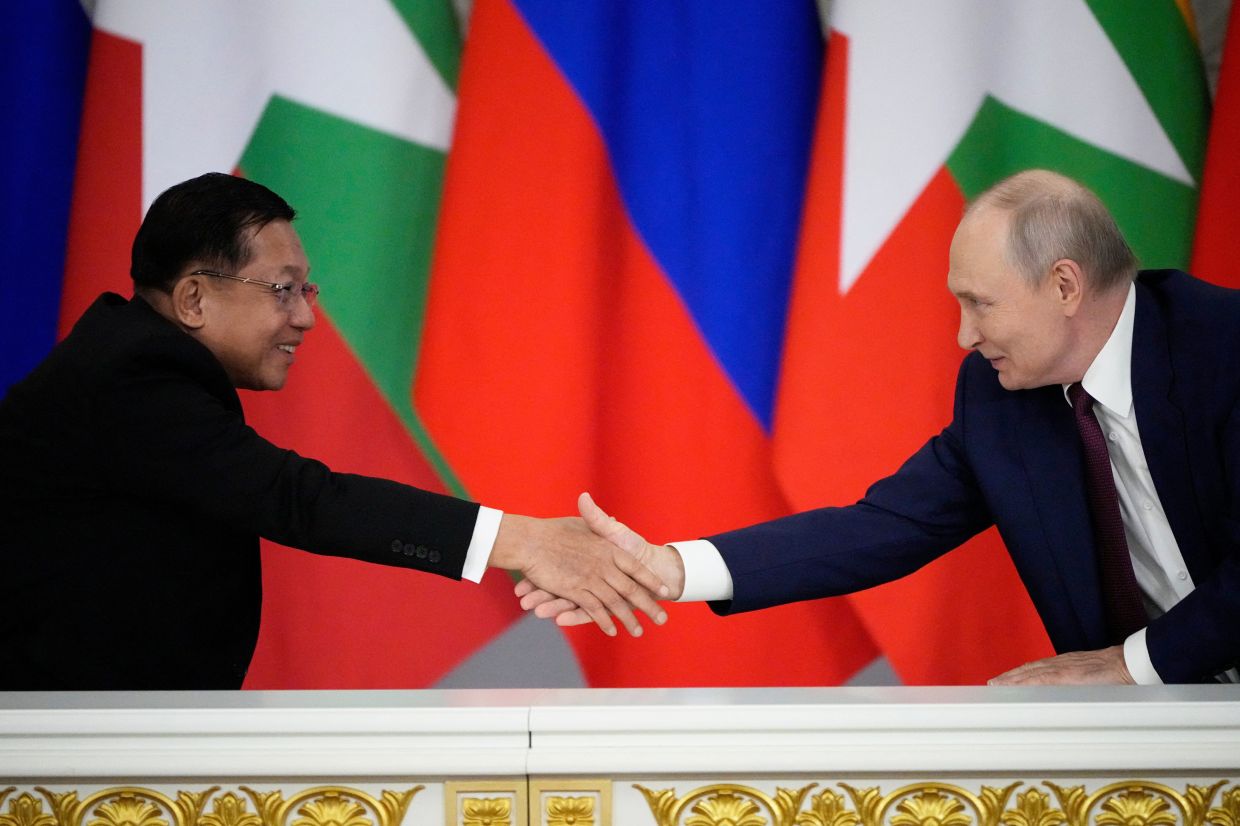
Russian President Vladimir Putin welcomed Myanmar's Min Aung Hlaing to the Kremlin on Tuesday, describing bilateral relations as having evolved into an "especially trusting" partnership that continues to deepen despite international isolation of Myanmar's military leadership. The meeting, held during the Myanmar leader's inaugural visit to Russia since assuming the presidency in April, demonstrated Moscow's sustained commitment to its Southeast Asian ally at a time when much of the Western world has frozen diplomatic ties following the 2021 military coup.
The scope of cooperation outlined during the talks reflects far more than symbolic diplomatic gestures. Putin announced Russian intentions to construct a power plant and oil refinery in southern Myanmar, alongside desires to participate in geological exploration and hydrocarbon extraction projects within the country. These infrastructure ambitions represent significant long-term economic commitments that would deepen Myanmar's energy dependency on Russia and lock in financial ties spanning decades. The emphasis on liquefied natural gas exports further underscores Moscow's strategy to position itself as a crucial energy partner for Naypyidaw, particularly as Myanmar seeks alternative markets to replace disrupted Western trade relationships.
The composition of Putin's delegation at the Kremlin talks underscored the multifaceted nature of Russian-Myanmar relations. High-ranking officials from the foreign ministry, defence establishment, energy sector and financial institutions flanked the Russian president, signalling that economic development and military cooperation constitute equally important pillars of the partnership. This comprehensive engagement strategy reflects Russia's determination to deepen institutional connections across all sectors of Myanmar's governance, ensuring influence across civilian and military bureaucracies.
Military and defence cooperation has historically anchored the Russia-Myanmar relationship, and Tuesday's discussions reinforced this foundation. Russia has supplied Myanmar's armed forces with advanced weaponry worth more than US$400 million since the 2021 coup, according to United Nations reports from May 2023. Beyond conventional arms transfers, the two nations collaborate on nuclear technology through Rosatom State Corporation, with Myanmar pursuing development of a small-scale nuclear power plant intended for applications in healthcare, agriculture and industrial sectors. These partnerships position Russia as indispensable to Myanmar's long-term security architecture and technological modernisation.
The timing and frequency of high-level meetings between Moscow and Naypyidaw reflects a diplomatic pattern that has accelerated since Russia's invasion of Ukraine in February 2022. Tuesday's encounter marks at least the fourth formal meeting between Putin and Min Aung Hlaing since the Ukrainian conflict commenced, with each summit occurring as Western sanctions against Russia tightened and Moscow found itself increasingly isolated from traditional Western allies. Myanmar's willingness to maintain open diplomatic channels and deepen cooperation with Russia during this period has provided valuable political cover for Moscow, demonstrating that its international position, while damaged in Western capitals, remains robust in strategic regions beyond Europe.
Min Aung Hlaing's broader diplomatic offensive extends well beyond Moscow. Since the military-backed parliament appointed him president following a contested election that drew widespread international condemnation, he has undertaken regional visits to China, India, Laos and Thailand. His administration simultaneously pursues engagement with the United States and the Association of Southeast Asian Nations, attempting to rehabilitate Myanmar's international standing whilst refusing concessions such as releasing detained former leader Aung San Suu Kyi. This multidirectional diplomatic strategy attempts to balance Myanmar's traditional relationships with the West against its deepening ties with non-democratic powers, though such positioning remains fundamentally unstable given the geopolitical pressures emanating from Myanmar's location and strategic importance.
The composition of Myanmar's delegation to Moscow itself deserves analytical attention. Beyond Min Aung Hlaing, a high-level contingent including multiple cabinet ministers and the head of Myanmar's Space Agency arrived in the Russian capital on Monday. The president additionally met with Prime Minister Mikhail Mishustin and Vyacheslav Volodin, speaker of the lower house, alongside attendance at a Myanmar-Russia Business Forum. This intensive schedule demonstrates Moscow's commitment to building relationships across Myanmar's entire governance structure, ensuring that economic and military partnerships embed themselves throughout state institutions.
Russia's strategic positioning towards Myanmar must be understood within the broader context of great power competition in Southeast Asia. As Western influence recedes due to sanctions and geopolitical realignment, Russia and China have expanded their respective footprints across the region. Myanmar, with its geographic location, natural resources and military significance, represents a crucial node in Russian efforts to maintain relevance in Asia despite its European isolation. For Malaysian observers and Southeast Asian policymakers, the deepening Russia-Myanmar relationship signals shifting regional alignments that may carry implications for broader security architecture and economic arrangements throughout the area.
The nuclear cooperation dimension warrants particular attention for regional security analysts. Myanmar's nuclear programme, developed with Russian assistance, introduces new technological capabilities to the Southeast Asian security environment. While civilian applications such as healthcare and agricultural development are emphasized by both Moscow and Naypyidaw, the strategic implications of nuclear technology transfer to a military-governed state under international isolation cannot be dismissed. The programme represents one of Russia's most ambitious technology transfer initiatives in Asia and carries potential long-term consequences for regional proliferation dynamics.
For Myanmar's military government, the Moscow visit represented an opportunity to demonstrate that diplomatic isolation from Western democracies need not constrain its access to advanced technology, investment capital and international legitimacy. By hosting high-level state visits in Moscow and receiving reciprocal visits from Russian officials, including Putin's security adviser Sergei Shoigu in February, Min Aung Hlaing seeks to normalize his regime's international position despite the disputed legitimacy of his electoral mandate. This strategy relies fundamentally on Russia's willingness to provide sustained diplomatic and material support, making Myanmar's geopolitical alignment increasingly asymmetrical and dependent.
The economic dimensions of expanded Russia-Myanmar cooperation present both opportunities and risks for Myanmar's development trajectory. While infrastructure investments in energy production could address chronic power deficits constraining Myanmar's economic growth, such projects inevitably strengthen financial ties to Moscow whilst potentially crowding out alternative partnerships. The liquefied natural gas export possibilities mentioned by Putin would further entrench Myanmar's role as a resource exporter to Russian markets, potentially limiting diversification opportunities and increasing vulnerability to Russian market dynamics and pricing pressures.
Southeast Asian governments, including Malaysia, must assess how deepening Russia-Myanmar ties affect regional stability and security arrangements. Myanmar's strategic location along major maritime routes and its relationship with powerful neighbours China and India mean that its external alignments carry broader implications. The consolidation of Russia-Myanmar cooperation, coupled with China's existing influence, could reshape regional power balances and limit space for other external powers to exercise meaningful influence in Myanmar's affairs.

