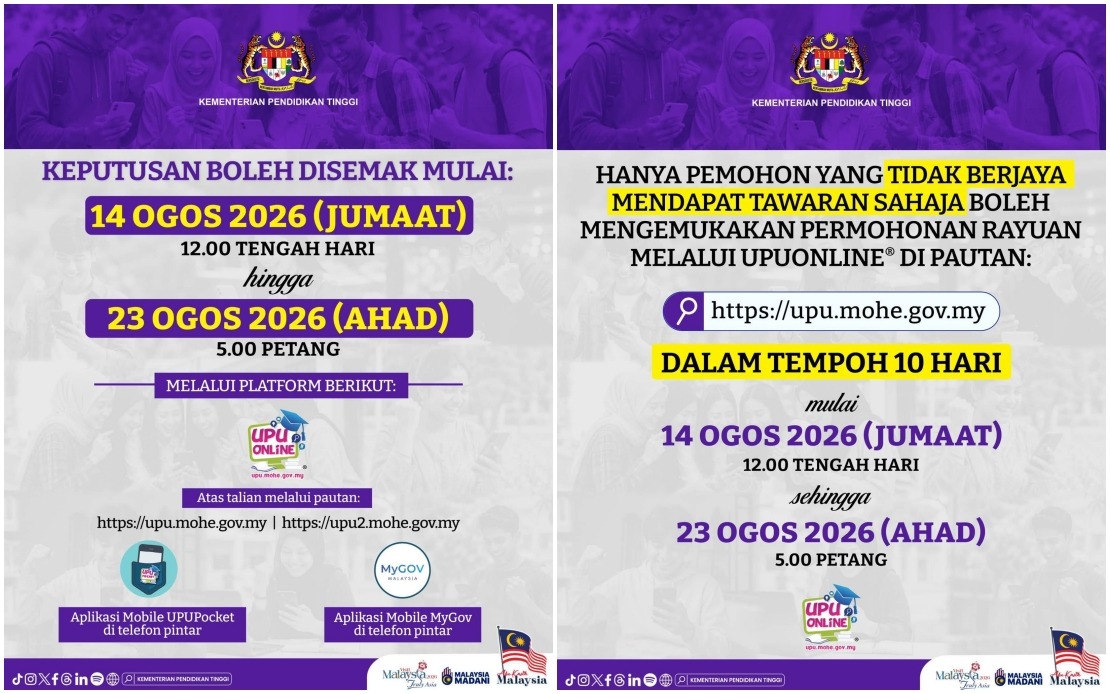
The Ministry of Higher Education has confirmed that admission decisions for Malaysia's public universities will be released on Thursday, August 14, marking a crucial milestone for thousands of STPM graduates and equivalent qualification holders applying for degree programmes in the 2026/2027 academic year. The announcement comes as the nation's higher education system continues to manage record application volumes through the centralised UPU (Unified Selection).
Applicants seeking to learn their admission status can access results starting from noon on August 14 through multiple digital channels, ensuring accessibility across different user preferences and device types. The official UPU portal at https://upu.mohe.gov.my and its mirror site https://upu2.mohe.gov.my will display results, supplemented by dedicated mobile applications including UPUPocket and Mobile MyGov for smartphone users. This window remains open until 5 pm on August 23, providing a ten-day period for candidates to review their outcomes at their convenience.
Once results are published, the confirmation phase commences immediately on August 15, when successful applicants must actively respond to their offers through individual university websites. This acceptance confirmation mechanism serves a dual purpose: it allows institutions to gauge genuine interest among admitted students while enabling the system to identify which places remain available for subsequent processing stages. Candidates have until August 23 to complete this critical confirmation step, after which universities will begin issuing formal offer letters to those who have accepted their admissions.
For applicants who do not receive initial offers, the appeal mechanism provides a structured second chance within a compressed timeframe. Between August 14 and August 23, unsuccessful candidates may submit formal appeals through the same UPU online platform, potentially gaining admission to programmes and institutions where vacancies emerge. However, the Ministry has emphasised that appeal consideration depends entirely on available capacity after current students complete their registration, meaning the volume of successful appeals may be limited and programme-specific.
A fundamental constraint that shapes the entire admission process is the Ministry's decision to declare the 2026/2027 placement offers as final and non-negotiable. Once a student's allocation to a particular university and programme has been confirmed, no subsequent requests for programme transfers or institution changes will be entertained. This policy aims to maintain administrative order and provide institutions with predictable cohort compositions for academic planning, though it removes flexibility for students whose preferences may shift during the confirmation period.
The timing of these announcements reflects the coordinated calendar that Malaysia's public university system maintains annually. By concentrating results, confirmations, and appeals into a three-week window, the Ministry streamlines the administrative burden on universities while creating clear deadlines that prevent indefinite uncertainty for applicants. This compressed timeline, while efficient from an institutional perspective, places considerable pressure on students to make irreversible decisions within days rather than weeks.
For Malaysian secondary school students, the STPM pathway represents one of two primary routes into degree-level study, alongside the Matriculation programme administered by the Ministry itself. The STPM qualification, issued by the Malaysian Examination Council, carries significant weight in university admissions and is recognised internationally, making this annual intake cycle particularly consequential for those pursuing academic rather than vocational trajectories. The August results therefore represent the culmination of months of examination preparation and university selection deliberation.
The regional context of Malaysia's higher education system reveals growing competition for places, particularly at flagship institutions in the Klang Valley and key sectors such as medicine, engineering, and commerce. Limited capacity at premium universities means that significant numbers of qualified STPM graduates may not secure their preferred choices, necessitating either acceptance of alternative placements or pursuit of private institution options. The appeal mechanism acknowledges this dynamic, though its success rate depends heavily on programme popularity and withdrawal patterns from initial offers.
Applicants should prepare documentation and ensure device access to the UPU portals well before the August 14 release, as simultaneous access by hundreds of thousands of users may occasionally cause system congestion. The Ministry's provision of multiple access points and extended checking windows through August 23 is designed to accommodate this demand, though candidates are advised against leaving confirmation submissions until the final days when technical issues could prove costly. Universities will distribute offer letters immediately after confirmations are received, enabling admitted students to prepare for registration and orientation activities scheduled before the academic session commences.
The implications of this admission cycle extend beyond individual students to shape Malaysia's demographic distribution across public universities. Institutional rankings, programme reputation, and geographic location all influence admission statistics, and patterns in this 2026/2027 intake will reflect current perceptions of universities' standing. For policymakers monitoring higher education equity, the results also provide data on which demographic groups successfully secure admission to premium institutions, informing future access initiatives aimed at broadening participation from underrepresented populations in Malaysian tertiary education.

