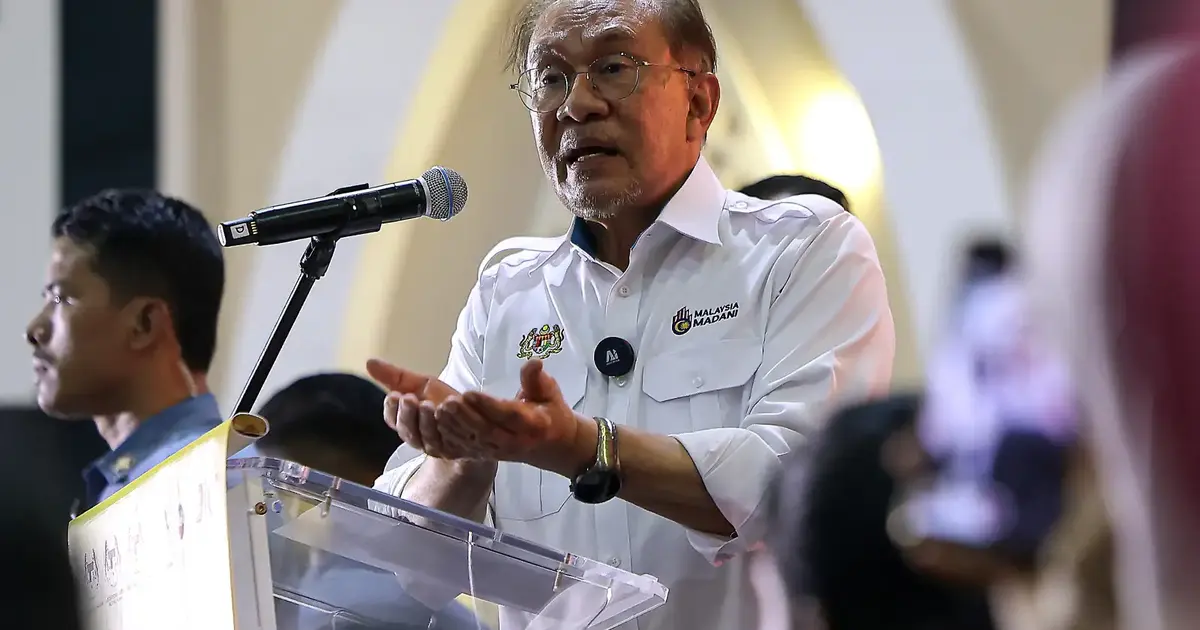
Prime Minister Anwar Ibrahim has pushed back against suggestions that safeguarding the rights of Chinese and Indian Malaysians undermines the constitutional framework protecting Malays and Islam, framing minority protection as complementary to rather than competitive with existing constitutional provisions. The assertion addresses a persistent fault line in Malaysian politics where discussions about advancing minority welfare often trigger concerns from segments within the Malay-Muslim community about dilution of Article 153 protections established at independence.
Anwar's position reflects an attempt to navigate the delicate balancing act that defines Malaysian governance. The 1957 Federal Constitution enshrines special position provisions for Malays and Islam, including reservations for civil service positions, land ownership restrictions, and educational quotas, in exchange for citizenship rights extended to Chinese and Indian immigrants and their descendants. This foundational bargain has defined the social contract for nearly seven decades, yet contemporary interpretations of its scope remain contested and emotionally fraught across communal lines.
The prime minister's intervention suggests growing recognition within government that Malaysia's continued stability depends on reinforcing rather than abandoning multi-communal accommodation. As the nation experiences economic pressures, generational shifts in voter expectations, and evolving international norms regarding minority rights and pluralism, political leaders face mounting pressure to demonstrate that protecting one group need not come at another's expense. This framing represents a rhetorical shift from earlier periods when political actors often portrayed constitutional provisions through zero-sum lenses.
For Malaysian readers, particularly those in urban areas where ethnic diversity is everyday reality, Anwar's argument speaks to aspirations for a functioning plural society where institutional protections coexist with genuine equality of opportunity. Middle-class families across all communities have increasingly internalized the view that their children's economic prospects depend less on communal entitlements than on educational quality, market competition, and meritocratic advancement. The prime minister's words acknowledge this demographic and ideological evolution without formally abandoning constitutional commitments that remain politically sacrosanct.
The timing of Anwar's remarks carries particular significance given Malaysia's ongoing struggles with religious polarization and communal tension. Recent years have witnessed intensifying debates around Islamic authority, religious conversion, interfaith dialogue, and the proper scope of Shariah law, debates that have sometimes been weaponized to suggest that defending minority interests represents an existential threat to Islamic governance. By explicitly decoupling minority protection from constitutional erosion, Anwar attempts to immunize these discussions against such framings while maintaining his government's stated commitment to inclusive development.
Yet translating rhetorical commitment into substantive policy remains Malaysia's persistent challenge. Beyond statements, the government must demonstrate through concrete action—judicial appointments, educational reform, housing policy, economic opportunity distribution, and civil service recruitment—that minority communities experience genuine advancement without triggering backlash that destabilizes the coalition holding together the ruling political structure. This implementation gap between declaratory positions and practical outcomes has historically undermined trust in political leadership across all communal groups.
The prime minister's intervention also reflects international pressure on Malaysia regarding minority rights, religious freedom, and institutional accountability. Multilateral organizations, foreign governments, and international civil society increasingly scrutinize Malaysia's treatment of ethnic and religious minorities, creating diplomatic incentives for political leaders to articulate inclusive governance frameworks. Simultaneously, domestic critics across different constituencies question whether such frameworks adequately address systemic inequalities, institutional capture, or inadequate protection for vulnerable populations.
Regional context matters substantially here. Throughout Southeast Asia, nations grapple with similar tensions between constitutional protections for majority populations and contemporary expectations for minority inclusion and equal treatment under law. Thailand, Myanmar, and Indonesia have all experienced communal violence and institutional instability partly rooted in failures to negotiate workable accommodations between majority-favoring constitutional provisions and minority demands for substantive equality. Malaysia's constitutional arrangement, while imperfect, has produced comparatively greater stability, yet it requires continuous political maintenance and rhetorical reinforcement to prevent erosion of legitimacy.
Anwar's articulation also addresses internal government coalition dynamics. His administration comprises multiple parties representing different constituencies and ideological orientations. Reassuring both Malay-Muslim partners committed to constitutional provisions and non-Malay partners seeking concrete improvements in minority status requires carefully calibrated messaging that satisfies both constituencies without satisfying neither adequately. The prime minister's position essentially argues that his government can deliver on both fronts simultaneously, a claim that will ultimately be judged through empirical outcomes rather than rhetorical positioning.
For multinational corporations, foreign investors, and international observers evaluating Malaysia's stability and governance trajectory, such statements from the prime minister provide reassurance regarding institutional continuity and rules-based pluralism. Investors historically factor political and social stability heavily into risk assessments, and evidence of leadership commitment to constitutional accommodation across communal lines can influence capital allocation decisions and confidence in Malaysia's business environment. Conversely, if rhetoric proves disconnected from practice, such statements may ultimately erode credibility more than strengthen it.
Moving forward, Anwar's challenge involves converting intellectual consistency—the logical argument that protecting one group need not threaten another—into political sustainability and institutional practice. This requires ongoing dialogue with constituencies across the ethnic and religious spectrum, continued judicial independence to arbitrate constitutional questions, and willingness to strengthen institutions that protect both majority and minority interests simultaneously. Whether this administration can achieve such calibration, particularly as economic pressures mount and demographic shifts reshape political alignments, will significantly determine Malaysia's governance trajectory through the coming decade.

