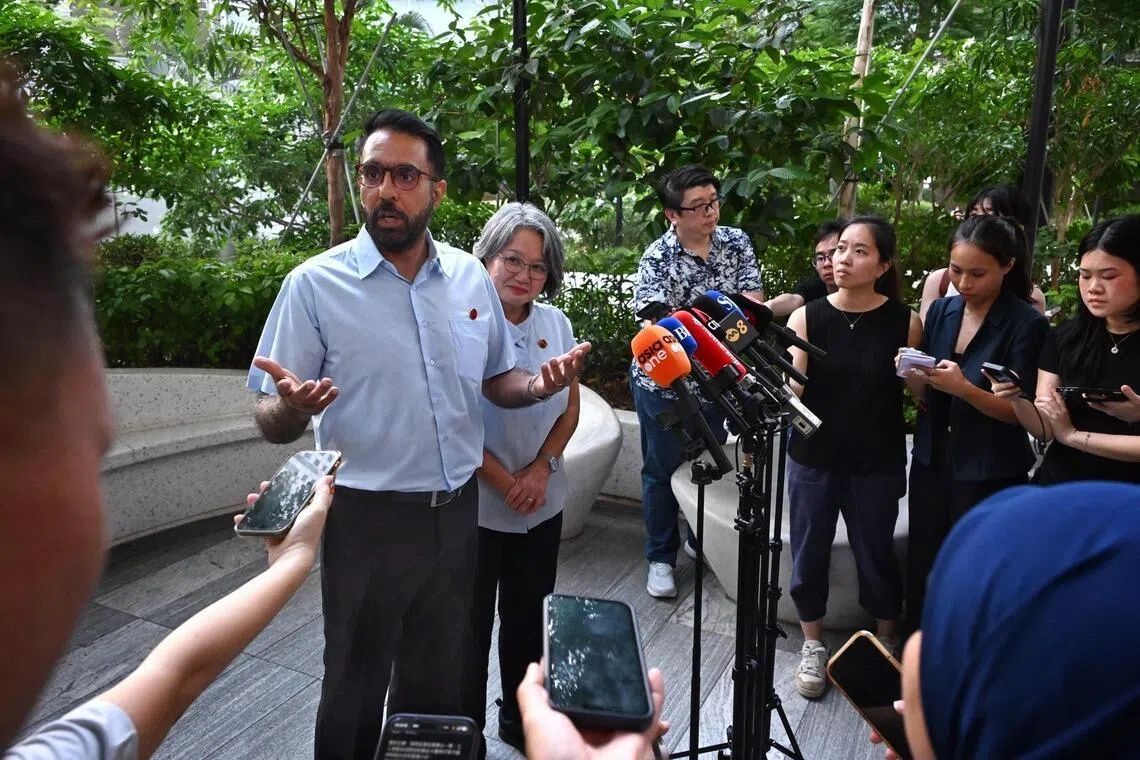
Singapore's Workers' Party has moved decisively to end an internal leadership challenge, re-electing Pritam Singh as chief without contest at elections held on June 28. The outcome represents a significant consolidation of power for Singh following months of organizational turbulence triggered by his legal conviction and a coordinated push by approximately 25 party members seeking his removal from office.
The re-election process unfolded in two distinct phases on the same day. Earlier in the morning, a special cadres conference convened to consider a motion demanding Singh's resignation. The proposal failed to gain sufficient support, with Singh subsequently subjected to a confidential ballot on his continued leadership. The secret vote demonstrated substantial backing for his tenure, though exact figures were not disclosed publicly. According to party sources, Singh commanded approximately 80 percent support among the more than 100 inner-circle members eligible to vote, well exceeding the supermajority threshold required to preserve his position.
The challenge to Singh's leadership emerged from frustrations accumulating over several years, particularly following the 2021 parliamentary statement controversy involving former Sengkang GRC MP Raeesah Khan. Singh's legal troubles—stemming from his conviction for misleading a parliamentary committee regarding his guidance to Khan about false claims she had made in Parliament—created openings for internal dissent. The High Court upheld this conviction in December 2025, and Singapore's Parliament subsequently deemed him unsuitable to serve as Leader of the Opposition, a ceremonial role subsequently withdrawn in January 2026. These reverses prompted the December 2025 letter from discontented cadres initiating the formal challenge process.
The morning meeting conducted by Aljunied GRC MP Gerald Giam provided opportunities for cadres to articulate concerns about Singh's judgment and organizational stewardship. The forum maintained decorum throughout discussions, with Singh responding to questions and providing an accounting of his actions. Giam characterized the exchange as demonstrating "proper accountability" on contested matters, suggesting the party's internal governance functioned according to established protocols even amid disagreement. Singh appeared satisfied with the outcome, emphasizing his interpretation that the result reflected genuine party unity rather than reluctant acquiescence.
Former party chief Low Thia Khiang's public endorsement delivered on June 28 proved strategically important for bolstering Singh's position. The endorsement dispelled speculation that Low, who previously steered the Workers' Party during its most successful periods, harbored doubts about his successor's suitability. Low's continued support functioned as a significant institutional validation, lending historical weight and organizational credibility to Singh's retention of the leadership position. This backing from the party's elder statesman likely influenced voting calculations among cadres wrestling with concerns about Singh's recent judicial setbacks.
Following the leadership vote, the party conducted its regular biennial internal elections at 3pm, during which it refreshed its central executive committee. Sylvia Lim retained her position as party chair, an office she has occupied since 2003, reflecting continuity in the party's senior governance structure. The committee included 12 elected members, with most returning from the previous iteration of this decision-making body. Notably, four of the 12 members—Low, former MP Faisal Manap, longtime cadre Tan Kong Soon, and newcomer senior counsel Harpreet Singh—do not currently serve as elected parliamentarians, providing the committee with perspectives from beyond the parliamentary caucus.
Harpreet Singh's election to the central executive committee marked the committee's only addition of a completely new member, though his inclusion was relatively unremarkable given that he contested the May 2025 general election as part of the Workers' Party's Punggol GRC slate. His subsequent social media commentary provided an unusually explicit defense of the re-election process, arguing that cadres exercised discernment rather than yielding to factional pressure. Singh's contribution to the post-election narrative emphasized that Workers' Party members assessed Singh's overall leadership record, including his organizational achievements and composure under sustained political pressure, rather than fixating narrowly on his legal conviction.
The disciplinary process preceding the leadership vote had already imposed formal consequences for Singh's conduct. A three-person panel comprising Jamus Lim, He Ting Ru, and Png Eng Huat determined that Singh violated two constitutional provisions through his handling of Khan's parliamentary misstatements. The central executive committee subsequently issued a formal reprimand in April 2026, approximately two months before the June elections. This disciplinary sanction established that the party hierarchy acknowledged serious failings in Singh's judgment while stopping short of recommending or requiring his removal from the top leadership position.
The internal conflict within Singapore's largest opposition party carries broader ramifications for parliamentary dynamics and the regional political landscape. Opposition parties across Southeast Asia frequently face cohesion challenges when senior figures encounter legal or ethical difficulties, and the Workers' Party's decision to retain Singh despite his conviction signals that institutional loyalty and accumulated organizational achievement can outweigh individual legal setbacks in party deliberations. The outcome also reflects a preference among Workers' Party cadres for continuity and stability over the uncertainty associated with leadership transitions, particularly given the party's significance as Parliament's most substantial non-government political force.
Singh's interpretation of the re-election outcome stressed the importance of "closing ranks" and maintaining the party's reputation for rational and responsible governance. His public remarks suggested an intention to move beyond the internal disputes and refocus organizational energy on parliamentary work and constituent representation. However, the substantial minority opposition—approximately 20 percent of inner-circle voters—indicates that skepticism about Singh's fitness for leadership persists within the party structure. This residual discontent could resurface if the party's electoral performance deteriorates or if Singh's legal situation evolves further through continuing appeal processes.
The Workers' Party's handling of the leadership challenge demonstrates how opposition parties in established democracies manage internal governance during periods of institutional stress. Unlike scenarios where beleaguered leaders face forced departures or where organizational factions achieve irrevocable schisms, the Workers' Party conducted formal processes respecting democratic voting procedures while allowing dissenting voices meaningful forums for expression. This approach preserved party unity while acknowledging legitimate concerns about Singh's recent troubles, creating space for organizational healing without requiring his removal from office. For Malaysian and broader Southeast Asian observers, the Workers' Party's resolution illustrates both the fragility and resilience of institutional opposition structures in competitive political systems.

