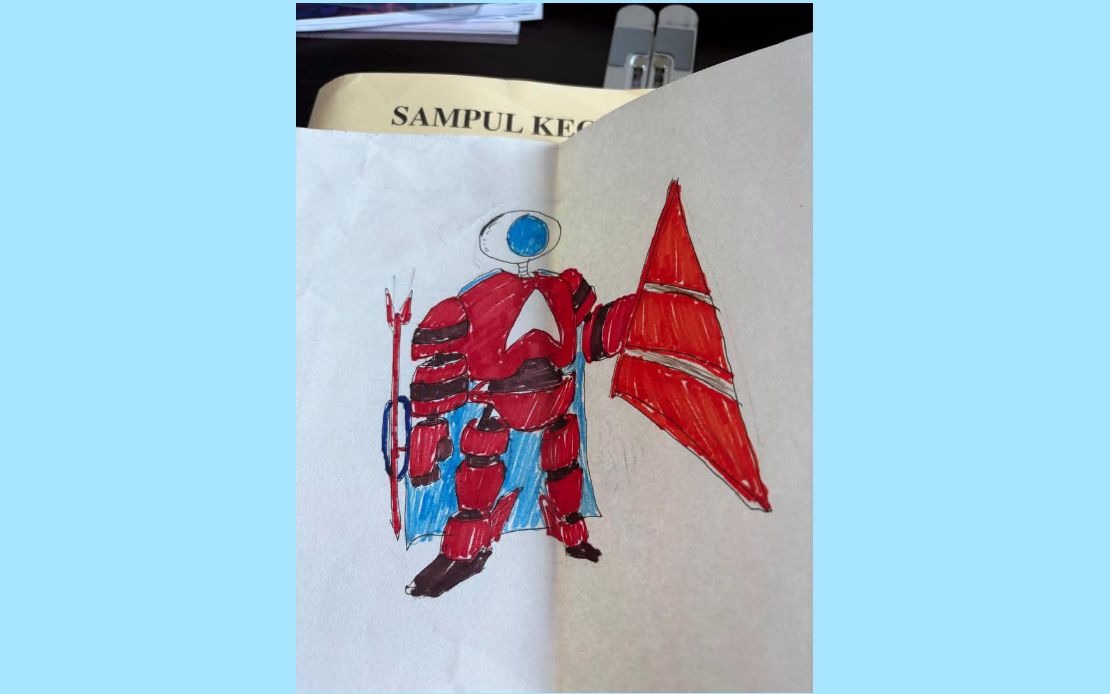
Prime Minister Datuk Seri Anwar Ibrahim has highlighted the emotional significance of an artwork presented to him by a child with special needs during a recent community engagement session in Negeri Sembilan, underscoring the personal connections forged through direct public interaction. The leader took to Facebook to share his reflections on receiving the gift, expressing gratitude and emphasising how the gesture had resonated with him on a personal level.
The drawing, which depicts a robot figure adorned in red and blue armour wielding a staff-like implement, was handed over during one of the Prime Minister's ongoing Temu Anwar programmes. The child's father carried his son during the presentation, a moment that Anwar indicated remained vivid in his memory. Such exchanges, though seemingly brief in the context of larger political events, often carry significant symbolic weight in demonstrating a leader's accessibility and willingness to engage across all segments of society.
Temu Anwar functions as a structured platform enabling direct dialogue between the Prime Minister and members of the public from diverse backgrounds and age groups. These sessions represent an evolution in Malaysian political engagement, moving beyond traditional top-down communication to foster two-way interaction. The programme explicitly targets youth and citizens from all walks of life, reflecting an effort to democratise access to high-level political leadership and create space for ordinary Malaysians to voice concerns, ideas, and gratitude directly.
The Prime Minister's public acknowledgment of this particular gift carries implications beyond the immediate personal gesture. By elevating a simple drawing to public attention through social media, Anwar signals recognition of individuals with special needs and their families as integral members of the Malaysian community deserving of visibility and respect. This narrative choice subtly reinforces inclusive governance messaging at a time when disability rights and accessibility remain ongoing policy discussions in Malaysia.
The Negeri Sembilan event where this exchange took place formed part of a broader agenda to maintain political momentum through community connection. The Prime Minister's decision to document and commemorate this interaction publicly suggests a strategic awareness of how personal stories and human connections can build political capital whilst simultaneously demonstrating genuine interest in constituent experiences. Such moments, when authentically presented, resonate across demographic lines and contribute to perceptions of approachability in leadership.
Children's artwork holds particular communicative power in political contexts. Unlike formal petitions or structured complaints, a drawing offers unfiltered emotional expression and creativity. The robot character chosen by this child perhaps reflects imagination and play untethered by adult constraints, and the Prime Minister's preservation and public recognition of it validates that imaginative voice. For parents of children with special needs, witnessing their child's contribution acknowledged at the highest governmental level carries psychological and social significance beyond the transaction itself.
The timing of Anwar's Facebook post reflects modern political communication strategies where leaders leverage social platforms to craft narratives about their character and values. By sharing this moment, the Prime Minister positions himself as one who values sincere gestures regardless of their commercial or political utility. The post's warm, personal tone contrasts with the formal rhetoric often dominating political discourse, offering supporters an alternative lens through which to view their leader as fundamentally human and emotionally responsive.
For Malaysia's special needs community, such visibility matters substantially. Advocacy organisations in the country have long pressed for greater mainstream recognition and policy prioritisation for disabled citizens. When a sitting Prime Minister publicly treasures a drawing from a special needs child, it sends subtle but important signals about societal positioning and governmental awareness. This gesture, though non-legislative, contributes to the broader cultural conversation about inclusion and dignity.
The concept underlying Temu Anwar—that direct political engagement across diverse populations strengthens democratic governance—remains contested in contemporary Malaysian politics. Critics argue that such programmes serve primarily performative functions, whilst proponents contend they create valuable accountability mechanisms and foster genuine connections. This particular incident, whether viewed cynically or optimistically, demonstrates the tangible human interactions that occur when such platforms operate, regardless of their broader systemic effectiveness.
The preservation of the artwork itself merits consideration. That the Prime Minister retained the drawing and subsequently publicised it suggests administrative processes supporting the maintenance of such items and their integration into personal or official record-keeping. This raises questions about how Malaysian government offices manage and archive citizen-gifted items, and whether systematic approaches exist for documenting these exchanges as historical records reflecting citizen-leadership interaction.
Looking forward, this incident illustrates how Malaysian political leadership continues adapting to public expectations regarding accessibility and emotional intelligence. The ability to receive, value, and publicly acknowledge a simple gift from a vulnerable community member increasingly forms part of contemporary political competence. For citizens, particularly those from marginalised communities, such moments provide tangible evidence that their existence and contribution register within governmental consciousness.
The broader implications for Malaysian governance involve recognising that inclusive politics extends beyond policy frameworks to encompass how leaders inhabit and enact their roles in lived interactions. The drawing's journey from a child's hand to the Prime Minister's collection to public Facebook testimony traces the arc of a political culture gradually expanding its aperture to encompass wider populations and their lived experiences.

