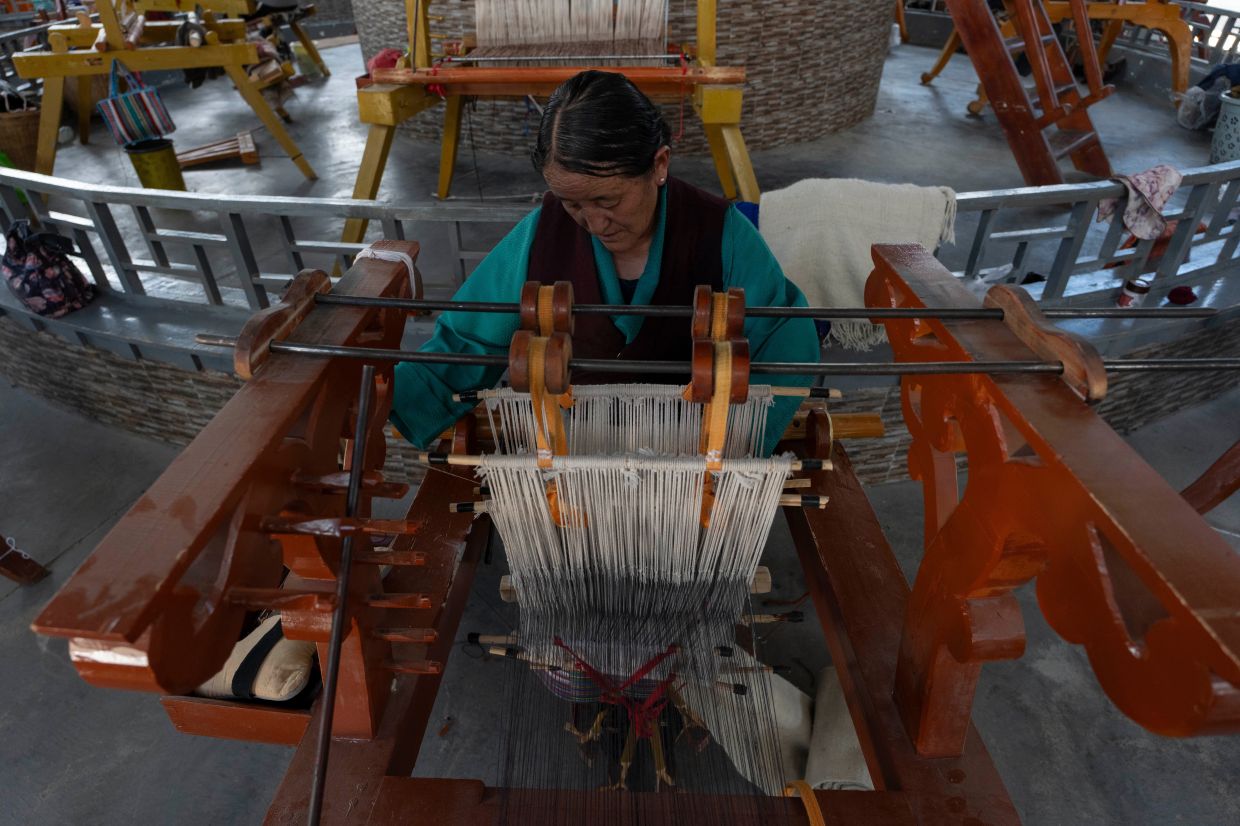
Across wooden looms in a workshop nestled on the Tibetan plateau, artisans rhythmically guide shuttles through carefully arranged wool yarns, their hands moving with practised precision to craft Pulu—a traditional fabric that has warmed the people of Tibet for centuries. The repetitive motion, refined through generations, represents far more than mere textile production; it embodies a living connection to the region's cultural heritage at a time when such traditions face pressure from modernisation and globalisation. This weaving tradition, rooted in the plateau's history, now finds its champion in the Ethnic Huaji Handwoven Cooperative, located in Shannan at approximately 3,700 metres above sea level.
When Tibetan artisan Pasang established the Ethnic Huaji Handwoven Cooperative in 2008, the situation for traditional weavers was dire. Fewer than 10 people in the entire region possessed the knowledge to create Zeter, the finest and most prized variety of Pulu, made from the exceptionally soft wool harvested from the necks and backs of sheep. Pasang had absorbed this knowledge from his parents during childhood, inheriting a skill that was rapidly disappearing as younger generations pursued different livelihoods. Recognising the urgency of preservation, he founded the cooperative with the dual purpose of maintaining the craft and creating sustainable employment opportunities within the community.
Today, the cooperative has expanded to employ more than 100 local residents, demonstrating that cultural preservation and economic viability need not be mutually exclusive. Notably, the workshop actively recruits people with disabilities, offering them meaningful work alongside their non-disabled neighbours. This inclusive approach transforms the cooperative into more than a craft centre; it becomes a social enterprise addressing multiple community needs simultaneously. The employment opportunities have proven transformative for residents like Tsering Yangchen, an 80-year-old woman who migrated from another county in search of work. Having struggled to find employment in her previous location, she discovered both professional opportunity and renewed purpose at the cooperative, where instructors patiently taught her the intricate techniques required to become a skilled weaver.
The distinction between ordinary Pulu and Zeter represents a crucial element of the cooperative's work and speaks to the sophistication of traditional Tibetan textile expertise. While standard Pulu serves practical purposes for the plateau's inhabitants, Zeter represents the pinnacle of the craft. The finer wool proves significantly more challenging to spin and weave, requiring greater skill and patience. This higher quality variant carries historical prestige: during the Ming dynasty, Zeter was deemed sufficiently exquisite to be presented as a tribute from Tibet to the Chinese imperial court, a testament to the fabric's perceived value and refinement.
The historical narrative surrounding Pulu weaving carries deep cultural significance, particularly regarding the tradition's origins. According to local accounts, the weaving techniques themselves trace their lineage to the 7th century, when Princess Wencheng married King Songtsen Gampo and introduced Chinese weaving methods to Tibet. This legendary union, commemorated through statues standing prominently in the workshop's centre, symbolises the cultural synthesis that shaped Tibetan textile traditions. Pasang himself articulates this perspective, viewing the fabric's history as evidence of integrated Tibetan and Chinese cultural evolution rather than imposition. This narrative framework positions the cooperative's work within a broader story of cross-cultural exchange and mutual enrichment.
The Chinese government has recognised Pulu weaving as part of the nation's intangible cultural heritage, according to Pasang, providing official validation and protection status for the tradition. This designation carries practical importance beyond mere symbolic recognition; it legitimises investment in preservation efforts and potentially opens pathways to government support and protection. For Pasang and the cooperative's members, this acknowledgement represents vindication of their conviction that the craft merits continuation and represents a valuable aspect of China's diverse cultural landscape.
The raw materials for the cooperative's work come from sheep grazing in the high-altitude regions surrounding Shannan, connecting the textile tradition directly to the plateau's pastoral economy and environment. This geographic anchoring ensures that the craft remains intertwined with the land and its resources, maintaining authenticity while creating linkages between herders and weavers. The cooperative's reliance on locally-sourced wool strengthens regional economic networks and incentivises the maintenance of traditional pastoral practices.
Marketing and commercial sustainability present ongoing challenges for the cooperative, though Pasang reports a steady domestic customer base. Most sales occur within Tibet itself, where Pulu and Zeter products maintain relevance in daily life and cultural practice. The showroom adjacent to the workshop displays the cooperative's range—scarves, shawls, jackets, bags, and other items—each representing hours of skilled labour and investment in material of premium quality. Customer inquiries increasingly originate from other regions of China, suggesting growing awareness of the products beyond Tibet's borders.
For residents like Tsering Yangchen, the cooperative represents something beyond commercial enterprise. She emphasises that Pulu transcends its identity as a commodity; the garments represent lived experience and practical necessity on the plateau. Workers and wearers alike appreciate the fabric's intrinsic qualities: the purity of its wool composition and its capacity to provide warmth in one of the world's most challenging climates. This grounding in practical utility prevents the cooperative's products from becoming merely cultural artefacts divorced from everyday application.
The cooperative's model offers broader lessons regarding cultural preservation in the contemporary world. By creating employment, incorporating marginalised workers, and building sustainable commercial operations around traditional crafts, Pasang has demonstrated that heritage need not exist only in museums or academic contexts. Southeast Asian nations facing similar pressures to preserve traditional textile arts, weaving practices, and craft knowledge might observe how economic incentives and inclusive employment structures can serve conservation objectives. The challenge remains ensuring that rapid modernisation does not hollow out these traditions, leaving only commercial shells behind while the living knowledge fades.
Looking forward, the cooperative's success depends significantly on cultivating the next generation of weavers. Pasang's commitment to teaching younger Tibetans reflects awareness that without active apprenticeship and knowledge transfer, even government recognition cannot prevent the eventual extinction of living tradition. The cooperative therefore functions as an informal academy, where technical skills transmit across generations through daily practice and mentorship. This pedagogical function may ultimately prove as important as the products themselves in ensuring that Pulu and Zeter remain living crafts rather than historical curiosities.
The Ethnic Huaji Handwoven Cooperative ultimately represents a model for reconciling cultural preservation with economic necessity in regions facing rapid modernisation. By valuing traditional knowledge, creating dignified employment, and maintaining connections to land and materials, the cooperative sustains not merely a craft, but an entire cultural ecosystem. As younger generations navigate choices between traditional livelihoods and contemporary opportunities, institutions like the cooperative become increasingly vital in demonstrating that heritage and livelihood need not exist in opposition.

