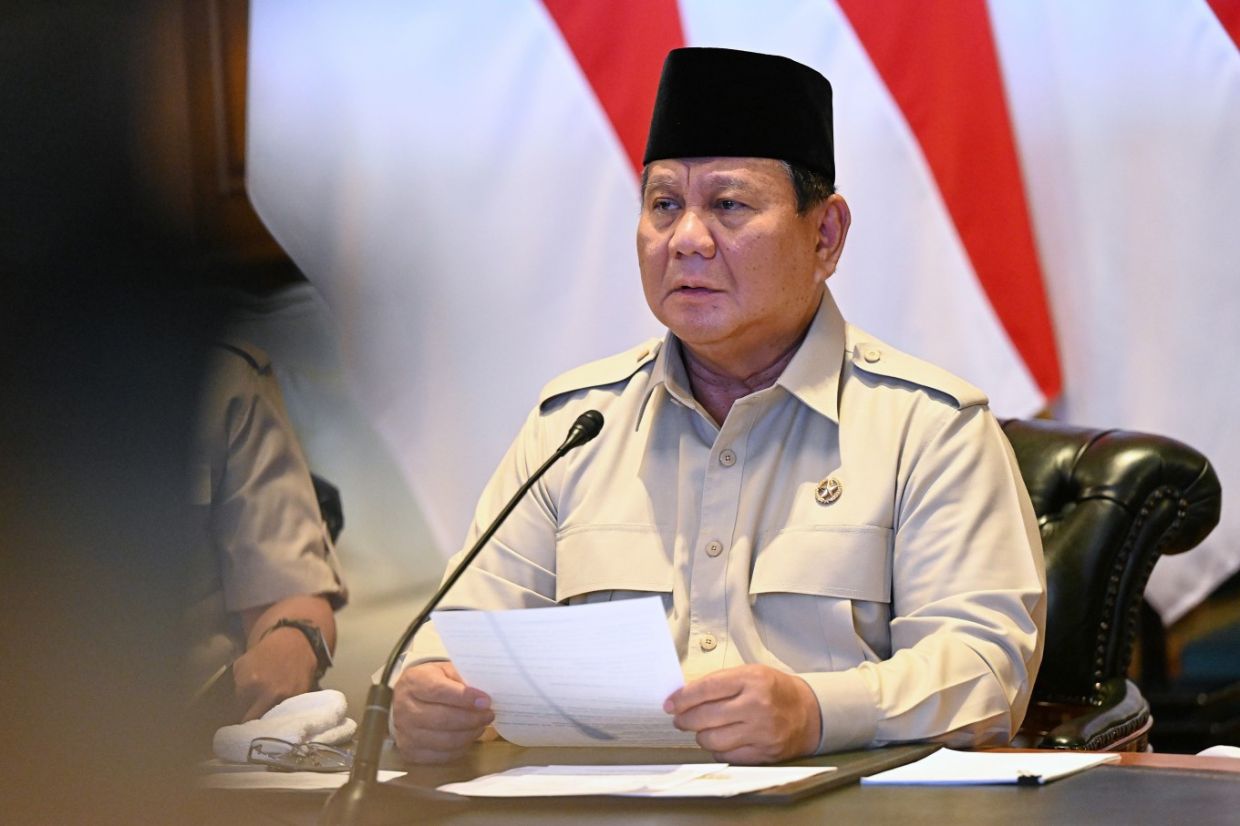
Indonesia's President Prabowo Subianto has experienced a dramatic reversal in public fortunes, with his approval rating collapsing by nearly 30 percentage points in just nine months. The latest data from Saiful Mujani Research and Consulting (SMRC) shows satisfaction with his performance dropping from 81.2 per cent in November 2025 to 51.1 per cent in July 2026, while dissatisfaction surged from around 16 per cent to 46.9 per cent over the same period. This sharp decline marks the end of an extraordinarily long political honeymoon that few world leaders have enjoyed, and it signals that Indonesians are growing weary of rhetorical flourishes and demanding tangible improvements in their daily lives.
Prabowo's extended period of extraordinarily high approval ratings was remarkable even by the standards of newly elected leaders. Unlike his predecessor Joko "Jokowi" Widodo, whose first term began with a similar opening level but collapsed rapidly after a contentious fuel price increase, Prabowo managed to sustain ratings in the 70 to 80 percent range throughout 2025. The SMRC data showing him at 81.2 per cent as recently as November 2025 placed him ahead of Widodo's personal best of 81.7 per cent, achieved only during the latter's second term in May 2023. This was a remarkable achievement for a president barely 18 months into his tenure, suggesting that Indonesian voters had given him exceptional initial confidence.
The sustained strength of Prabowo's approval ratings appears to have stemmed from two complementary sources. The first was the residual goodwill from his 2024 election victory, which gave him a natural honeymoon period that new leaders typically enjoy. The second, and more substantial factor, was his administration's aggressive social spending agenda, particularly the free nutritious meal programme launched in January 2025. This initiative resonated strongly with voters and helped extend the honeymoon well beyond its normal lifespan. By providing immediate, visible benefits to ordinary Indonesians, especially children and lower-income households, the programme created a tangible connection between the government and the electorate that transcended typical political rhetoric.
The international context makes Prabowo's longer honeymoon even more striking. When compared with recent American presidents, his experience appears exceptional. Donald Trump's second term began in January 2025 with historically low approval of just 47 per cent, while both Barack Obama and Joe Biden saw steep early declines from their opening positions. None approached Prabowo's plateau of sustained 70 to 80 percent ratings. This comparative advantage appeared to give Prabowo more political space to navigate the challenges inherent in governing a complex economy and addressing entrenched institutional problems.
However, the July 2026 SMRC survey, which involved 749 respondents polled between July 5 and 19, confirms that political reality has finally caught up with Prabowo. The 30-point collapse is neither unprecedented nor necessarily catastrophic, but it reflects a fundamental shift in how Indonesians evaluate their president. The gap between campaign promises and delivered results is widening visibly. Prabowo had pledged to curb corruption and accelerate economic growth from around 5 per cent to an ambitious 8 per cent. These commitments are now being tested against a weakening rupiah, a sluggish stock market, mounting concerns about state spending sustainability, and questions about the independence of the central bank in managing monetary policy.
SMRC executive director Deni Irvani identified three specific areas where public perceptions have deteriorated markedly. Economic sentiment has plummeted, with positive perceptions of economic conditions at just 15.7 per cent in July 2026. Political perceptions have likewise collapsed, falling from 35.8 per cent in November 2025 to just 13.5 per cent in July 2026, suggesting widespread disappointment with the government's political management and decision-making. Law enforcement sentiment, while relatively stronger at 26.4 per cent in July 2026, nonetheless indicates persistent public frustration with judicial and security institutions. These three dimensions of dissatisfaction paint a picture of a government struggling across multiple fronts simultaneously.
Prabowo has not been passive in the face of his declining fortunes. He maintains a highly visible public presence, regularly delivering televised speeches and maintaining an active communications operation designed to keep him prominent in public consciousness. The President has also demonstrated a willingness to confront critics and journalists directly, adopting a combative approach to opposition voices. This strategy functioned reasonably well when underlying economic conditions remained sufficiently favourable to allow rhetoric to compensate for gaps between promise and performance. Yet the July figures suggest that this rhetorical ceiling has been reached. No matter how frequently the President appears on screen or how forcefully he rebuts detractors, ordinary Indonesians ultimately judge their government by tangible daily experiences: food prices, the exchange rate, employment prospects, whether the free meals programme arrives on schedule, and whether they can afford basic necessities.
It is worth acknowledging that SMRC founder Saiful Mujani has become an outspoken government critic, a point that Prabowo's Gerindra Party has already raised in discussions about polling methodology. However, this fact alone does not invalidate the survey's findings. SMRC has maintained credible polling standards over many years, including periods when its numbers were favourable to the Jokowi administration. More significantly, SMRC's findings are not isolated. Indikator Politik Indonesia conducted an independent poll of 4,250 respondents between July 14 and 24, finding satisfaction at 49.5 per cent, down from 68 per cent in April 2026 and 81 per cent in December 2025. This closely mirrors SMRC's trajectory. When two independently operated polling organisations converge on similar numbers from the same time period, accusations of pollster bias become difficult to sustain.
The convergence of these independent polling results indicates that Prabowo's approval collapse is genuinely reflective of public sentiment rather than an artefact of any single organisation's methodology or political leanings. The magnitude of the decline—from 81 per cent to around 50 per cent in nine months—is substantial, yet historical precedent shows that presidents can recover from steeper falls if circumstances improve. The critical question is whether Prabowo's administration can arrest the slide before it deepens further or becomes politically entrenched.
In response to mounting pressure, government officials have indicated that Prabowo has convened meetings with the National Economic Council (DEN) to devise strategies for improving economic policy outcomes, the area where public satisfaction has declined most sharply. According to an official familiar with these discussions, the administration plans to expand social assistance programmes, recognising that the initial nutritious meal initiative alone is insufficient to sustain public confidence. The government is also grappling with emerging challenges related to weakening household purchasing power and rising food prices, particularly amid meteorological forecasts predicting an El Niño event that could disrupt agricultural production and trigger broader economic turbulence. To mitigate immediate hardship, the administration has decided to maintain fuel prices at current levels despite inflationary pressures.
Beyond economic management, Prabowo's inner circle has engaged pollsters who played key roles in his successful 2024 presidential campaign to diagnose the approval decline and recommend corrective measures. These consultants have urged the President to undertake comprehensive improvements in public communication strategy and to conduct thorough reviews of government programmes experiencing implementation difficulties. The free nutritious meal programme, despite its initial popularity, has encountered logistical and delivery challenges. Similarly, the Red and White Cooperatives initiative, designed to strengthen micro-entrepreneurship and rural economic development, has faced execution problems that have undermined public confidence. One pollster involved in these discussions suggested that approval ratings could recover substantially if the President's inner circle successfully addresses these implementation deficits and improves the coherence and effectiveness of government communication.
The path forward for Prabowo hinges not on increased television appearances or more aggressive rebuttals to critics, but on whether his administration can deliver measurable improvements in economic conditions, political governance, and institutional performance that ordinary Indonesians experience directly in their communities. The honeymoon has definitively ended, and the initial reservoir of goodwill accumulated through social spending has been largely depleted. What remains is a government that must now prove it can govern effectively, not merely promise effectively. The coming months will be crucial in determining whether Prabowo can stabilise his support and begin rebuilding public confidence, or whether the approval decline will accelerate further as Indonesians become increasingly disillusioned with his administration's capacity to deliver on its ambitious agenda.

