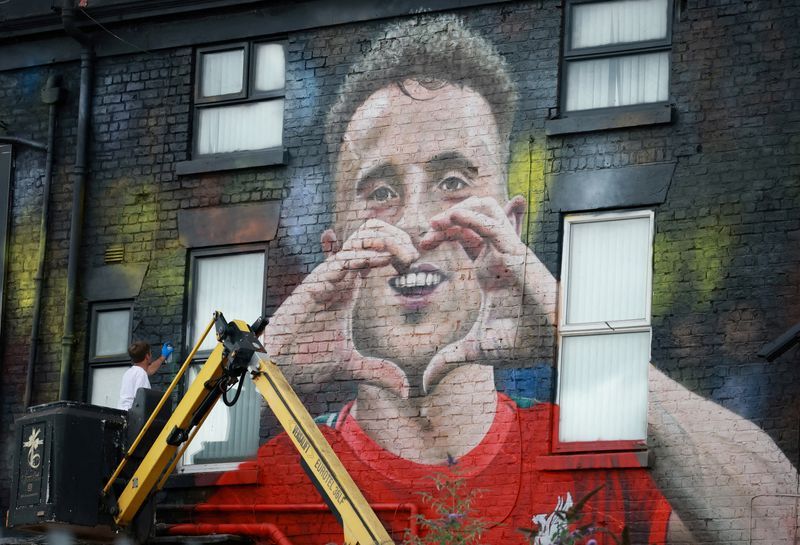
The Portuguese national football team will take to the field against Croatia in Toronto on Thursday for a World Cup round of 32 encounter that coincides with a solemn milestone back home. Although the match kicks off in Canadian time on July 2, the clock will have already turned to July 3 in Portugal—exactly one year since Diogo Jota's tragic death in a car accident. The temporal divide underscores the weight this fixture carries beyond sporting competition, transforming what would ordinarily be routine tournament football into a moment laden with national grief and remembrance.
Jota, the 28-year-old Liverpool forward who earned 49 caps for Portugal, was killed alongside his brother Andre Silva when their Lamborghini veered off the road in northwestern Spain and burst into flames. His passing sent shockwaves through Portuguese football and the broader European sporting community, robbing the national team of a player whose combination of technical skill, clinical finishing, and unwavering commitment had made him a cornerstone of their contemporary success. The tragedy was particularly acute for Portugal's football fraternity, which had come to regard Jota not merely as a consummate professional but as an integral personality within the squad's collective identity.
Portuguese manager Roberto Martinez has deliberately ensured that Jota's presence remains tangible throughout the team's World Cup journey. The coach, who has publicly eulogized Jota as "our light," took the symbolic step of naming him as an honorary member of the squad—a gesture that affirms his enduring place within the national team's fabric. This deliberate incorporation of his memory into the campaign's architecture reflects a broader understanding that honouring fallen colleagues serves a profound psychological function, transforming grief into a unifying force that can galvanize collective purpose.
The tangible manifestations of remembrance have become woven into the fabric of Portugal's World Cup experience. Midfielder Ruben Neves, who shared a deep personal friendship with Jota, has adopted the number 21 shirt as a tribute to his late friend. Prime Minister Luís Montenegro distributed commemorative wristbands bearing Jota's name to the squad, institutionalizing the remembrance through an official gesture that carries the weight of national recognition. During Portugal's opening World Cup encounter against DR Congo in Houston, Jota's parents Isabel and Joaquim Silva were present in the stands as an emotional tribute unfolded, their visible presence serving as a poignant reminder of the human dimension underlying the sporting spectacle.
The emotional resonance of this anniversary has reverberated beyond Portugal's borders, touching the hearts of those who played alongside or knew Jota during his time at Liverpool. Scottish defender Andy Robertson, who shared both dressing rooms and genuine friendship with Jota, found his thoughts immediately drawn to his fallen colleague when Scotland secured World Cup qualification in November. During the current tournament, Jota's widow Rute Cardoso penned a deeply moving message to Robertson, acknowledging the Liverpool captain's decision to carry her husband's memory into the competition. Her words—expressing gratitude that Robertson had "not forgotten him" and transformed "the pain of loss into strength and into something so beautiful"—encapsulate the manner in which football can transcend its sporting boundaries to become a vehicle for collective grieving and mutual support.
For Portugal's current squad, Jota represented far more than a statistically productive teammate. He embodied a generation of Portuguese footballers who have successfully maintained their nation's standing among Europe's footballing elite, contributing 14 goals across his 49 international appearances. His absence from the 2018 World Cup due to a calf injury had proven particularly frustrating, and his almost certain inclusion in the current North American campaign adds a layer of tragedy to contemplating what might have been. Defender Vitinha articulated the emotional landscape confronting his teammates, referencing the constellation of motivations—family, country, and now the specific remembrance of Jota—that would drive Portugal's performance on Thursday.
Within Toronto's Portuguese-Canadian community, awareness of the anniversary's coincidence with this World Cup fixture has already begun shaping local discourse. Miguel De Silva, owner of Amigos da Dundas Sports Bar in the city's Little Portugal neighbourhood, recognizes that Jota's memory will provide the Portuguese players with an additional emotional wellspring as they pursue victory. De Silva's observation that Jota "was a player that was very loved by the Portuguese people" captures the extraordinary affection in which the late forward was held—affection that transcends conventional sporting appreciation to encompass deeper cultural and national sentiment.
The philosophical reality confronting Portuguese football at this World Cup is that while the passage of time provides measured perspective, it has done comparatively little to diminish the acute pain of losing such a vital squad member at the height of his powers. The team now faces the challenge of channelling this grief into competitive motivation without allowing it to become a destabilizing emotional burden. Roberto Martinez and his coaching staff have clearly calculated that consciously incorporating Jota into the team's narrative, rather than attempting to compartmentalize or suppress his absence, represents the healthier psychological approach. This philosophy appears to have resonated with the squad, whose members have spoken openly about using the anniversary as additional motivation to perform.
As Portugal prepares for Thursday's encounter, the broader sporting world will be watching not merely to witness tactical competition between two nations, but to observe how a team processes collective loss while maintaining competitive focus. The simultaneous occurrence of sporting excellence and profound grief creates a uniquely poignant narrative—one in which victory would carry significance extending far beyond tournament mathematics. For Portuguese supporters, particularly those viewing from the homeland where July 3 carries its weight of remembrance, the match will represent an opportunity to see their nation's footballing representatives honour a fallen colleague by channelling sorrow into the kind of performances that might have made Jota himself proud.

