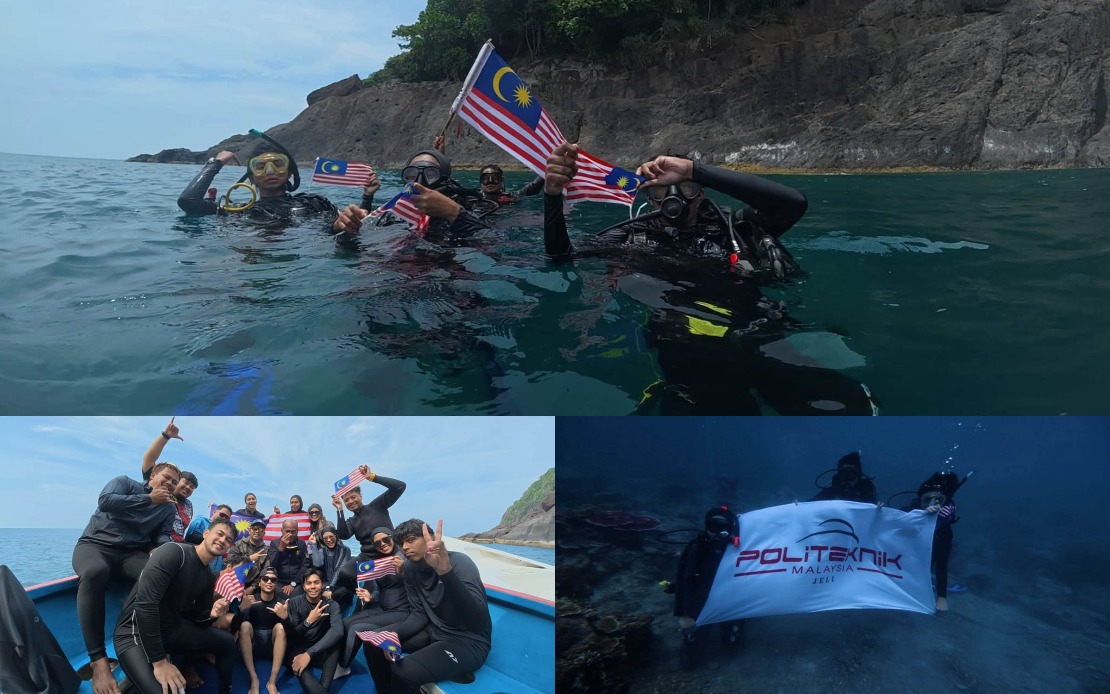
Politeknik Jeli Kelantan has taken National Day commemoration to new depths—literally—by planting the Jalur Gemilang on the ocean floor off Pulau Tenggol in Terengganu as part of the institution's observance of Malaysia's 69th National Day. The initiative, executed on August 31, merged institutional pride with practical underwater training, demonstrating how educational institutions can blend patriotic observance with skill development in emerging fields.
The underwater flag display was conducted during a four-day scuba diving training and certification programme that ran from August 27 to 30 at Dive Buddy Dungun. Two lecturers and two fifth-semester students from the Diploma in Aquaculture Technology programme participated in the initiative, which combined practical diving instruction with water safety education. According to Mohd Adam Nashriq Bani Yamin, an aquaculture lecturer at the institution, the symbolic gesture represented far more than ceremonial patriotism—it embodied the technical competencies that form the backbone of modern marine-based education and industry practice.
The training programme centred on PADI (Professional Association of Diving Instructors) certifications, with participants undertaking both PADI Open Water Diver and PADI Divemaster courses under the guidance of Dr Nabila Talib from Dive Buddy Malaysia. These internationally recognised qualifications equip graduates with credentials that carry weight across Asia-Pacific maritime industries, where demand for certified diving professionals continues to expand. The presence of both institutional and national flags at the underwater site reinforced the educational philosophy that technical competence and national consciousness need not exist in isolation.
For students pursuing aquaculture and marine biotechnology studies, exposure to practical diving skills addresses a significant gap in conventional classroom education. Malaysia's growing focus on marine resource development—from sustainable aquaculture operations to offshore biotechnology ventures—creates employment pathways that demand both theoretical knowledge and hands-on diving proficiency. The Politeknik Jeli initiative recognises this reality by embedding water safety and diving certification into the curriculum rather than treating them as optional add-ons.
The water safety component of the training programme addressed a critical concern for future marine professionals. Accidents and emergencies in aquatic environments can escalate rapidly, and operators must possess not only diving competence but also emergency response awareness. By exposing students to realistic training scenarios during their education, the institution better prepares graduates to manage the inherent risks of marine work. This proactive approach to safety aligns with international maritime standards and reflects best practices observed across established marine industries worldwide.
Politeknik Jeli's integration of patriotic observance with vocational training illustrates how Malaysian educational institutions are evolving to meet dual imperatives: fostering national identity and preparing students for competitive global employment landscapes. The underwater flag display, while memorable and symbolic, functioned primarily as a teaching tool that reinforced the practical skills students were simultaneously acquiring. This pedagogical approach transforms ceremonial activities into meaningful learning opportunities rather than treating them as separate institutional obligations.
The broader context of this initiative reflects Malaysia's strategic positioning within Southeast Asia's expanding blue economy. Nations across the region are increasingly investing in marine resource management, sustainable aquaculture, and ocean-based biotechnology ventures. Institutions like Politeknik Jeli that produce graduates equipped with internationally recognised diving certifications contribute to a skilled workforce capable of competing for positions in these high-value sectors. The PADI certification obtained during this training carries recognition across Asia and beyond, enhancing graduate employability in multinational marine enterprises.
Mohd Adam Nashriq emphasised that diving skills extend beyond recreational or exploratory applications into practical professional domains. Marine research operations frequently require certified divers for data collection and ecosystem monitoring. Aquaculture facilities situated in coastal and offshore environments necessitate personnel capable of conducting underwater inspections, maintenance, and problem-solving. Marine ecosystem conservation initiatives—an increasingly important focus for both governmental and non-governmental organisations—depend on trained divers to assess environmental conditions and implement restoration programmes. By developing these competencies during tertiary education, Politeknik Jeli enhances the utility of its graduates across multiple marine industries.
The programme's design also reflects contemporary understanding of how educational institutions should position themselves within their regional contexts. Kelantan, while not primarily known for marine industries, sits adjacent to Terengganu, a state with significant aquaculture potential and maritime heritage. By establishing diving training facilities and expertise at Politeknik Jeli, the institution creates opportunities for students across the eastern seaboard to access qualifications that might otherwise require travel to major urban centres. This geographical accessibility democratises access to vocational certifications and contributes to more balanced human capital development across Malaysia's regions.
The symbolic dimension of planting flags at significant depths carries resonance for Malaysian audiences accustomed to seeing the Jalur Gemilang displayed in conventional settings. The novelty of the underwater placement generates media attention and social media engagement, which in turn raises awareness of marine-based educational pathways among younger Malaysians considering career options. When educational initiatives attract public interest through creative approaches to familiar symbols, they simultaneously advance institutional visibility and broaden understanding of emerging vocational opportunities within the broader society.
Looking forward, the success of this initiative may encourage other polytechnics and technical institutions across Malaysia to integrate similar practical training approaches into their curricula. The model demonstrates that patriotic observance, skills development, and industry preparation need not exist in tension—they can be thoughtfully combined to serve multiple educational and institutional objectives simultaneously. As Southeast Asian economies continue diversifying into marine-based sectors, the capacity to produce graduates with both technical expertise and safety consciousness becomes increasingly valuable to regional competitiveness.

