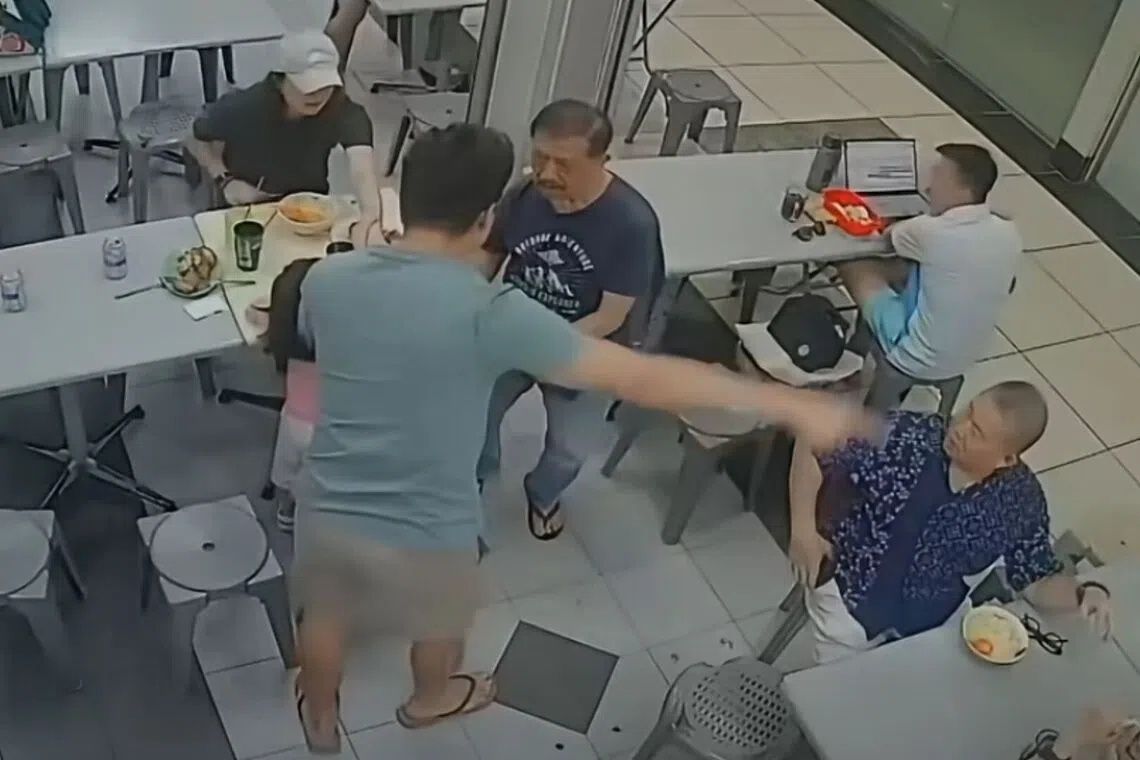
Singapore's police have opened an investigation into a confrontation at an East Coast coffee shop that left an elderly man injured after he patted a young girl's head. The incident, which unfolded in front of other patrons, has drawn widespread attention online and raised questions about public conduct and appropriate responses to perceived transgressions in shared spaces.
Authorities confirmed receipt of a police report on Sunday, August 16, and stated that investigations into the matter remain ongoing. The incident itself occurred on August 15 when the elderly man, described as being in his 70s, was present at the coffee shop where he assists at a food stall despite his age and mobility challenges. Security camera footage released on social media captured the sequence of events that preceded the physical confrontation, providing a clear visual record of what transpired.
According to the video evidence and eyewitness accounts shared online, the elderly man was making his way through the coffee shop premises, carefully navigating between tables while holding onto them for balance and support. As he proceeded past one particular table, he extended a hand and gently patted a young girl who was seated there on the head. This simple gesture, which the elderly man apparently intended as an innocuous, perhaps grandfatherly act, immediately triggered a response from the girl's companion.
A woman sitting with the child attempted to intervene by pushing his hand away, signalling her disapproval of the physical contact. The situation escalated quickly when a man associated with the group, who had initially stepped away from the table, returned upon seeing what was occurring. He engaged the elderly man in verbal confrontation, his irritation evident from the footage captured by the establishment's security system.
The confrontation then became physical. The man shoved the elderly man forcefully to the ground, causing him to fall in front of numerous witnesses present at the coffee shop. The incident was distressing not only for those directly involved but also for other patrons and staff members who observed the altercation unfold. The aftermath was marked by apparent remorse from the man who had pushed the elderly patron; he subsequently approached the elderly man to apologise and offered him a beverage as a gesture of conciliation.
The elderly man's son, identifying himself online as Bei-ing Wanton Noodle, shared the security footage and account of the incident on Facebook on the evening of August 15 at 7:14 pm, appealing to the public for assistance in identifying the man involved. In his initial post, he noted that his father had experienced severe lower back pain following the incident, raising concerns about potential lasting physical damage from the fall. He also provided context that his father, despite being in his 70s and facing mobility issues, remains actively engaged in the family business at the coffee shop.
The post resonated with social media users, generating discussion about the appropriateness of the elderly man's action, the proportionality of the response, and broader questions about how society should handle moments of perceived boundary-crossing in public spaces. Some commenters expressed sympathy for the elderly man's injury, while others debated whether his gesture towards the child, however innocent in intent, warranted the defensive reaction it provoked.
In a subsequent Facebook post the following morning on August 16 at 9:55 am, the elderly man's son expressed gratitude to the online community for their support and concern, as well as for those who provided relevant information about the incident. However, he indicated that despite these efforts and the widespread sharing of the video, he had not yet succeeded in obtaining the identity of the man involved in the physical altercation. This lack of resolution has left the matter in a state of ongoing uncertainty, with the family awaiting both answers and justice through the police investigation.
The incident highlights the complexities of modern public interactions in densely populated urban environments like Singapore, where different cultural backgrounds and parenting philosophies coexist. What one person might view as a harmless, affectionate gesture toward a child could be perceived as an unacceptable invasion of personal space by others, particularly when involving a stranger and someone else's child. The severity of the physical response—pushing an elderly man to the ground—raises questions about whether such force was a proportionate and justified reaction to the initial contact.
For Malaysia and other Southeast Asian countries observing this incident, it serves as a reminder of the importance of clear communication and restraint in public settings. The case underscores how misunderstandings and cultural differences can escalate quickly into physical confrontations, even in well-developed societies with strong rule of law. The involvement of police and the formal investigation process reflect Singapore's commitment to addressing such incidents through official channels rather than allowing mob justice or public assumption of guilt.
The elderly man's injury and the broader family distress caused by the incident demonstrate the real human cost of public altercations. As Singapore's authorities pursue their investigation, the case serves as a cautionary tale about the need for measured responses to perceived transgressions, particularly when elderly individuals are involved. The outcome of the police investigation may provide important guidance on community expectations regarding appropriate conduct in shared public spaces and the reasonable limits of defensive action.

