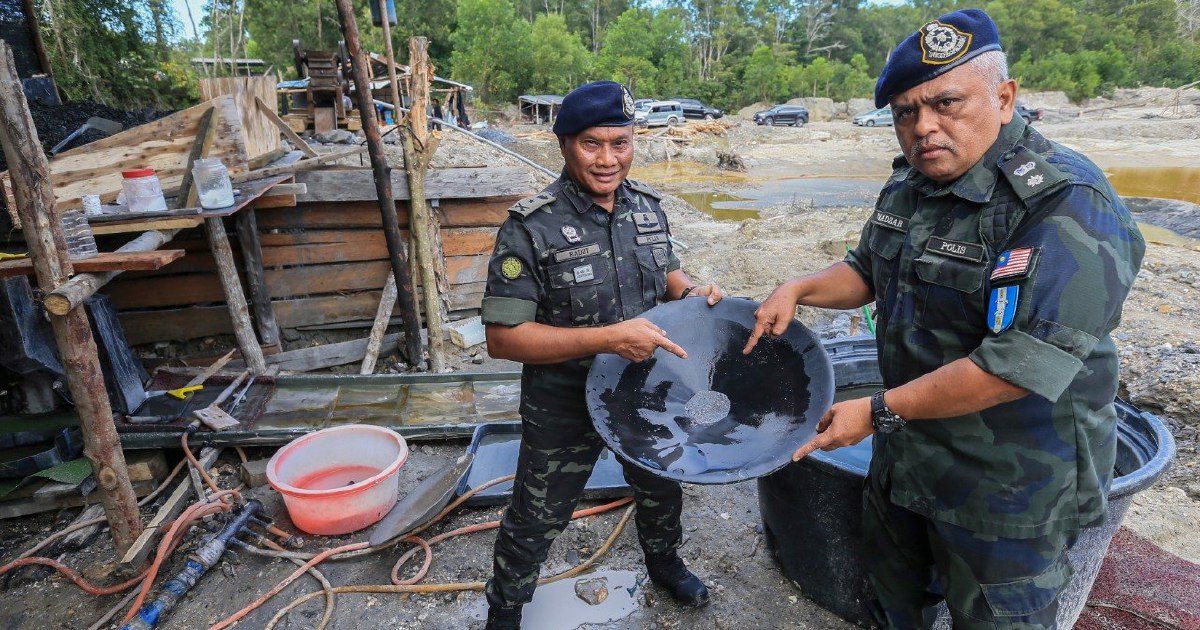
Police in Terengganu have successfully shut down an organised gold mining syndicate operating under the moniker 'Mak Siti' following a strategic enforcement operation at Bukit Kor in the Marang district. The raid culminated in the detention of 15 individuals suspected of orchestrating the illicit mining enterprise, which had been generating substantial daily revenues estimated at up to RM13,000 through the extraction and processing of precious metals.
The dismantling of this operation represents a significant victory for law enforcement efforts aimed at curbing illegal mining activities across the state. Illegal mining operations have become increasingly problematic in Malaysian states with mineral-rich geology, particularly in Peninsular Malaysia where scattered deposits of gold and other valuable minerals have attracted organised criminal syndicates. These ventures typically operate with minimal regard for environmental regulations, worker safety standards, or legal licensing requirements, creating multiple layers of social and ecological harm.
The 'Mak Siti' syndicate's daily profitability of up to RM13,000 underscores the substantial financial incentives driving such operations. At this revenue rate, an annual operation could theoretically generate nearly RM4.7 million, making the venture highly attractive to criminal enterprises seeking quick profits with minimal capital investment compared to legitimate industrial mining operations. The efficiency of the operation and its organisational structure suggest a sophisticated criminal network rather than ad-hoc amateur prospecting.
Bukit Kor's location in Marang places the site within Terengganu's broader mining landscape, a state with historical significance in mineral extraction. The concentration of such operations in specific geographical areas often reflects the distribution of natural mineral deposits and the exploitation of local topography that makes clandestine mining more feasible. Marang, in particular, has faced recurring challenges with unauthorised extraction activities that compromise both the landscape and downstream water resources.
Illegal mining syndicates typically employ a hierarchical structure with multiple operational layers, ranging from site managers and equipment operators to middlemen who facilitate the sale of extracted minerals to dealers or refineries. The apprehension of 15 individuals suggests this particular network likely encompassed such diverse roles, with each layer contributing essential functions to maintain continuous production and distribution. Disrupting these networks at critical points can substantially impede their operational capacity, though some members may attempt to reconstitute the enterprise elsewhere.
The environmental implications of such mining operations warrant particular attention. Illegal mining frequently involves the use of mercury and other hazardous chemicals in processing extracted materials, contaminating soil and groundwater. The absence of proper site restoration measures means affected areas remain degraded long after operations cease. For residents in surrounding communities, particularly in rural Marang, such contamination poses serious health risks including heavy metal poisoning and water supply deterioration.
From a regulatory perspective, the operation occurred despite Malaysia's strict licensing regime overseen by the Department of Minerals and Geoscience. All commercial mining activities require appropriate permits, environmental impact assessments, and compliance with the Minerals Act 1967. The existence of unlicensed operations indicates enforcement gaps, whether through insufficient surveillance capacity, corrupted local authorities, or deliberate concealment through remote site locations and nocturnal activity schedules favoured by many syndicates.
The success of this particular raid likely resulted from intelligence gathering, possibly involving tip-offs from community members, rival syndicates, or systematic surveillance by police and mining enforcement units. Such operations typically benefit from cross-agency cooperation combining law enforcement, mining officials, and environmental authorities, though coordination remains an ongoing challenge in Malaysia's enforcement landscape where jurisdictional boundaries sometimes impede comprehensive responses.
The detention of 15 suspects opens investigative pathways into the broader network supplying equipment, purchasing extracted gold, and providing financial support. Authorities will likely scrutinise connections to licensed gold dealers, refineries, and international export networks that may have provided markets for the illicitly obtained metal. These downstream investigations frequently reveal connections extending beyond simple mining operations into broader financial crimes and money laundering schemes.
For Malaysian policymakers, the existence of highly profitable illegal mining ventures points to persistent regulatory challenges in resource-rich regions. Addressing this requires not only enhanced enforcement capacity but also addressing the economic incentives driving participation. Many participants in illegal mining operations come from economically marginalised communities where legitimate employment opportunities remain limited, suggesting that sustainable solutions require complementary development initiatives alongside strict law enforcement.
The case also highlights the vulnerability of rural Terengganu to criminal enterprises exploiting geographical isolation and sparse population density. As authorities continue developing responses to illegal mining, integrating community engagement and environmental monitoring systems may prove as important as reactive enforcement operations. The disruption of 'Mak Siti' represents important tactical progress, but comprehensive solutions require sustained strategic commitment addressing both supply-side enforcement and demand-side incentives.

