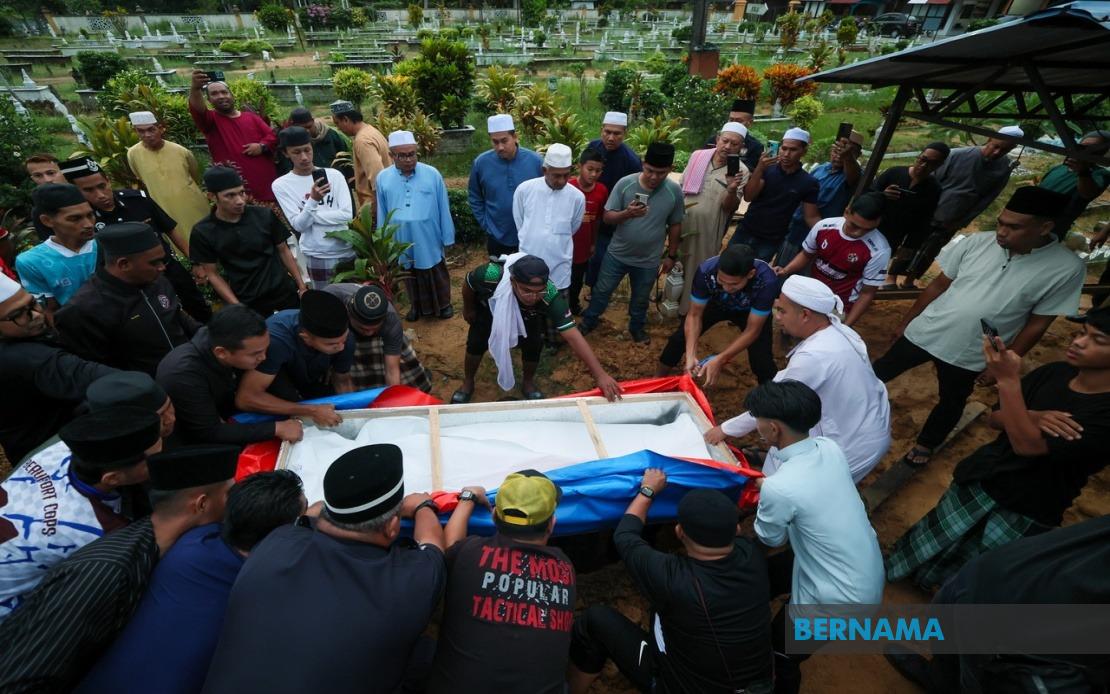
The funeral of Corporal Mohamad Nur Hafiz Rahim took place in Kota Bharu this morning, bringing closure to a family grieving the loss of a young officer who died in a workplace tragedy that has raised serious questions about occupational safety within the police force. The 29-year-old, based in Sabah, was returned to his home state of Kelantan for burial after succumbing to injuries sustained during an electrocution incident at Weston Police Station in Beaufort the previous day.
The ceremony unfolded with traditional Islamic funeral rites performed at his family residence in Kampung Hutan Pasir, attended by relatives who travelled from across Malaysia to pay their final respects. His body was subsequently interred at Kampung Pangkal Kuang Muslim Cemetery in Ketereh, a final resting place close to the family home where his loved ones continue to grapple with the sudden and preventable nature of his death.
Nurlella Rahim, Mohamad Nur Hafiz's eldest sister at 34 years old, described the family's tight bonds and expressed gratitude to the Royal Malaysia Police for coordinating the logistical arrangements that enabled his swift return home. She recounted how the remains arrived early on Thursday morning and emphasised that despite geographical separation, the five siblings maintained constant contact through modern communication technology. Living in Ipoh whilst her brother served in Sabah did not diminish their connection, as they engaged in frequent video calls and maintained an active family WhatsApp group.
The siblings' daily digital interactions painted a picture of a close-knit family that prioritised staying engaged despite Malaysia's vast distances. Nurlella revealed that even during work shifts, Mohamad Nur Hafiz made time for brief video calls with family members, demonstrating a commitment to maintaining relationships amidst the demands of police service. His final conversation with their mother occurred on Thursday afternoon, when he appeared fatigued and less talkative than usual, though he managed to reassure her he would reconnect later as work obligations beckoned.
Just days before his death, Nurlella had last communicated with her brother on Sunday when he shared a video call showing him at the beach with his wife, Fatimah Shahira, and their child. These ordinary family moments, now preserved as final memories, underscore the tragedy of losing a young officer in the prime of his career and family life. The images of him enjoying leisure time with his family starkly contrast with the horror of what would unfold at his workplace within days.
The electrocution occurred at 5.50 pm when Mohamad Nur Hafiz and two colleagues were moving a 29-foot metal pole designed for harvesting coconuts outside Weston Police Station near Sekolah Kebangsaan Weston. The equipment made fatal contact with an overhead electrical source, resulting in a catastrophic incident that claimed three lives simultaneously. The other victims were Corporal Chiu Teck Siong, a 40-year-old officer from Sarawak, and Constable Muhammad Raimi Ismarubee, a 26-year-old from Terengganu, each with their own families now left mourning preventable deaths.
The triple fatality has triggered high-level government attention, with Prime Minister Datuk Seri Anwar Ibrahim ordering a comprehensive, transparent and expedited investigation into the incident. Anwar's intervention signals recognition that this tragedy demands thorough scrutiny beyond routine protocol, particularly regarding how workplace safety standards are implemented and enforced within police stations across the nation. His public commitment to determining root causes reflects pressure from civil society and families affected to prevent recurrence of such incidents.
The investigation mandated by the Prime Minister carries implications extending beyond this single station. The incident raises fundamental questions about electrical safety protocols, equipment maintenance procedures, staff training in hazard identification, and whether sufficient safeguards exist to protect police personnel engaged in routine maintenance activities. For a nation with an expanding police force deployed across diverse environments, from urban centres to remote postings in Sabah and Sarawak, standardised safety procedures become critical.
The use of a coconut-harvesting pole at a police facility suggests ad-hoc utility arrangements that may lack proper electrical insulation or operational oversight. Such equipment, typically designed for agricultural rather than law enforcement contexts, may not have been subjected to rigorous safety assessments before deployment at government installations. The fact that multiple officers were engaged simultaneously in moving the pole indicates either inadequate supervision or insufficient awareness of electrical hazards among personnel.
For Malaysia's wider workforce and occupational safety framework, this tragedy underscores persistent gaps between safety regulations and their practical implementation. While the Occupational Safety and Health Act establishes legal obligations for employers to protect workers, enforcement and compliance monitoring remain uneven across sectors. Police stations, often prioritising operational readiness over administrative compliance, may inadvertently overlook systematic hazard assessments and risk mitigation measures.
The emotional toll on Mohamad Nur Hafiz's family, mourning a son and brother whose life was cut short by preventable circumstances, mirrors countless workplace tragedies that burden Malaysian families annually. Nurlella's testimony about their daily contact patterns emphasises how such deaths reverberate through extended family networks, stripping away the ordinary rhythms of video calls and group chats that maintained familial bonds across distances.
As investigations proceed, the focus must extend beyond determining immediate technical causes to examining systemic vulnerabilities in how government agencies, including the police force, manage workplace safety. The findings may catalyse broader reforms ensuring that officers like Mohamad Nur Hafiz are protected by robust safety cultures rather than discovering hazards only through tragedy. His legacy, alongside his colleagues, should spur the institutional changes necessary to prevent similar losses among Malaysia's uniformed personnel.

