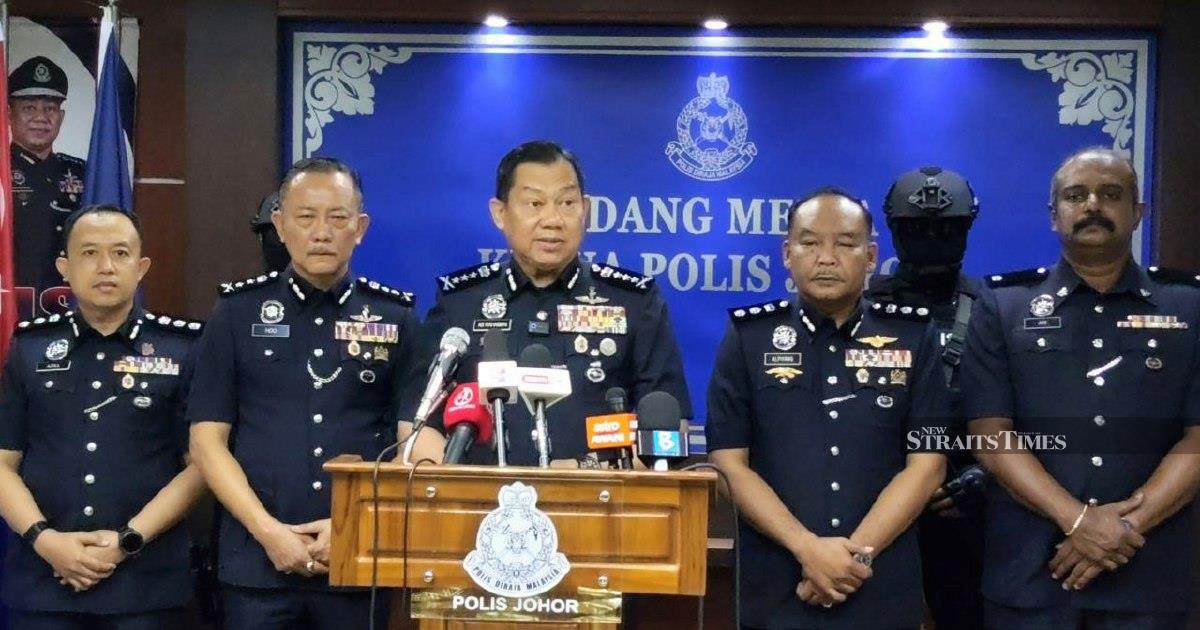
Law enforcement authorities in Johor Baru executed a coordinated operation on Saturday that resulted in one of the state's more substantial drug seizures this year. The raids culminated in the apprehension of eight individuals connected to a methamphetamine distribution ring and the confiscation of crystalline drugs with a street value estimated at RM3.04 million. The breakthrough underscores ongoing efforts by the Royal Malaysia Police to dismantle organised narcotics trafficking networks operating across the southern corridor of Peninsular Malaysia.
Among those detained was a school dropout who had been enlisted by traffickers to courier drug shipments between distribution points. The decision to recruit young dropouts as transporters represents a deliberate strategy employed by organised crime syndicates to minimise their legal exposure—the use of teenage couriers often results in lighter sentences under the Dangerous Drugs Act 1952, and these individuals are viewed as expendable assets within the hierarchical structure of trafficking operations. The capture of this particular courier provides investigators with a crucial entry point into the broader supply chain that serviced the local methamphetamine market.
The 60.78kg of methamphetamine seized during the Saturday operations represents a quantity substantial enough to flood the regional illicit market for weeks. Crystal methamphetamine, commonly known as "ice" or "shabu" throughout Southeast Asia, has become increasingly prevalent in Malaysia's urban centres, with consumption patterns shifting markedly toward younger demographic groups over the past five years. The drug's potency, affordability relative to cocaine or heroin, and availability through distributed production networks across the Greater Mekong Subregion make it a preferred product for criminal entrepreneurs targeting Malaysian consumers.
The valuation of RM3.04 million reflects current street-level pricing in major Malaysian cities, where a gram of methamphetamine typically commands between RM40 and RM60 depending on purity and local market conditions. This pricing structure has rendered the drug economically accessible to working-class users, particularly those in manufacturing, service, and gig economy sectors where stimulant consumption may be perceived as performance-enhancing. The profitability margins at each distribution tier—wholesale, mid-level dealer, and street-level peddler—create powerful incentives for continued trafficking despite escalating enforcement operations.
Johor Baru's geography renders it particularly vulnerable to drug trafficking activity. The proximity to Singapore's western border, the Port of Tanjung Pelepas, and multiple highway corridors facilitating north-south movement make the city a natural transshipment hub for synthetic drugs originating from clandestine laboratories throughout Thailand, Laos, and Cambodia. Regional production networks have optimised their supply chains through systematic corruption of customs and enforcement personnel, utilising compartmentalised courier systems, and maintaining redundancy across multiple trafficking routes. The Saturday raid suggests that local authorities have achieved incremental success in mapping these networks, though the underlying supply pressures remain substantial.
The arrest of eight suspects provides intelligence opportunities extending beyond the immediate investigation. Interrogations typically reveal information about supplier relationships, financial flows, distribution territories, and customer bases. In Malaysia's fragmented drug market, rival syndicates often vie for control of specific geographic sectors or demographic customer segments. The detention of mid-level operatives frequently triggers internal recalibrations within trafficking hierarchies, as suppliers attempt to locate replacement transporters and distributors. Such disruptions occasionally surface through increased violence as different factions contest control of destabilised territory.
The operational coordination evident in Saturday's raids reflects capacity-building within Johor's narcotics enforcement apparatus. The Johor police contingent has progressively enhanced intelligence-gathering techniques, inter-agency information sharing with federal authorities, and tactical execution capabilities. However, systematic constraints persist—chronic resource limitations, personnel shortages in specialist units, and competing operational demands across violent crime, sexual offences, and property crimes strain investigative capacity. Many enforcement professionals argue that supply-reduction strategies, while necessary, address only the downstream consequences of trafficking rather than upstream production capacity.
The involvement of a teenage transporter in this network illustrates a persistent challenge in drug enforcement: the recruitment of vulnerable youth lacking employment prospects and family support structures. Impoverished school dropouts represent accessible labour for trafficking organisations offering immediate cash compensation, typically ranging from RM200 to RM500 per successful delivery. The socioeconomic drivers perpetuating youth involvement in the illicit economy remain substantially unaddressed through conventional public policy mechanisms, creating a renewable supply of couriers despite ongoing arrests.
As methamphetamine consumption continues expanding across Southeast Asia, Malaysia faces escalating pressures on both public health and criminal justice systems. Emergency departments increasingly treat acute methamphetamine toxicity cases; rehabilitation facilities report growing admission rates among young adult users; and the criminal justice system processes mounting volumes of drug-related prosecutions. The Saturday seizure and arrests represent discrete victories in sustained enforcement efforts, yet regional supply dynamics and persistent demand suggest that such operations constitute necessary but insufficient responses to systemic trafficking challenges extending far beyond Johor's borders.

