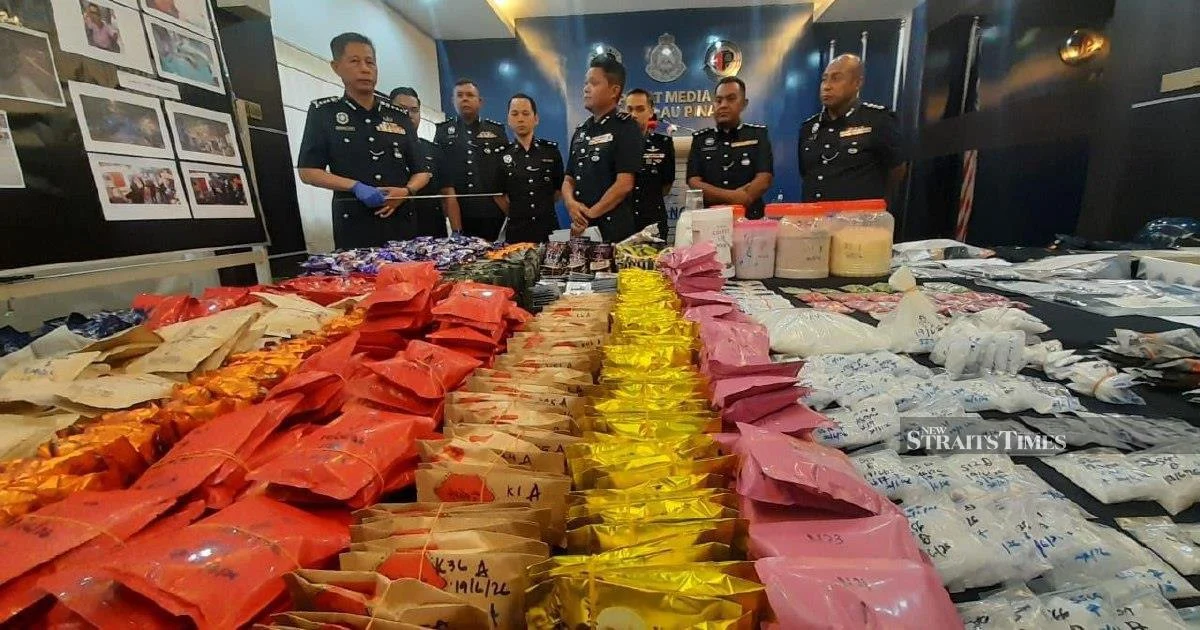
Law enforcement authorities in Penang have dealt a substantial blow to organised drug trafficking following the discovery and shutdown of a sophisticated processing and distribution facility operating from a residential condominium unit in Butterworth. The operation culminated in the arrest of a romantic couple and the confiscation of controlled substances with an estimated street value of RM9.7 million, marking one of the region's more significant recent seizures.
The discovery emerged from investigative work by Penang police, whose narcotics division conducted surveillance and intelligence-gathering operations that ultimately led officers to the targeted condominium address. The raid itself yielded not merely finished products intended for street-level distribution, but also evidence of an integrated operation suggesting the couple had undertaken manufacturing and processing activities on the premises. This vertical integration—where traffickers both produce and distribute—typically indicates a more organised and financially substantial criminal enterprise than simple dealing operations.
The RM9.7 million valuation assigned to the seized materials reflects current market assessments across Malaysian urban centres. For context, seizures of this magnitude remain noteworthy within Penang, historically one of Southeast Asia's strategic trafficking corridors given its position along major maritime and overland smuggling routes. The recovery underscores continued law enforcement capability despite the evolving sophistication of criminal networks operating throughout the region.
Detailsregarding the specific substance categories recovered—whether the cache comprised heroin, methamphetamine, cocaine, or synthetic compounds—and the precise breakdown of finished versus raw materials remained unavailable in initial police statements. However, the operational profile evident in the condo setting suggests involvement with substances commanding premium prices and serving established consumer markets rather than experimental trafficking.
The arrest of both individuals as a couple presents particular analytical significance. Many major distribution networks worldwide employ relationship-based partnerships, particularly for sensitive operational roles involving manufacturing oversight or logistics management. Such arrangements may reduce external visibility and create mutual dependency reducing cooperation risk with law enforcement. The joint arrest suggests investigators had developed sufficient evidence to implicate both parties in the enterprise's core functioning.
For Malaysia's broader drug enforcement landscape, the seizure carries several implications. Penang and surrounding regions have experienced documented increases in methamphetamine availability alongside traditional heroin markets, competing for distribution networks and consumer bases. Large-scale manufacturing capacity within residential areas complicates detection compared to traditional smuggling operations relying on cross-border importation, as domestic production facilities require minimal international coordination and leave fewer customs or transport-related forensic trails.
The condominium setting chosen for such operations reflects evolved criminal methodology. High-rise residential complexes throughout Malaysian urban centres provide multiple access and egress routes, transient tenant populations reducing neighbour familiarity, and relative anonymity compared to landed properties. The interior sealed environment permits odour control and operational concealment from external observation, while the address itself—a private residential unit—generates less immediate suspicion than commercial or industrial premises.
Butter worth's strategic geography contributed to this location's operational utility. Positioned within rapid commuting distance to George Town whilst maintaining separation from the state capital's concentrated enforcement resources, the township serves as a distribution hub linking Penang's urban markets to broader Perak and central region networks. This intermediate positioning has historically attracted trafficking infrastructure seeking balance between market access and enforcement risk mitigation.
The investigation's success reflects resource allocation within Penang's narcotics division toward proactive enforcement beyond reactive street-level interdiction. Sustained surveillance capability and intelligence development require institutional commitment and trained personnel—areas where Malaysian federal police and state contingents have progressively developed capacity. The breakthrough also demonstrates information-sharing effectiveness across relevant agencies when coordinated properly.
Looking forward, the dismantled operation will face replacement pressure from competing trafficking organisations seeking to reposition distribution networks and manufacturing capacity within the region. The RM9.7 million seizure represents genuine supply disruption likely impacting street-level availability and pricing in short term, though criminal enterprises traditionally adapt through supply chain reconfiguration rather than fundamental business model revision.
The arrested couple's prosecution will generate important legal precedent regarding manufacturing-level charges and conspiracy liability within Malaysian narcotics statutes, potentially informing future enforcement strategy refinement. Asset seizure and confiscation following conviction could theoretically impact broader criminal network financial capacity, though money laundering countermeasures remain inconsistently applied across jurisdictions.
International cooperation implications emerge from the operation's profile. Manufacturing capacity and distribution reach of this scale frequently involves transnational coordination with source countries and transit networks requiring regional law enforcement cooperation. The bust provides data points for intelligence sharing among Association of Southeast Asian Nations member states coordinating against trafficking corridors increasingly targeting the region's middle-income consumer markets.
For Malaysian residents and property owners, the incident underscores risks associated with residential security complacency and insufficient neighbour communication within high-density housing complexes. Early detection of suspicious activity—unusual hours, restricted access patterns, chemical odours, or traffic inconsistency—remains relevant neighbourhood watch awareness, though direct police reporting channels should supersede vigilante intervention.