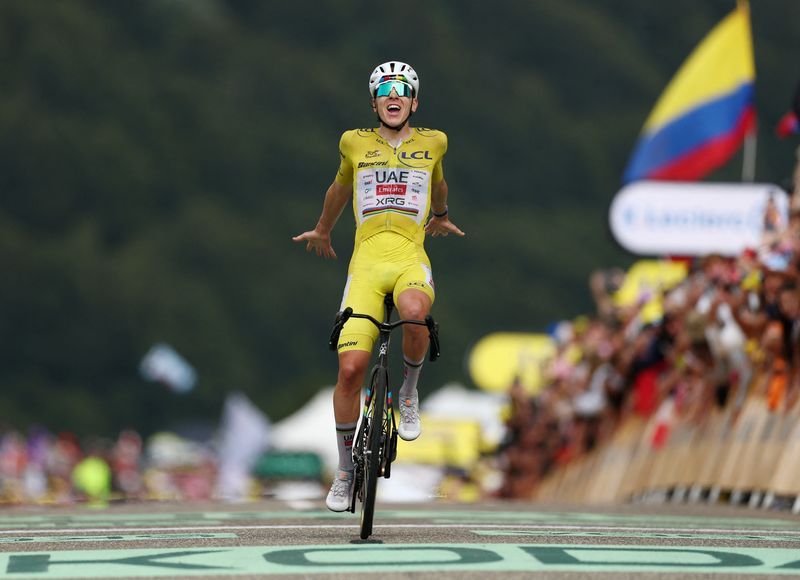
Tadej Pogacar demonstrated the form that has defined this year's Tour de France campaign, executing a perfectly timed assault on the steepest gradients of the Col du Haag to secure a commanding solo victory on stage 14. The four-time champion's attack on Saturday came at the decisive moment as the gradient rose to 16 per cent in the final two kilometres of the climb, allowing him to distance his rivals and extend his stranglehold on the yellow jersey. With this fourth stage victory of the race, the Slovenian cyclist now holds a commanding lead of four minutes and 30 seconds over Jonas Vingegaard, positioning himself in a formidable position to claim his third consecutive Tour de France title.
The 155.3-kilometre stage from Mulhouse to Le Markstein Fellering presented a relentless examination of the peloton's climbing credentials, featuring three category one ascents that tested riders throughout the day. Changeable weather conditions added another layer of difficulty, with competitors navigating wet roads during the descent from Col du Page as heavy rain swept across the course. These conditions might have dampened the spectacle for spectators, but they provided a test that would separate the genuine contenders from the supporting cast.
The early running of the stage was dictated by an ambitious breakaway group led by Frenchman Valentin Paret-Peintre of Soudal Quick-Step and Richard Carapaz. At the Grand Ballon, the first major climb, Paret-Peintre captured the mountain prize as the crowd offered vocal support to the French rider, with the main peloton trailing by nearly two minutes at that point. Four additional riders joined the break, extending the advantage as the leaders navigated the technical descent from Col du Page.
The fluid nature of the race unfolded as Carapaz and EF Education–EasyPost teammate Ben Healy briefly went astray on the approach to Ballon d'Alsace, a navigational error that cost them precious seconds. However, their recovery was swift, and they managed to rejoin the lead group as the peloton, powered by Pogacar's UAE Team Emirates-XRG domestiques, began eating into the three-minute advantage. This represents a critical tactical point in stage racing—the need to balance maintaining sufficient separation to avoid being swallowed entirely while ensuring the leaders remain close enough to defend their position.
As the race approached Ballon d'Alsace, Paret-Peintre and Carapaz again reached the summit first, but their advantage had evaporated significantly. The subsequent assault on the 11.2-kilometre Col du Haag saw the dynamics shift dramatically once more. Carapaz launched an early acceleration followed by Tobias Johannessen, but as the general classification contenders joined the party around 2.5 kilometres from the summit, the breakaway's fate was sealed. Pogacar's team had successfully neutralized what had been a substantial time gap, orchestrating a controlled approach that positioned their leader perfectly for the final push.
Pogacar's decisive moment came precisely when the road steepened to its most brutal gradient in the final two kilometres. Rather than gradually applying pressure, the 27-year-old unleashed an acceleration that his rivals could not match, opening a 30-second advantage by the summit and then managing his lead expertly on the remaining five kilometres to the finish. This tactical awareness—knowing not just when to attack, but precisely where on a climb the gradient favours his particular strengths—separates elite stage racers from exceptional ones. He crossed the line 38 seconds ahead of Isaac del Toro, his own teammate, demonstrating the depth of resources available to Pogacar's squad.
Del Toro's second-place finish represented a strong performance that earned him promotion to fourth overall, ahead of teammate Jai Ayuso, while local favourite Paul Seixas rounded out the podium in third. The battle for the remaining positions illuminates the depth of talent in this year's race, with multiple riders capable of stage victories and general classification impact. Vingegaard's fourth-place finish on the day, though respectable, underscores the mounting challenge posed by Pogacar's superiority on the mountains.
The substantial margin of four minutes and 30 seconds represents meaningful insurance against potential reversals of fortune, though cycling's unpredictability means nothing is genuinely settled with more than a week remaining. Pogacar acknowledged the magnitude of the advantage while tempering expectations about the road ahead, noting that Sunday's stage 15 from Champagnole to Plateau de Solaison would present formidable obstacles. This measured assessment reflects maturity that the Slovenian has developed through repeated stage racing successes, understanding that complacency at this level is rapidly punished.
For Malaysian cycling enthusiasts and Southeast Asian observers of the Tour, Pogacar's dominance provides a masterclass in controlled aggression and tactical precision at sport's highest level. His approach—building advantages gradually through team coordination before executing devastating attacks at precisely calculated moments—offers instructive lessons that extend beyond cycling into professional competition generally. The race remains genuinely competitive despite his lead, with upcoming mountain stages potentially providing opportunities for Vingegaard or others to mount challenges, though Pogacar's demonstrated form and tactical nous suggest his third consecutive title remains his to lose.

