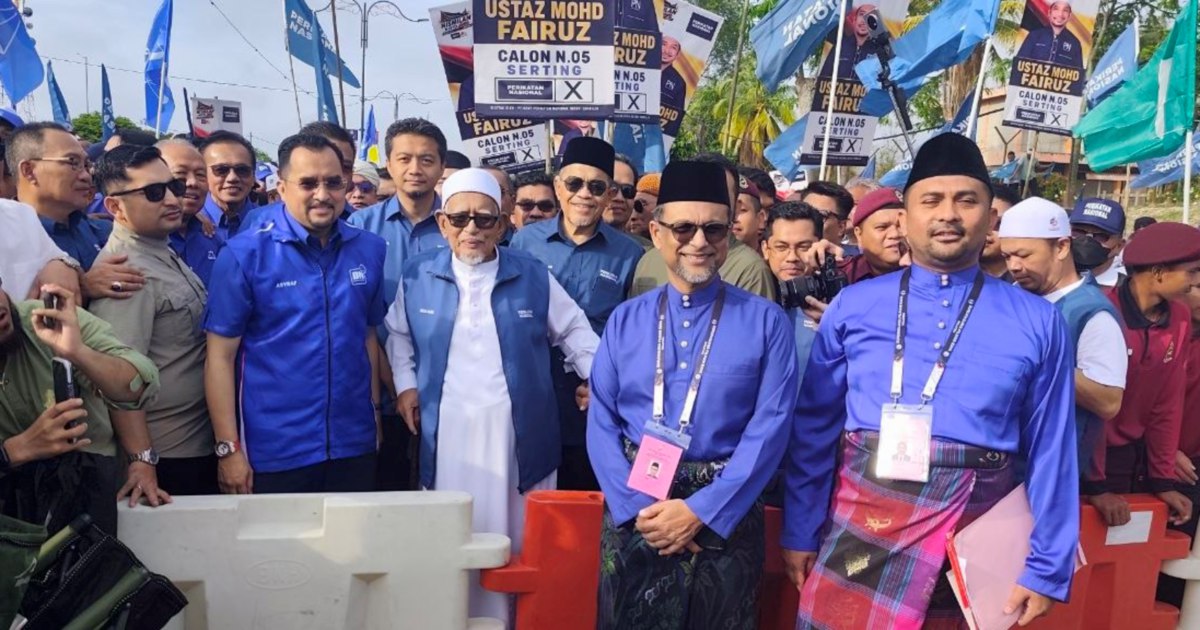
Perikatan Nasional will throw its weight behind Barisan Nasional's campaign machinery during the forthcoming Negri Sembilan state election, PAS president Tan Sri Abdul Hadi Awang announced, marking another instance of electoral cooperation between Malaysia's two largest political coalitions in recent state-level contests.
The commitment represents a continuation of the pragmatic political alignment that has defined much of Malaysian politics since the 2022 general election. Rather than competing head-to-head across the peninsula, PN and BN have increasingly carved out territorial agreements and strategic arrangements to contest specific states, reflecting the fractured nature of the country's electoral landscape and the mutual benefits of avoiding destructive three-way battles that could advantage opposition parties.
Negri Sembilan, one of Malaysia's smaller states by population but strategically important given its location in the central region and historical significance as a Malay-Muslim stronghold, has witnessed shifting political fortunes in recent election cycles. The state's election, which follows a pattern of regional contests held separately from federal parliamentary votes, will serve as a crucial barometer of voter sentiment and coalition strength in a key demographic area.
Hadi's declaration of support underscores PN's formal commitment to channelling party machinery, volunteer mobilization, and campaign resources to assist BN-aligned candidates across Negri Sembilan's parliamentary and state assembly seats. This practical cooperation extends beyond mere verbal endorsement; it encompasses ground-level organizational efforts that can materially influence voter outreach, registration drives, and get-out-the-vote operations that prove decisive in tight contests.
The arrangement carries particular significance for Negri Sembilan's political composition, where BN has traditionally maintained stronghold status, though recent years have seen varying degrees of electoral volatility. PN's decision to prioritize BN's success in this state, rather than fielding competing candidates, reflects calculations about where each coalition can most effectively consolidate power and pursue its respective political interests across Malaysia's complex multi-party environment.
Such informal power-sharing agreements, while pragmatic, have drawn scrutiny from observers concerned about democratic competition and voter choice. Critics argue that pre-election arrangements between major coalitions can reduce genuine contestation and diminish the electoral agency of constituents who might otherwise have preferred genuine three-way races. However, proponents counter that such arrangements reflect rational political behaviour in a system where fragmented votes can inadvertently produce unfavourable outcomes for all parties involved.
For Malaysian voters in Negri Sembilan, the PN-BN cooperation signals that both coalitions view the state as territory where they can work toward shared objectives rather than fundamentally opposed ones, contrasting sharply with their fierce competition during the 2022 general election when each coalition positioned itself as fundamentally incompatible with the other. The cooperation framework suggests that state-level politics operates according to different strategic calculus than national contests, where broader narratives about governance legitimacy and political direction drive voter behaviour more forcefully.
The election also carries implications for Negri Sembilan's internal political dynamics, where various factions within BN and potential PN interests have competed for influence and resource allocation. By formalizing PN's support role, both coalitions effectively marginalize challengers from PH or independent candidates who might otherwise benefit from divided opposition. This consolidation of major political forces behind agreed-upon candidates raises questions about institutional space for alternative political voices and movements that don't fit neatly within established coalition frameworks.
Regionally, Negri Sembilan's electoral outcome will reverberate across Southeast Asia's broader political landscape, particularly given Malaysia's position as a significant economy and democratic experiment within the region. International observers, policymakers, and analysts tracking regional political trends often cite Malaysian election results as indicators of stability or instability, governance quality, and the health of democratic institutions in a rapidly changing geopolitical environment.
The timing of Hadi's announcement also reflects PN and BN's ongoing efforts to demonstrate political stability and coalition coherence at a moment when Malaysian politics confronts questions about institutional integrity, reform trajectories, and the capacity of major political forces to deliver effective governance. By publicly committing to electoral cooperation, PN leadership signals that despite past rivalries and fundamental disagreements about national direction, the coalition recognizes shared interests in maintaining political order and preventing complete fragmentation of Malaysia's two-coalition system.
For Negri Sembilan constituents preparing for state-level polling, the PN support commitment means encountering a unified BN-PN campaign infrastructure rather than competing machines vying for their votes. Whether such consolidation ultimately serves voter interests or merely concentrates political power among establishment actors remains a central debate animating contemporary Malaysian political discourse.

