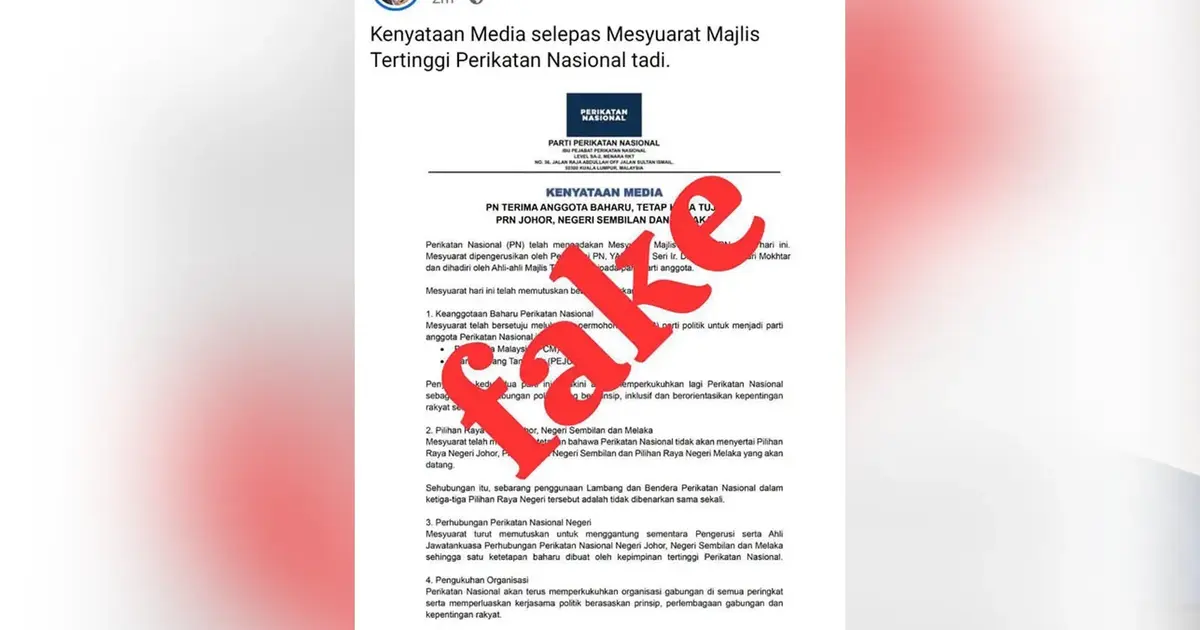
Perikatan Nasional moved swiftly to debunk a fraudulent statement circulating within political circles that alleged the coalition intended to abstain from participating in three forthcoming state-level elections. The coalition's emphatic rejection of these claims underscores growing concerns about misinformation in Malaysia's political landscape and the risks posed by spurious documents attributed to major political actors.
The false statement, which originated from unidentified sources, suggested a coordinated withdrawal by PN from electoral contests across three states. Such a move would represent a significant strategic departure for a coalition that has been actively contesting elections at multiple levels since its formation. By immediately labelling the document as counterfeit, PN sought to prevent the narrative from gaining traction among its supporters and the broader electorate.
The incident highlights the vulnerability of Malaysia's political ecosystem to deliberate disinformation campaigns. In an era when digital communication enables rapid information spread, the ability to create and distribute seemingly credible but entirely fabricated statements has become a recognised threat to electoral integrity. PN's swift response reflects a growing awareness among major political organisations of the need to address false attributions before they embed themselves in public discourse.
The timing of such a statement's circulation raises questions about motivations and origins. Electoral boycotts or strategic withdrawals would typically be announced through official party channels via press conferences, formal statements, or direct communication with party members and allied organisations. The emergence of an unverified document claiming such a significant policy shift signals either a deliberate attempt to sow confusion or a serious breach of internal communication protocols.
For Malaysian voters, particularly those in states targeted by this false claim, the episode serves as a reminder to verify political announcements through credible sources. The proliferation of fabricated statements requires citizens to develop heightened scrutiny when encountering purported official positions from political parties. This places additional responsibility on news organisations and civil society to maintain rigorous verification standards and to clearly distinguish between confirmed statements and claims under investigation.
PN's denial also reflects broader competitive dynamics within Malaysia's political space. As the coalition positions itself for upcoming electoral contests, maintaining credibility about its intentions and strategic direction becomes paramount. Any successful misinformation about withdrawal from elections could undermine voter confidence and provide advantage to rival coalitions. The swift repudiation serves both to protect PN's electoral prospects and to demonstrate organisational transparency to its stakeholders.
The three states referenced in the false statement remain significant political battlegrounds. State-level elections in Malaysia determine control of important government structures, including the allocation of development funds and implementation of state-specific policies. Should PN genuinely consider abstracting from contests in any state, this would represent a material shift in its political strategy and would merit serious attention from analysts and voters alike.
Malaysia's experience with fake political statements predates recent social media proliferation. However, the digital age has substantially amplified both the creation and distribution mechanisms for such misinformation. Previous incidents have demonstrated how false statements attributed to political leaders or parties can generate brief but measurable political turbulence before corrections gain circulation. The challenge lies in ensuring that denials reach audiences as effectively as the original false claims.
The broader implications extend beyond PN's immediate electoral calculations. The existence and circulation of a credible-seeming but entirely fabricated statement raises questions about document security and the ease with which official-looking communications can be generated. Political parties, election authorities, and government bodies increasingly confront the reality that authenticity verification has become a necessary component of public communication.
Moving forward, PN and other major coalitions will likely need to implement additional verification mechanisms to authenticate official statements. This could include digital signatures, official letterhead standards, or statement verification protocols through official websites and social media accounts. Such measures would create friction for misinformation campaigns while helping legitimate communications stand out.
The incident also serves as a case study for how Malaysian media and civil society respond to electoral misinformation during periods preceding major elections. As the country approaches potential state-level electoral contests, the capacity to distinguish authentic from fabricated political communications will prove increasingly important. PN's decisive response demonstrates awareness of these stakes, though broader systemic solutions will require coordination among political parties, media organisations, and election administrators to establish shared verification standards and rapid response mechanisms.

