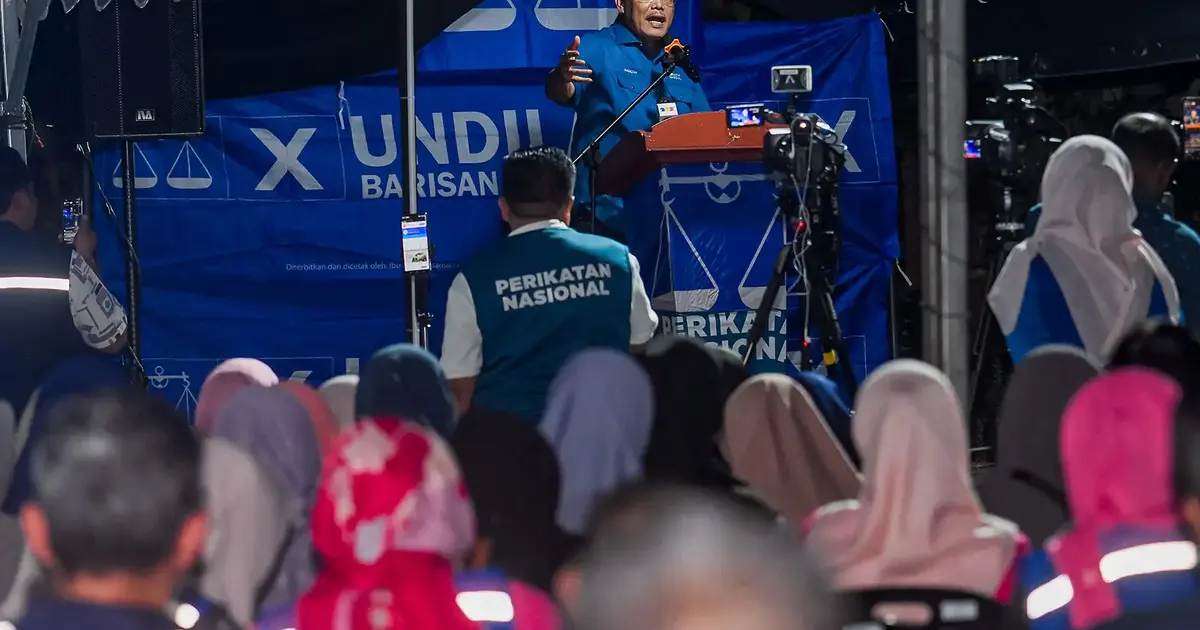
Perikatan Nasional has signalled its willingness to step back from the chief minister's post in Negeri Sembilan, ceding leadership of the state government to Barisan Nasional should their electoral alliance secure victory in the August 1 state election. The arrangement, articulated through the coalition's leadership, represents a carefully calibrated power-sharing agreement designed to maximise their combined electoral prospects in the state while maintaining internal coalition stability.
The decision underscores a broader pattern of pragmatic political cooperation that has gained traction across Malaysia in recent years, where rival coalitions find common ground to challenge incumbent administrations or strengthen their parliamentary positions. By formalising leadership terms before voters head to the polls, the PN-BN partnership seeks to project coherence and demonstrate to Negeri Sembilan voters that a vote for either party represents a unified governing agenda rather than a fractured mandate.
Negeri Sembilan occupies a strategically significant position within Malaysia's political landscape, serving as a swing state that has historically shifted between competing coalitions. The state's twelve state assembly seats mean that whoever commands a simple majority will assume control of the Menteri Besar position and the executive machinery of government. In a context where no single coalition commands overwhelming dominance, the PN-BN partnership acknowledges the mathematical reality that cooperation offers better prospects than fragmentation.
The nomenclature suggested—'Perikatan Barisan Nasional'—reflects an effort to brand this alliance as a unified entity rather than a temporary marriage of convenience. Nomenclature matters in Malaysian politics, where coalition identities carry weight with voters and serve as shorthand for governing philosophies and power distributions. By proposing a combined identity, architects of this pact signal their intent to present voters with a coherent alternative framed around shared values and complementary strengths.
For Barisan Nasional, the arrangement provides access to PN's electoral machinery and supporter base in constituencies where the traditional ruling coalition faces headwinds. This has become increasingly valuable following Barisan's political diminishment over the past decade, during which it lost federal power and control of multiple state governments. Partnership with PN represents a potential avenue for rehabilitating Barisan's standing, particularly among voter segments that migrated towards PN during periods of BN's unpopularity.
Conversely, Perikatan Nasional's decision to accept a subordinate role in this particular state election demonstrates strategic flexibility and recognition of political realities. Rather than insisting on leadership positions across every contested state, PN appears willing to negotiate asymmetric arrangements where its leverage varies by electoral context. In Negeri Sembilan specifically, ceding the chief minister's role may prove politically rational if the alternative is a scattered opposition vote that benefits the incumbent government.
The August 1 election itself will occur against a backdrop of broader Malaysian electoral activity, including concurrent contests in other states and the perpetual jockeying within federal parliament. Negeri Sembilan voters will essentially decide whether they prefer continuity under the current Menteri Besar or wish to see the PN-BN partnership assume control. The clarity provided by pre-election agreements on leadership succession helps voters make informed choices about what governmental transition, if any, they wish to effect.
For Malaysian observers, the PN-BN arrangement in Negeri Sembilan illustrates how Malaysia's party political system has evolved towards greater coalition fluidity and negotiation. Gone are the days when BN's dominance meant automatic electoral victory, or when opposition coalitions could assume permanent configurations. Instead, contemporary Malaysian politics increasingly features ad-hoc alliances tailored to specific electoral contests, with leadership and portfolio distributions determined through bilateral negotiation rather than ideological principle.
The implications extend beyond Negeri Sembilan's borders. Should the PN-BN coalition triumph in August, it would validate the partnership model and potentially encourage similar arrangements elsewhere. Conversely, an electoral defeat might suggest that voters view such alliances with scepticism or prefer to support coalitions with clearer, longstanding organisational structures. The outcome will therefore provide important signals to both PN and BN regarding voters' appetite for this form of pragmatic cooperation.
Regionally, Malaysia's political experiments with coalition restructuring and power-sharing mechanisms attract attention from other Southeast Asian democracies navigating similar terrain. How Malaysian coalitions negotiate internal hierarchies, distribute leadership positions, and maintain cohesion offers instructive lessons for parties elsewhere seeking to build durable electoral alliances. The PN-BN arrangement thus represents not merely a local electoral calculation but a test case in coalition engineering with implications for regional democratic practice.
The success of this partnership will ultimately depend on whether PN and BN can maintain discipline among their respective party members and supporters through the campaign period. Coalition management in Malaysia has historically proven difficult, with leadership disputes and member defections undermining electoral prospects. The clarity provided by pre-negotiated agreements on the chief minister position may help forestall such complications, though the August vote remains unpredictable given Negeri Sembilan's history as a competitive electoral battleground.

