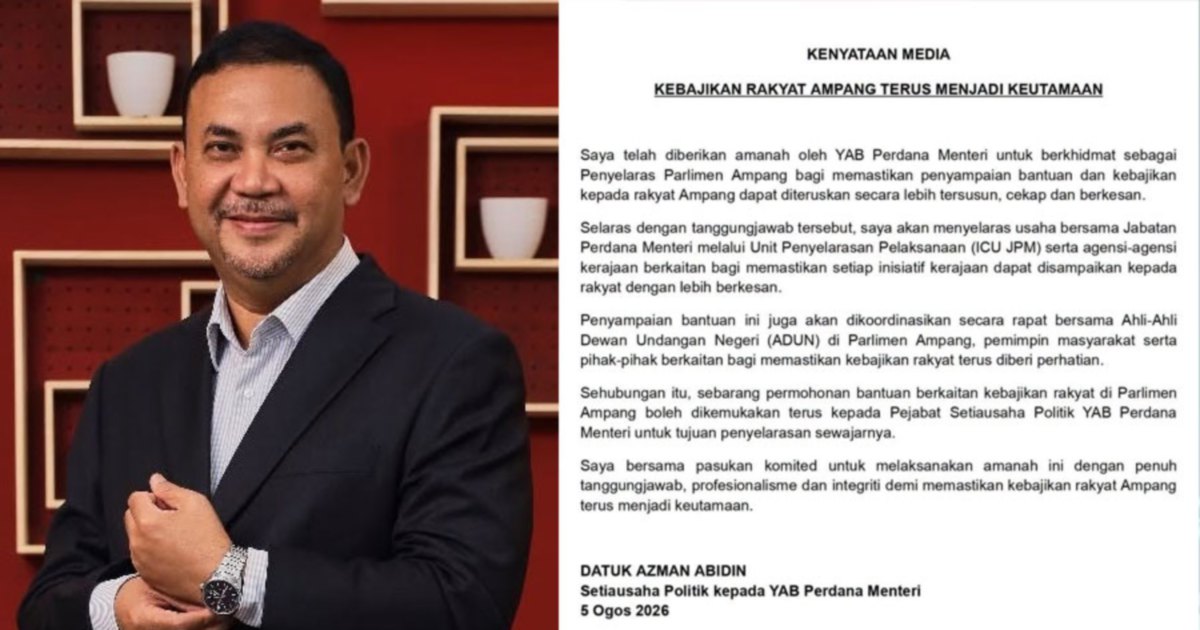
The Prime Minister's office has moved to install one of Datuk Seri Anwar Ibrahim's political secretaries as parliamentary coordinator for the Ampang constituency, a step that follows the recent suspension of PKR lawmaker Rodziah Ismail's ability to access the MyKhas funding allocation platform.
The appointment signals a significant shift in the governance structure of the Ampang parliamentary division at a time when questions about internal party discipline and resource management have become increasingly prominent within PKR's ranks. The MyKhas system, which channels constituency development funds directly to elected representatives, represents a crucial mechanism through which Malaysian MPs implement localized projects and maintain constituent relations. The suspension of Rodziah Ismail's access therefore effectively undermines her capacity to execute traditional parliamentary functions in her district.
This development reflects deeper tensions within the ruling coalition that have periodically surfaced over questions of party loyalty, internal accountability, and the distribution of political resources. The appointment of a Prime Minister's aide to coordinate parliamentary affairs in Ampang suggests that the federal leadership has determined a need for closer oversight of the constituency's operations. Such arrangements have occasionally been deployed in Malaysian politics when party leadership seeks to establish tighter control over a particular division or when concerns arise regarding an MP's alignment with party directives.
Rodziah Ismail, who has represented Ampang in the Dewan Rakyat, now faces a substantial reduction in her practical authority within her own constituency. The inability to access MyKhas funds represents more than a bureaucratic inconvenience; it curtails her ability to fund community projects, respond to constituent grievances with tangible development initiatives, and maintain the electoral machinery that typically depends on visible parliamentary delivery. This form of constraint has become an increasingly common tool within Malaysian political parties seeking to enforce discipline without resorting to formal expulsion.
The timing of this appointment raises questions about the broader context of intra-party management within PKR. The party, which forms a critical component of the Pakatan Harapan coalition supporting the Anwar administration, has experienced periodic frictions between its federal leadership and certain MPs over issues ranging from voting patterns to public statements. The decision to place a Prime Minister's aide in a coordinating role suggests that the federal administration views direct intervention as necessary in this instance.
For constituents in Ampang, the practical implications are significant. They will now navigate a divided authority structure where parliamentary functions are nominally still the responsibility of their elected MP, yet financial and administrative resources flow through a separate coordinator appointed by the Prime Minister's office. This arrangement potentially creates confusion regarding accountability and may complicate efforts by residents to access assistance from their parliamentary representative.
The MyKhas system itself, introduced as part of governance reforms intended to improve transparency and efficiency in constituency management, has become central to Malaysian parliamentary politics. The platform was designed to enable MPs to directly monitor and implement development projects within their constituencies, creating a direct link between elected representatives and local development. Suspending an MP's access to this system effectively removes them from active participation in this crucial function.
Within the broader context of Southeast Asian politics, this development illustrates the ongoing tension between democratic representation and executive control that characterizes many regional democracies. Malaysia's political system continues to grapple with questions about how much power should be concentrated in the executive office and how far parliamentary independence should extend. The appointment of a Prime Minister's aide to oversee Ampang operations represents one data point in this broader pattern.
The situation also underscores the complex relationship between formal structures and informal power arrangements in Malaysian governance. While Rodziah Ismail technically retains her parliamentary seat and the formal titles associated with her position, her practical capacity to exercise the discretionary functions that define a modern MP's relationship with constituents has been substantially curtailed. This reflects a pattern whereby political control is maintained through administrative mechanisms rather than through crude formal measures.
PKR's approach to this situation will likely influence how other coalition parties manage similar internal challenges in coming months. If this model proves effective from the perspective of party leadership, it may establish a precedent for managing MPs deemed insufficiently aligned with party direction. Conversely, if the arrangement generates constituent dissatisfaction or creates friction with other coalition partners concerned about federal overreach, it could trigger broader recalibrations within the ruling alliance.
The appointment also carries implications for how the Anwar administration manages its coalition partnerships more broadly. The decision to place a Prime Minister's aide in Ampang demonstrates a willingness by the federal leadership to exercise direct administrative control over parliamentary constituencies when party mechanisms prove insufficient. This approach may be welcomed by those prioritizing executive efficiency but could raise concerns among those emphasizing parliamentary autonomy and separated powers.
Moving forward, the situation in Ampang represents a test case for how effectively a divided administrative structure can operate in managing parliamentary affairs. The appointment of the Prime Minister's coordinator alongside the continued nominal authority of the elected MP creates an inherently complex arrangement requiring careful navigation to avoid constituent confusion or service delivery breakdown. The success or failure of this arrangement will likely shape how Malaysian political parties approach similar challenges in the future.

