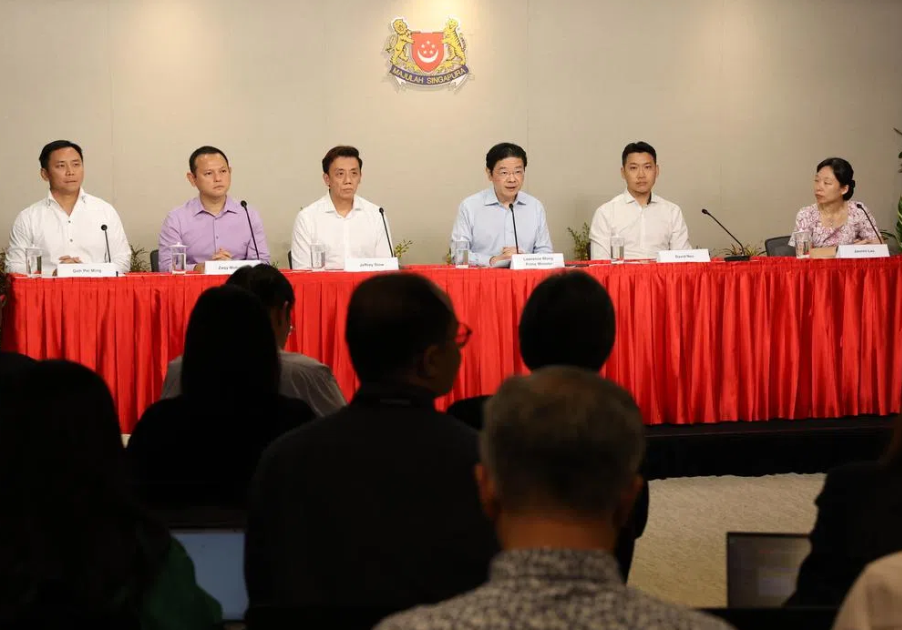
Prime Minister Lawrence Wong announced a significant restructuring of Singapore's Cabinet on July 22, promoting a cohort of newer parliamentarians to more demanding positions while maintaining the guidance of senior statesmen in key advisory roles. The reshuffle reflects the government's deliberate strategy to refresh its leadership pipeline whilst retaining institutional experience during a critical period of political change. The moves come in the wake of recent high-profile resignations that have disrupted the administration's stability over the past months.
Two General Election 2025 newcomers, Jeffrey Siow and David Neo, have been elevated to full ministerial rank following their successful stewardship of acting roles since May 2025. Siow, who has been serving as Acting Transport Minister, and Neo, who has led the Culture, Community and Youth portfolio, will continue overseeing their respective ministries after receiving their formal promotions. Their appointments signal the government's confidence in their ability to manage complex policy areas independently. The progression from acting to substantive roles follows what Wong described as a period during which both politicians have "settled into their roles well" and "earned the confidence of their colleagues and of the civil servants they work with."
Sim Ann takes on the portfolio of Second Minister for Foreign Affairs and Home Affairs, adding another first-term figure to the upper echelon of government. Perhaps most notably, Jasmin Lau will assume the position of Acting Minister for Manpower, replacing the departing Tan See Leng, who transitions to the newly configured Ministry of Trade and Industry overseeing Energy and Industry matters. The ministerial shuffle extends to backbench MPs Foo Cexiang and Shawn Loh, both first-term parliamentarians with prior experience in the civil service, who are now appointed as Ministers of State. These appointments represent a meaningful acceleration of responsibility for politicians who have served only one election cycle, indicating the government's assessment that they possess the capability to contribute to senior-level decision-making.
The Cabinet changes also involve experienced politicians reassuming or relocating within the government structure. K. Shanmugam will be appointed Senior Minister, a position emphasising his role as a mentor and strategic advisor to younger colleagues. Labour chief Ng Chee Meng makes a return to Cabinet as Minister in the Prime Minister's Office after his previous tenure, bringing back to the centre of power someone with deep organisational knowledge. Wong characterised these appointments as essential to ensuring continuity and providing the institutional memory necessary during periods of uncertainty. Senior Minister Lee Hsien Loong, already serving in an advisory capacity, will continue to provide counsel as one of the two most experienced Cabinet members alongside Shanmugam.
The timing of the reshuffle cannot be divorced from the political upheaval that has characterised 2026. Faishal Ibrahim, who served as Acting Minister-in-charge of Muslim Affairs and Senior Minister of State for Home Affairs, resigned on July 20 following what he publicly described as a "lapse of judgment" in managing personal interactions with a woman. This resignation came merely three weeks after another senior figure, Koh Poh Koon, stepped down on June 1 citing family considerations. Wong acknowledged these unexpected departures as factors influencing the composition of the new Cabinet, noting that whilst the government reviews its Cabinet structure annually as a matter of course, unanticipated resignations necessitate more immediate strategic recalibration.
Wong articulated the philosophical underpinning of the reshuffle during the press conference at the National Press Centre, emphasising that Singapore requires both experienced leaders to navigate immediate domestic and regional challenges and a younger generation prepared to assume stewardship in the medium to long term. He stressed that leadership renewal extends beyond the Cabinet itself, requiring the cultivation of strong backbenchers and younger office-holders who can eventually progress to more prominent roles. The concept of a "strong pipeline" recurred throughout his remarks, suggesting that the government recognises the need for continuous grooming of talent to prevent gaps in expertise as senior figures eventually transition out of active service.
The structural architecture of the Cabinet also attracted Wong's attention during questioning. He defended the decision to retain a single Deputy Prime Minister in the form of Gan Kim Yong rather than appointing a second figure to that rank, arguing that the current configuration provides sufficient senior leadership firepower. Additionally, he noted the existence of three Coordinating Ministers—Shanmugam overseeing National Security, and both Chan Chun Sing and Ong Ye Kung managing other government portfolios appointed in May 2025—which he presented as providing adequate horizontal integration across ministerial silos. This arrangement, Wong suggested, reflects a deliberate architectural choice that can be reviewed as circumstances evolve but remains appropriate for the present juncture.
Wong's own continued stewardship of the Finance portfolio since 2021 prompted questions about succession planning for one of the government's most technically demanding roles. He characteristically deflected with measured language, characterising the search for an appropriate successor as "a work in progress" whilst acknowledging that people "develop at different paces" and that some demonstrate readiness for larger responsibilities earlier than others. His approach reflects a philosophical patience with regard to talent development, suggesting that forcing promotions prematurely risks placing individuals in positions for which they are not yet equipped. Instead, Wong framed his role as one of careful assessment and strategic placement, endeavouring to position people "where they can best contribute to Singapore" rather than adhering to arbitrary timelines or formulaic advancement schedules.
The reshuffle takes effect progressively from July 27, with certain changes implemented at staggered intervals over subsequent weeks. This graduated approach permits administrative machinery to adjust without precipitating institutional disruption. Wong characterised the entire exercise as exemplifying "the Singapore way of leadership renewal," a continuous iterative process rather than a one-time event. For regional observers, particularly those in Malaysia and neighbouring Southeast Asian nations grappling with their own succession questions, the exercise provides a case study in how a governing system manages the transition from foundational leaders to a subsequent generation whilst retaining experienced hands. The explicit commitment to balancing fresh perspectives with institutional continuity offers a model of managed change that contrasts with the more abrupt transitions occasionally witnessed elsewhere in the region.
The implications for Southeast Asia's broader governance landscape merit consideration. Singapore's approach to institutionalised leadership transition—with clear signals sent through Cabinet restructuring about the direction of future governance—stands in contrast to political systems where succession remains opaque or contested. For Malaysian policymakers and political observers, the Singapore example illustrates how transparent management of generational change can contribute to economic and political stability. The elevation of figures like Siow and Neo signals to markets, civil society, and the international community that Singapore possesses a functioning system for identifying and promoting capable administrators, reducing uncertainty about the government's future direction and capacity. Whether Singapore's deliberate, institution-focused approach to leadership renewal can serve as an instructive model for other regional governments facing similar demographic and institutional challenges remains a question for ongoing regional political analysis.

