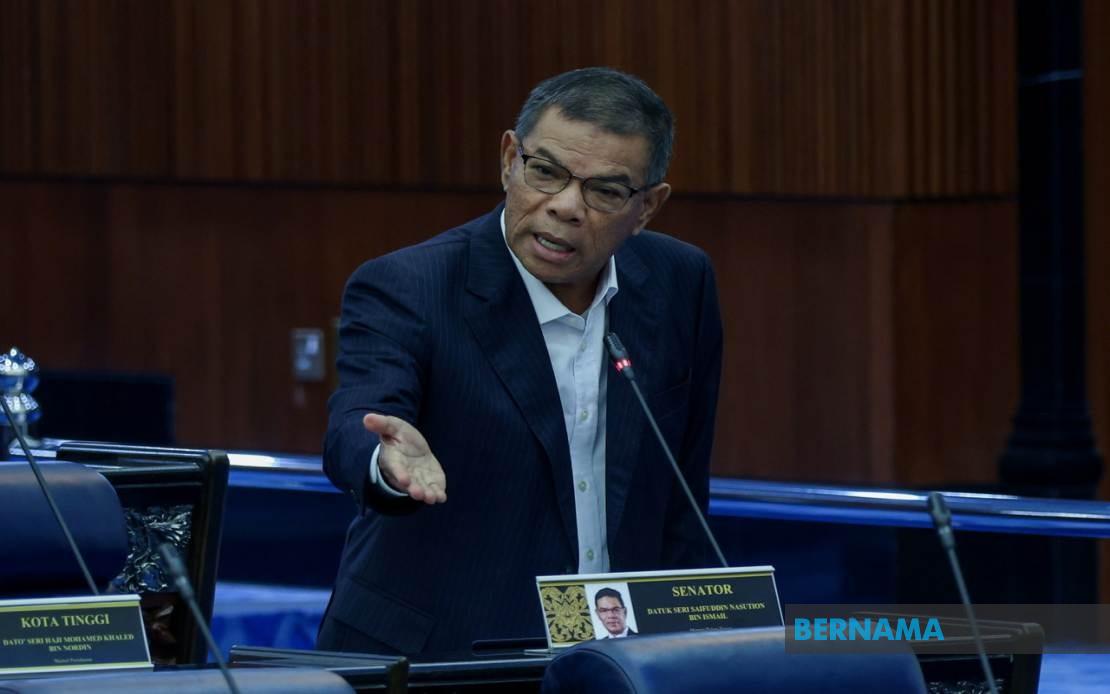
Prime Minister Datuk Seri Anwar Ibrahim has approved a RM22 million funding allocation to equip the Border Control and Protection Agency (AKPS) with firearms and associated protective equipment, Home Minister Datuk Seri Saifuddin Nasution Ismail announced during parliamentary proceedings on June 23. The decision follows mounting pressure to strengthen operational capabilities and personnel safety within the newly established agency tasked with securing Malaysia's borders.
The financial commitment emerged directly from security vulnerabilities exposed during a shooting incident in February targeting a vehicle carrying an AKPS commander in Bukit Kayu Hitam, Kedah. That episode underscored the operational hazards faced by border personnel operating without adequate defensive equipment. Saifuddin Nasution subsequently petitioned the Prime Minister for armament provisions, receiving swift approval for the comprehensive package intended to furnish AKPS with weapons and gear deemed operationally necessary for frontline border duties.
The approval addresses a longstanding concern raised by parliamentary members regarding the disparity in safety provisions available to AKPS officers. During Ministers' Question Time, Datuk Seri Takiyuddin Hassan from Kota Bharu highlighted the problematic reality that agency personnel operate without standard protective equipment including firearms and bulletproof vests—a significant liability given the inherent risks of border enforcement work. The supplementary questioning mechanism ultimately catalysed formal ministerial acknowledgement of these gaps and the subsequent budgetary response.
Implementation considerations remain nuanced, however. AKPS comprises personnel drawn from multiple government agencies, including the Ministry of Health, creating a mixed workforce with varying skill levels in weapons handling. Saifuddin Nasution acknowledged this structural reality, noting that only certain personnel segments—principally former police officers—possess requisite firearms competency. The RM22 million allocation will therefore support selective weaponisation rather than universal arming of all AKPS staff, a pragmatic approach balancing operational effectiveness with institutional capability.
The firearms investment represents a broader confidence in AKPS's structural consolidation objective. The Home Minister articulated a compelling administrative rationale for the agency's existence: by centralising border functions previously fragmented across more than twenty separate agencies, AKPS theoretically reduces bureaucratic complexity and integrity vulnerabilities. The sequential processing burdens of multi-agency coordination historically created opportunities for administrative friction and corrupt facilitation. A unified operational framework theoretically streamlines procedures while minimising systemic exposure to malpractice.
Early operational performance provides supporting evidence for this institutional consolidation thesis. Within its first operational year, AKPS recorded substantial achievements including a multi-million ringgit narcotics seizure at Penang International Airport and the detection of electronic waste smuggling at maritime ports. These successes, achieved through coordinated inter-agency collaboration, demonstrate that consolidated command structures can generate tangible security outcomes that fragmented arrangements struggled to match historically.
Constitutional questions surrounding AKPS establishment have occasionally surfaced, particularly regarding implications for Sabah and Sarawak's historical autonomy under the Malaysia Agreement 1963. Saifuddin Nasution provided explicit assurances that AKPS operations remain constitutionally compliant and that MA63 rights continue receiving formal respect. The minister characterised the constitutional debate as concluded, shifting focus from policy legitimacy to practical implementation challenges. This framing suggests that earlier stakeholder consultation achieved sufficient consensus before legislative passage, positioning current debates as operational rather than foundational.
The AKPS model draws precedential support from established security consolidation successes. The Eastern Sabah Security Command (ESSCOM) and Malaysian Maritime Enforcement Agency (MMEA) both demonstrate how integrating multiple agencies into unified operational frameworks strengthens national security delivery. These organisations evolved from similar circumstances—fragmented responsibilities across various departments—and subsequently achieved enhanced coordination and responsiveness through centralised command. AKPS represents an extension of this consolidation philosophy into the terrestrial border domain.
The RM22 million allocation signals confidence that border management challenges require sustained institutional investment beyond initial establishment funding. Operating sophisticated checkpoint systems, maintaining personnel readiness, and sustaining inter-agency cooperation mechanisms all demand continuous resource commitment. This funding package acknowledges that security infrastructure requires not merely structural reorganisation but adequate material provisions—firearms procurement, training programmes, maintenance systems, and replacement cycles.
For Malaysian border regions and communities, the AKPS weaponisation carries immediate implications. Enhanced enforcement capability theoretically strengthens deterrence against smuggling operations, human trafficking networks, and transnational criminal activities that utilise maritime and terrestrial entry points. The February shooting incident that prompted this approval highlighted how under-equipped personnel become vulnerable targets for organised criminal elements operating at border interfaces. Improved protective provisions should correspondingly reduce personnel casualties and operational disruptions.
Regionally, Malaysia's border security investments reflect broader Southeast Asian patterns regarding transnational threats. As countries increasingly recognise that porous borders facilitate drug trafficking, wildlife trafficking, and irregular migration, dedicated border agencies enjoy expanding political support and budgetary prioritisation. AKPS joins comparable Thai, Indonesian, and Vietnamese border security initiatives in addressing shared regional challenges through institutional consolidation and material modernisation.
The firearms approval also signals parliamentary consensus around AKPS as an institutional commitment despite occasional scepticism. Opposition members' questions regarding safety deficiencies generated ministerial responses that validated the underlying concerns while advancing government solutions. This dynamic—critical parliamentary scrutiny provoking defensive institutional investment—reflects functioning democratic accountability, even when specific legislators harbour reservations about broader AKPS policy architecture.
Moving forward, AKPS implementation will require sustained attention to personnel training, operational protocols, and inter-agency coordination mechanisms. The RM22 million firearms investment represents necessary but insufficient infrastructure; equally important remain institutional culture development, accountability frameworks, and performance metrics distinguishing AKPS from its fragmented predecessors. Whether consolidation ultimately reduces corruption and enhances security delivery depends substantially on implementation fidelity beyond budgetary allocation.