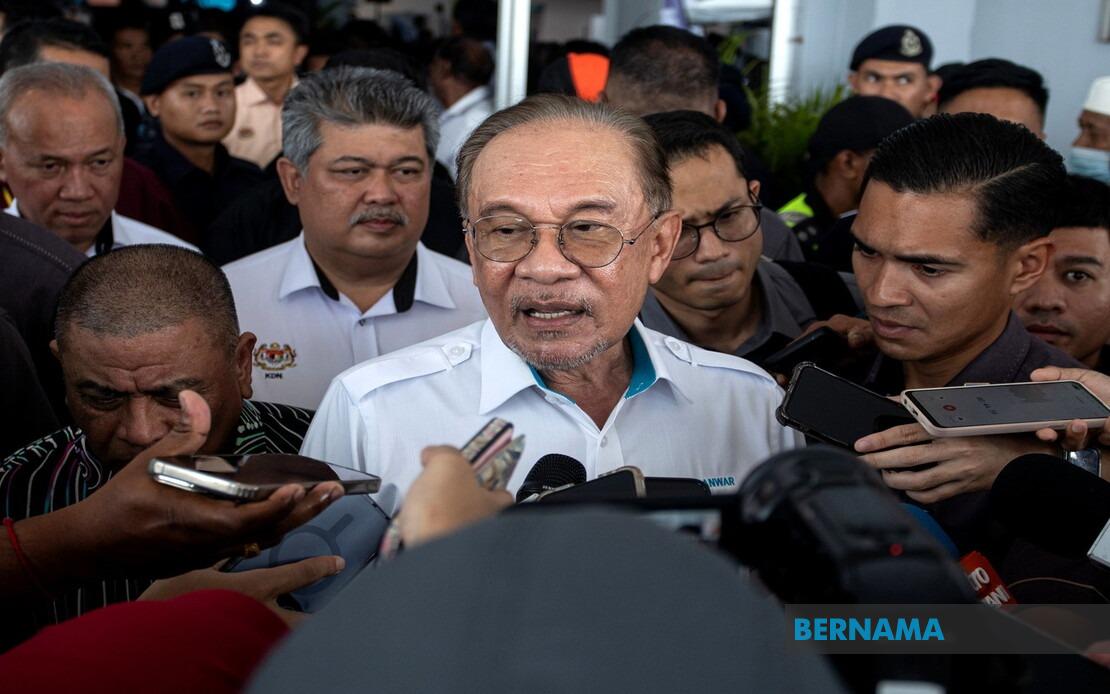
Prime Minister Datuk Seri Anwar Ibrahim has issued a stern reminder to all government officials that they must exercise restraint and discipline when campaigning in state elections, particularly when it comes to publicly criticising the Federal Government. Speaking in Ipoh following a community engagement session, Anwar emphasised that individuals holding ministerial and agency positions have a responsibility to uphold the standards expected of their office, and that violating this expectation should result in their resignation from government roles.
The Prime Minister's statement acknowledges the complex political reality in Malaysia's federal system, where parties aligned at the national level often find themselves in direct competition at state level. Anwar recognised this as a legitimate aspect of democratic practice, noting that coalition partners can indeed contest against one another in state elections without necessarily undermining the federal alliance. However, he drew a clear distinction between campaigning on state-specific issues and launching attacks on the integrity or decisions of the Federal Government itself.
Anwar's caution addresses a persistent tension within the Unity Government coalition, which brings together previously rival political factions under a shared governing framework. The coalition's diverse membership means that political tensions and tactical disagreements are inevitable, and state elections often become flashpoints where these underlying differences surface. By publicly articulating expectations for ministerial conduct, Anwar is attempting to establish clear boundaries that allow healthy democratic competition while protecting the coherence of the federal administration.
The Prime Minister disclosed that he has already discussed this matter with his two deputies, Datuk Seri Dr Ahmad Zahid Hamidi and Datuk Seri Fadillah Yusof, indicating that the issue had reached sufficient prominence to warrant high-level conversations within the executive branch. This suggests that instances of problematic campaign conduct may have already occurred, prompting the need for clarification and reinforcement of expectations. The involvement of both deputy prime ministers signals the seriousness with which the Prime Minister's office views potential discipline violations.
Beyond the immediate question of campaign conduct, Anwar's intervention reflects deeper concerns about governance continuity and service delivery. A fractious political environment at the federal level could undermine the government's ability to implement policies and respond to public needs effectively. By urging unity government partners to preserve cordial relations across both federal and state spheres, Anwar is attempting to insulate core government functions from the pressures of electoral competition. This approach recognises that public confidence in government services depends partly on institutional stability and coherent leadership.
For Malaysian voters and observers, this pronouncement carries implications regarding how elections will be conducted and what standards of political conduct will be enforced. Government officials who ignore these warnings risk facing disciplinary action, though the mechanisms for enforcement remain somewhat unclear. The public nature of Anwar's statement suggests that breach of these expectations would become highly visible and potentially career-damaging, creating a reputational deterrent beyond formal institutional penalties.
The unity government framework itself represents a significant shift in Malaysian politics, bringing together Pakatan Harapan, Barisan Nasional, and other parties in a cooperation that was unthinkable in previous electoral cycles. This arrangement delivers mutual benefits to its constituent parties while creating inherent tensions, as partners must balance coalition loyalty against competitive electoral interests. Anwar's leadership challenge involves managing these tensions while maintaining sufficient coherence for effective governance, a balancing act that requires careful messaging and clear boundary-setting.
State elections present particular challenges for unity governments because they often become referendums on particular regions or state administrations rather than direct tests of federal policy. This creates space for legitimate criticism of specific state-level decisions without necessarily attacking the federal structure. However, the line between state-level critique and federal government attacks can become blurred in campaign rhetoric, particularly when opposition parties seek to exploit divisions within ruling coalitions. Anwar's warning attempts to maintain this distinction and prevent its erosion through aggressive campaigning.
For regional observers across Southeast Asia where coalition governments are increasingly common, Malaysia's experience with managing unity government campaign discipline offers valuable lessons. The challenge of maintaining coalition coherence during elections is not unique to Malaysia, and how the Anwar administration navigates this question could influence approaches adopted by other countries grappling with similar political arrangements. The Malaysian government's emphasis on preserving service delivery standards despite electoral competition suggests a pragmatic prioritisation of governance outcomes over political point-scoring.
Looking forward, the effectiveness of Anwar's directive will depend on voluntary compliance from government officials and the willingness of coalition partners to enforce expectations among their members. There remains a question of whether informal appeals to discipline will suffice, or whether more formal mechanisms may eventually become necessary. The implicit threat that officials who attack the Federal Government should resign establishes consequences for non-compliance, though implementation of this principle during active campaigns remains to be tested.

