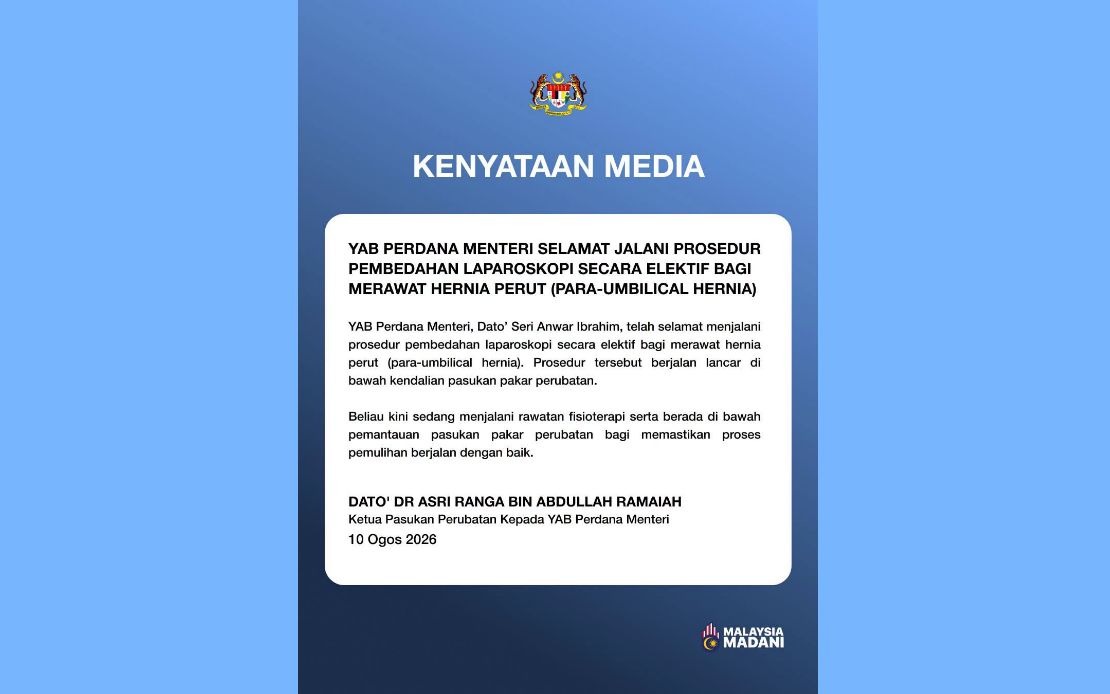
Prime Minister Datuk Seri Anwar Ibrahim has successfully completed elective laparoscopic surgery to address a para-umbilical hernia, with his medical team confirming that the procedure proceeded without complications. The minimally invasive approach, which involved small incisions and specialised instrumentation to repair the hernia, represents a modern treatment option that typically results in faster recovery compared to traditional open surgery.
The head of the Prime Minister's Medical Team, Datuk Dr Asri Ranga Abdullah Ramaiah, confirmed that Anwar's surgical intervention was handled by a multidisciplinary group of medical professionals who monitored his condition throughout the operation. The choice of laparoscopic technique for this type of abdominal wall defect demonstrates access to advanced surgical capabilities within Malaysia's healthcare infrastructure, though elective procedures of this nature are generally considered routine within modern medicine.
Following the operation, Anwar has entered the critical initial recovery phase under intensive medical observation. His care regimen includes physiotherapy sessions designed to restore strength and mobility, a standard protocol following abdominal surgery to prevent complications such as fluid accumulation and to facilitate proper healing of the surgical site. The medical team has structured a comprehensive monitoring framework to track his progress through each stage of recovery.
The Prime Minister's senior press secretary, Tunku Nashrul Abaidah, indicated that Anwar would remain hospitalised for approximately two days as part of the prescribed observation schedule. This timeframe aligns with typical post-operative protocols for laparoscopic hernia repair, allowing medical staff to monitor vital signs, assess pain management efficacy, and identify any potential complications during the crucial period immediately following surgery. The duration of hospitalisation reflects current medical best practices for this category of elective procedure.
From a political continuity perspective, the surgical timing and relatively straightforward nature of the intervention suggest minimal disruption to government operations. The Prime Minister's office has maintained standard communication channels with key stakeholders regarding the procedure, and the medical team's confidence in Anwar's prognosis indicates that resumption of full ministerial duties should occur within a reasonable timeframe following discharge.
Abdominal hernias, which occur when internal tissue protrudes through a weakness in the surrounding muscle wall, affect individuals across all demographics and activity levels. The para-umbilical variant specifically develops near the navel and can result from various factors including previous abdominal surgery, pregnancy, or chronic conditions that increase intra-abdominal pressure. While many hernias remain asymptomatic, elective surgical repair prevents potential complications such as incarceration or strangulation, where blood supply to the protruding tissue becomes compromised.
The laparoscopic approach selected for Anwar's procedure involves significantly smaller incisions than traditional open surgery, typically measuring less than one centimetre. This technique reduces postoperative pain, shortens recovery duration, and decreases the risk of infection compared to larger surgical wounds. Most patients receiving laparoscopic hernia repair can return to normal activities within two to three weeks, though strenuous physical exertion requires a longer recuperation period.
From a broader governance perspective, the transparent communication regarding Anwar's medical procedure reflects contemporary standards for managing prime ministerial health information. The decision to publicly acknowledge the surgery and recovery timeline demonstrates confidence in institutional stability and the functioning of succession mechanisms within Malaysia's cabinet structure. Deputy ministers and relevant government officials would assume any urgent decision-making responsibilities during this period of medical leave.
The Malaysian healthcare system's capacity to deliver advanced surgical interventions at the prime ministerial level reflects ongoing investments in medical infrastructure and specialist training across the country. The availability of laparoscopic surgical expertise within government medical facilities indicates that such capabilities extend beyond executive-level patients to the broader population, supporting the government's broader health system modernisation objectives.
Anwar's recovery trajectory will likely attract attention given his political significance and the centrality of his role to Malaysia's current governance framework. The Prime Minister has maintained a demanding schedule across multiple policy portfolios, and the medical team's emphasis on proper recuperation underscores the importance of allowing adequate healing time before resuming full responsibilities. Public expressions of support from government colleagues and well-wishers are expected as he progresses through the immediate post-operative period.
The incident also highlights the reality that even senior government figures require routine medical interventions, a reminder that leadership continuity depends not only on constitutional frameworks but also on personal health circumstances. Malaysia's cabinet structure includes multiple layers of authority that can manage government functions during temporary absences, ensuring that day-to-day administration continues uninterrupted. The professional handling of this situation demonstrates institutional maturity in managing medical emergencies or planned interventions affecting top officials.

