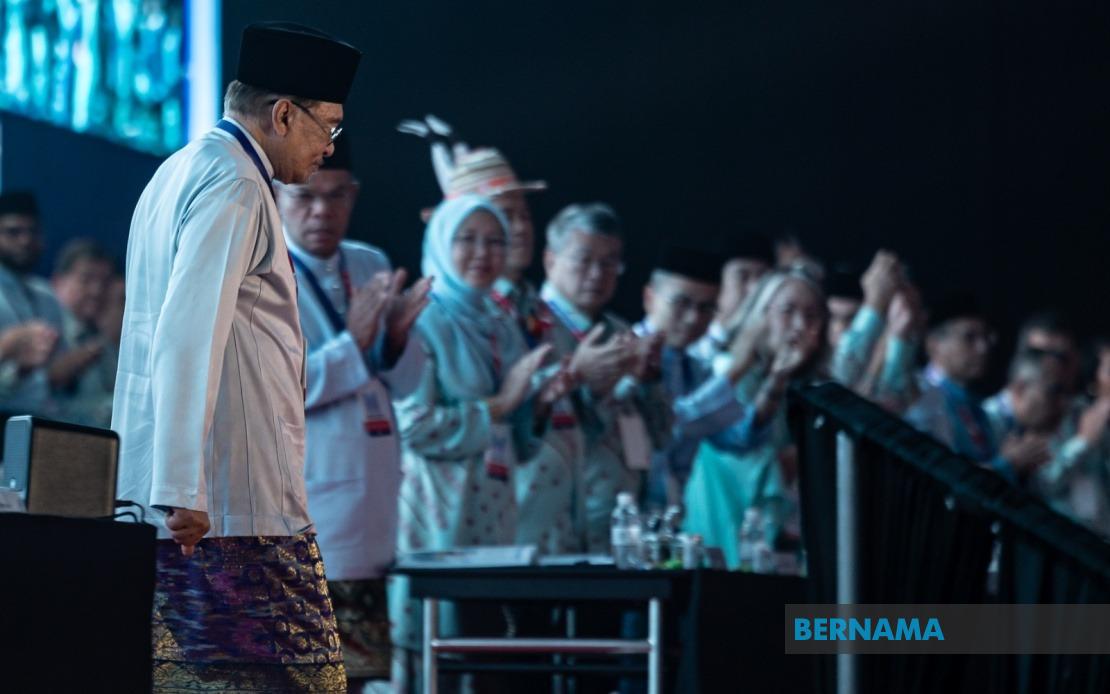
Prime Minister Datuk Seri Anwar Ibrahim has moved to counter assertions that the MADANI Government allocates federal resources unevenly across Malaysia's thirteen states and three federal territories. Speaking at the 2026 PKR National Congress held at the Melaka International Trade Centre (MITC) in Ayer Keroh on August 15, Anwar stressed that while state-by-state allocations naturally vary depending on assessed needs and development priorities, funding levels have risen consistently across the board during his tenure since assuming office.
To substantiate his position, the Prime Minister cited a series of specific budget figures spanning the past four years. He highlighted that Sabah's federal allocation has grown by 35 per cent, climbing from RM13 billion in 2022 to RM17.6 billion in 2026. Sarawak, meanwhile, has seen even more substantial growth, with its allocation rising by 48 per cent over the same period, from RM10.2 billion to RM15.1 billion. These figures demonstrate a clear upward trajectory in investment flowing to East Malaysia, where economic development and infrastructure expansion remain strategically important to the federal government's broader regional agenda.
Anwar also drew attention to increases benefiting peninsula-based states, particularly those that have sometimes featured in discussions about developmental disparities. Terengganu's allocation rose from RM6 billion in 2022 to RM8.1 billion this year, representing a significant boost to a state that has historically sought greater federal support for its economic transition and infrastructure modernisation. Johor, one of the nation's most economically significant states, has also received enhanced allocations, growing from RM10.2 billion in 2022 to RM14.6 billion in 2026, reflecting the government's commitment to supporting diverse economic corridors across Peninsular Malaysia.
The Prime Minister's remarks were framed within a broader defence of his administration's resource distribution philosophy. Anwar suggested that criticism of allegedly unequal allocations oversimplified the budgeting process, which necessarily reflects differing circumstances, population sizes, developmental stages, and infrastructure requirements across regions. He noted that states including Kedah, Kelantan, Perlis, and Johor have all experienced overall increases in their federal allocations, though he did not provide comprehensive comparative data for all jurisdictions during his speech.
Anwar's comments invite scrutiny into how federal funds are distributed and the criteria used to determine state-level allocations. While raw budget figures provide one lens through which to assess equity, analysts often examine allocations relative to population size, existing infrastructure deficits, and strategic development objectives. The varying percentage increases across states—from the 35 per cent growth in Sabah to the 48 per cent surge in Sarawak—suggest that prioritisation may follow different calculi for different regions, a reality that Anwar implicitly acknowledged while asserting the overall upward trend.
For Malaysian readers and observers, understanding federal budget distribution carries political weight. Regional disparities in development and investment have historically fuelled political tensions, particularly in states where economic opportunities remain concentrated or where populations perceive their regions receiving disproportionate neglect. Anwar's presentation of these figures appears designed to neutralise such grievances by demonstrating tangible commitment to raising investment across multiple states simultaneously.
The timing of these remarks at the PKR National Congress underscores their significance within party politics. PKR, as the dominant coalition partner within the MADANI government, has positioned itself as a defender of equitable development and inclusive governance. By publicly reaffirming that state allocations have risen broadly under his watch, Anwar seeks to reinforce the government's legitimacy and deflect criticism from both opposition voices and discontented constituencies within partner states.
However, the Prime Minister's rhetorical approach contains an implicit acknowledgment that questions about equitable resource distribution persist. The very fact that he deemed it necessary to deliver comprehensive budget comparisons during a major party address suggests ongoing scepticism or dissatisfaction regarding federal allocation fairness. His comment that state governments had not previously raised concerns about Sabah's budgetary position before his administration's tenure indicates an attempt to contrast his government's record with predecessors, though such historical comparisons require careful contextualisation.
From a Southeast Asian perspective, Malaysia's internal federal resource distribution carries implications beyond domestic politics. As the nation positions itself as a stable, economically diversified regional hub, perception of equitable development across all states strengthens its competitive standing. States with improved infrastructure and greater economic investment become more attractive to both domestic and foreign investors, potentially contributing to broader national competitiveness in the region.
Looking forward, the continued scrutiny of federal budget allocations suggests this will remain a recurring policy debate. Whether current allocation levels adequately address developmental gaps, and whether projected increases materialise as scheduled, will determine the credibility of Anwar's defence of his government's resource distribution record. The figures he cited span to 2026, placing claims about future allocations beyond the near term and requiring monitoring of actual expenditure against budgeted amounts.

