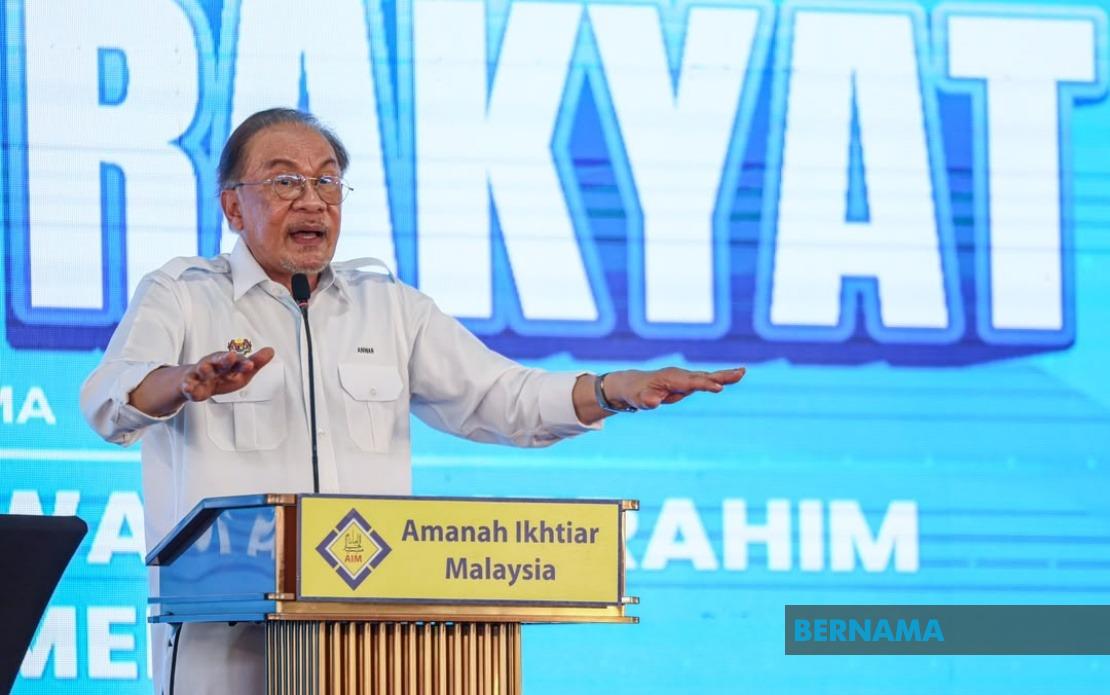
Prime Minister Datuk Seri Anwar Ibrahim has alleged that multiple political parties are orchestrating a combined campaign to unseat him, attributing their coordination to his administration's stringent anti-corruption measures and refusal to tolerate the abuse of public power. Speaking at a Pakatan Harapan gathering in Senggarang, Batu Pahat, during the ongoing Johor state election campaign, Anwar characterised the pressure as confirmation that his government's uncompromising approach has struck a nerve with those accustomed to exploiting their positions.
The Prime Minister's remarks underscore a central theme of PH's electoral messaging: that integrity and clean governance represent the ideological fault line separating the ruling coalition from its adversaries. By framing opposition coordination as a defensive response to his administration's crackdown, Anwar seeks to position his government as the guardian of public accountability while implying that competitors fear the loss of access to state resources and patronage networks that enabled enrichment and privilege.
Anwar's personal record on restraint became a focal point of his address, where he emphasised that despite numerous official visits to Johor throughout his tenure as Prime Minister, he has refrained from acquiring land, securing development projects, or accepting shares in the state. This rhetorical strategy serves multiple purposes: it establishes a moral benchmark against which voters might evaluate other leaders, it immunises him against accusations of corruption by establishing a precedent of demonstrated abstinence, and it tacitly suggests that political rivals have been less scrupulous in their conduct.
The emphasis on principled leadership reflects broader governance challenges within Malaysia's political ecosystem, where conflicts of interest and the blurring of public duty with personal advancement have historically undermined public confidence. By making transparency and self-restraint explicit governance values, Anwar attempts to differentiate his administration and appeal to voters fatigued by decades of patronage politics and resource misallocation that enriched connected elites while ordinary citizens struggled with affordability crises.
Central to PH's campaign narrative in Johor is the argument that state-level alignment with federal governance produces superior developmental outcomes and more effective welfare delivery. Anwar acknowledged that Johor, despite its wealth and the billions in ringgit invested in infrastructure projects, continues grappling with fundamental challenges including affordable housing shortages, deteriorating road networks, and insufficient support for religious institutions and vulnerable populations. This framing implicitly criticises the incumbent state administration for failing to translate economic resources into tangible improvements in living standards for ordinary residents.
The affordability crisis represents a particularly potent electoral vulnerability across Malaysia's wealthier states, where rapid development has often concentrated gains among property developers and corporate investors while pricing out young families and middle-income workers. Anwar's critique—that Johor remains a prosperous entity whose benefits accrue disproportionately to a narrow stratum—resonates with economic anxieties that transcend partisan lines and touch the material concerns of voters regardless of their political leanings.
Anwar also addressed inter-coalition sensitivities by publicly defending the participation of the Democratic Action Party (DAP) within his Cabinet and broader PH framework. Asserting that throughout his three-and-a-half year tenure, DAP ministers have never obstructed programmes benefiting Malays or Islam, he attempted to preempt a perennial attack vector used by opposition parties seeking to inflame communal anxieties about Chinese political influence and threats to Bumiputera interests. This defence becomes increasingly necessary as opposition coalitions leverage religious and ethnic polarisation as strategic counters to PH's governance record.
The turnout at the Senggarang gathering, which Anwar characterised as extraordinary given the intense heat, reflects grassroots mobilisation efforts that both major coalitions are conducting across Johor's 56 contested state seats. The visible enthusiasm of supporters willing to endure discomfort to hear PH messaging provides psychological reinforcement for campaign narratives about momentum and popular support, though electoral outcomes depend on voters' assessment of economic performance, service delivery, and credibility rather than emotional atmospherics at campaign events.
Johor's state election, scheduled for July 11 with early voting on July 7, presents a critical battleground for PH's broader national political positioning. As Malaysia's second-largest state by population and a traditional Barisan Nasional stronghold, a PH victory would signal erosion of opposition coalitions' traditional bases and validate the government's anti-corruption messaging as resonant with voters. Conversely, a defeat would undermine Anwar's claims of popular legitimacy and embolden the opposition's narrative that his administration faces mounting rejection.
The 172 candidates contesting 56 seats across various coalitions and independent candidacies suggest a fragmented political environment where vote-splitting could produce unexpected outcomes and marginalise traditional power brokers. Smaller parties and independent candidates increasingly compete for the protest vote or niche constituencies dissatisfied with both major coalitions, reflecting deeper fracturing of Malaysia's two-coalition system and the emergence of more complex voter preferences centred on competence, integrity, and delivery rather than institutional loyalty.
Anwar's anti-corruption campaign messaging resonates most powerfully among younger voters, urban professionals, and civil society constituencies that have historically placed governance quality and transparency above communal grievances or patronage considerations. However, securing victory in Johor requires assembling a coalition encompassing rural constituencies, Bumiputera-conscious voters, and communities dependent on government assistance—demographics that may prioritise different concerns and respond to different messaging strategies than those Anwar emphasised at the Senggarang event.
The broader context of Malaysian politics suggests that anti-corruption messaging, while universally acknowledged as important, competes against immediate material anxieties regarding employment, housing, education, and religious accommodation. Anwar's challenge involves demonstrating that his government's principled stance translates into concrete improvements in these domains, particularly in Johor, where state governance remains separate from federal structures despite ideological alignment. The election outcome will reveal whether voters prioritise the abstract commitment to clean governance or the tangible provision of services and economic opportunity.

