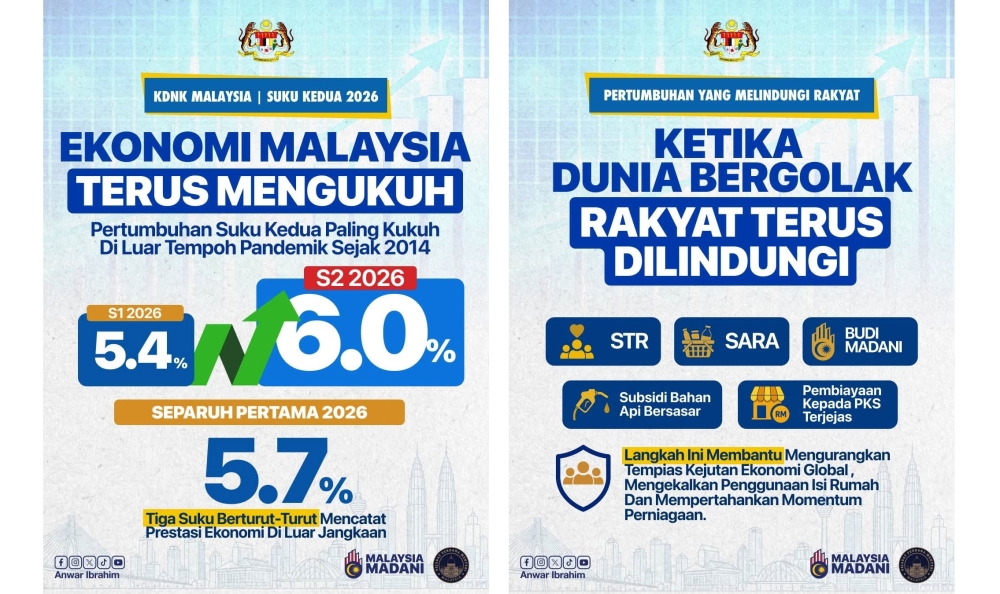
Prime Minister Datuk Seri Anwar Ibrahim has moved to celebrate Malaysia's stronger-than-anticipated economic performance in the second quarter, framing the expansion as evidence that the administration's approach to managing inflationary pressures has successfully buffered ordinary Malaysians from the worst global headwinds. Speaking on the heels of freshly released growth figures, the premier expressed confidence that the nation's economy is on a stable trajectory despite persistent challenges in the international environment.
The economic data released for the April-to-June period reveals expansion that surpassed initial forecasts, signalling resilience in key sectors and sustained consumer activity despite cost-of-living concerns that have preoccupied households across the region. This outperformance carries particular significance given that many Southeast Asian economies have struggled to maintain momentum while combating imported inflation stemming from supply chain disruptions and elevated commodity prices. Malaysia's ability to grow faster than anticipated suggests that underlying structural strength remains intact, even as policymakers face mounting pressure to deliver tangible improvements in household finances.
Anwar's remarks underscore a deliberate narrative strategy whereby the government seeks to position its interventions—ranging from targeted subsidies to price controls on essential goods—as instrumental in shielding the population from inflation imported through global markets. The administration has consistently argued that without such measures, Malaysian households would face substantially steeper increases in the cost of living. By highlighting the Q2 growth figures, the premier appears intent on demonstrating that protective policies need not come at the expense of broader economic momentum, a claim that appeals to constituencies anxious about both inflation and employment prospects.
The timing of Anwar's statements reflects broader political considerations. With inflation remaining a sensitive topic among voters, and purchasing power consistently ranking high in public concern surveys, the government has invested considerable effort in communicating the value of its defensive policies. However, critics have questioned the long-term sustainability of some price-control mechanisms and subsidy programmes, arguing that they distort market signals and may ultimately prove fiscally unsustainable without structural reforms to productivity and competitiveness. The premier's emphasis on growth performance suggests an attempt to demonstrate that such measures can coexist with healthy economic expansion.
Malaysia's growth trajectory also reflects the relative fortitude of its manufacturing and services sectors, which have maintained reasonable activity levels even as global trade volumes have fluctuated. Domestic consumption has provided important ballast, supported partly by labour market resilience and government transfer programmes that have helped sustain household spending power. The tourism sector's recovery has similarly contributed to overall output, as international visitor arrivals have rebounded from pandemic lows, bringing in foreign exchange and supporting employment in hospitality and related industries.
Yet the broader regional context complicates the government's narrative of success. While Malaysia's second-quarter growth exceeded expectations, many economists remain cautious about the sustainability of this pace given external uncertainties. Trade tensions, geopolitical instability affecting supply chains, and the possibility of further monetary tightening by advanced economies all pose risks to the outlook. For a country where exports represent a significant share of GDP, these external vulnerabilities cannot be easily dismissed, regardless of the robustness of current growth figures.
The question of how long government protection mechanisms can shield households without generating fiscal strain looms large over policy discussions. Malaysia's budget position has gradually improved from pandemic-era deficits, but further deterioration could constrain the government's capacity to maintain the same level of price support. Anwar's emphasis on growth, therefore, may also reflect hopes that stronger economic expansion will generate additional tax revenues and permit a gradual, less disruptive transition away from some extraordinary support measures.
For Southeast Asian observers and policymakers beyond Malaysia, the country's experience offers a useful case study in balancing social protection with macroeconomic prudence. The region faces similar inflation pressures and household cost-of-living anxieties, yet policy responses have varied considerably. Malaysia's approach—combining targeted interventions with emphasis on broad-based growth—sits somewhere between the more interventionist strategies adopted by some peers and the more market-oriented approaches favoured by others. Whether this middle path proves sustainable remains an open question.
Anwar's highlighting of Q2 performance also carries implications for investor confidence and the government's credibility with international financial markets. A growth narrative that emphasises resilience and effective policy management can help support the ringgit and Malaysia's standing in global capital flows. Conversely, if growth were to falter while inflationary pressures persist, the government's policy credibility could face testing. The premier's current optimism, therefore, rests partly on the assumption that the expansion showcased in Q2 figures will prove durable rather than merely a temporary bounce.
Moving ahead, the government faces the delicate task of maintaining growth momentum while gradually adjusting the scale of price support in ways that do not trigger immediate household hardship or political backlash. Anwar's messaging appears designed to lay the groundwork for this transition by emphasising that growth itself constitutes the ultimate protection for living standards. If the economy continues expanding at healthy rates, the government's argument goes, households will benefit from job creation, wage growth, and improved fiscal capacity to support targeted assistance for the most vulnerable. This framing positions economic expansion as the foundation upon which sustainable inclusive prosperity must ultimately rest.

