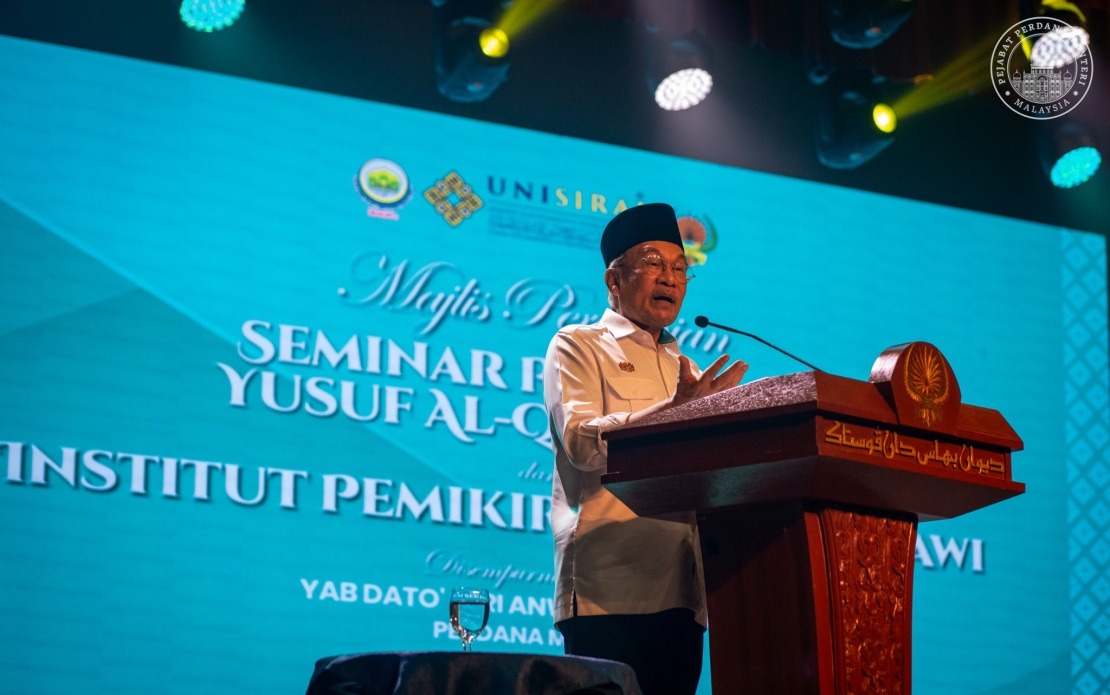
Prime Minister Datuk Seri Anwar Ibrahim has pledged RM2 million in government backing for the Al-Qaradawi Thought Institute, underscoring the MADANI administration's commitment to advancing Islamic scholarship and intellectual discourse in Malaysia. The announcement came during the inaugural ceremony of both the Yusuf Al-Qaradawi Thought Seminar and the establishment of the dedicated research institute at Wisma Dewan Bahasa dan Pustaka in Kuala Lumpur on July 21. This financial commitment signals the government's recognition of the enduring intellectual contributions of the late Islamic scholar Sheikh Dr Yusuf Al-Qaradawi to contemporary Islamic thinking across the Muslim world.
Anwar's personal connection to Al-Qaradawi runs deep, spanning decades of intellectual exchange and mutual regard. The Prime Minister shared his reflections on this relationship through a post on social media, expressing his profound debt to the scholar across multiple dimensions—philosophical ideas, spiritual encouragement, and a friendship grounded in genuine sincerity. Beyond mere ceremonial acknowledgment, Anwar's public testimonial reflects the substantial influence Al-Qaradawi exercised on a generation of Malaysian Islamic activists and intellectuals during formative periods of political and religious awakening in the nation.
The funding allocation demonstrates tangible government support for institutional research infrastructure dedicated to preserving and expanding scholarly understanding of Al-Qaradawi's prolific output and intellectual methodologies. By establishing a dedicated thought institute, Malaysia positions itself as a custodian of the scholar's legacy while creating an academic resource that future generations of Islamic thinkers and researchers can draw upon. The institute will focus on documenting, analyzing, and contextualizing Al-Qaradawi's contributions to Islamic jurisprudence, religious reform, and contemporary problem-solving within an Islamic framework.
Anwar's recollection of his early collaboration with Al-Qaradawi during his tenure with the Malaysian Islamic Youth Movement (ABIM) provides crucial historical context for understanding the scholar's influence on Malaysian Islamic thought. During the 1970s and 1980s, when ABIM emerged as a dynamic force in Malaysia's Islamic resurgence, Al-Qaradawi played an advisory role in shaping the movement's intellectual direction. This mentorship proved instrumental in determining ABIM's organizational trajectory and ideological orientation during a pivotal moment in Malaysia's modern history.
Central to Al-Qaradawi's counsel to ABIM was his advocacy for wasatiyyah, or moderate centrism, as an antidote to what he perceived as rigidity in Islamic thought. During the early 1980s, a period of heightened religious fervor and ideological polarization, Al-Qaradawi transmitted a treatise to ABIM's leadership urging the movement to eschew hardline positions and instead embrace intellectual flexibility. His counsel against doctrinal inflexibility encouraged ABIM to remain receptive to diverse perspectives and to engage constructively with viewpoints that diverged from its own, even while maintaining core Islamic principles.
Anwar characterizes Al-Qaradawi as a transformative intellectual force—a zeitgeist embodying the spirit of his era who consistently demonstrated openness to new ideas while pursuing meaningful reform. This characterization extends beyond mere scholastic achievement; it positions Al-Qaradawi as an agent actively shaping how Islamic communities understood and responded to the challenges of their time. Rather than retreating into historical precedent or rejecting modernity outright, Al-Qaradawi modeled an approach that engaged contemporary realities through Islamic intellectual resources.
The timing of this institute's establishment and the government's financial commitment carry significance for Malaysia's current political trajectory. As the MADANI administration emphasizes inclusive governance and moderate Islam, the decision to institutionalize Al-Qaradawi's thought resonates with broader policy directions. The backing signals official endorsement of intellectual traditions emphasizing balance, reasoned engagement with pluralism, and reform-oriented Islamic scholarship—approaches that align with the government's stated development philosophy.
For the broader Southeast Asian context, Malaysia's investment in preserving and advancing Al-Qaradawi's intellectual legacy assumes regional importance. As other Muslim-majority nations in the region grapple with questions of religious identity, modernization, and social cohesion, the availability of rigorous scholarship on moderate Islamic thought provides valuable reference points. An institute dedicated to this purpose could establish Malaysia as a regional center for serious Islamic intellectual engagement, potentially attracting scholars and students from across ASEAN and beyond.
The RM2 million allocation, while modest in absolute terms, carries symbolic weight in signaling governmental priorities. Educational and research investments constitute long-term institutional commitments rather than ephemeral political gestures. This funding enables the institute to develop permanent research capacity, maintain archives, publish scholarly works, and convene academic conferences that advance understanding of Islamic thought within multicultural contexts. Over time, such infrastructure investments yield intellectual returns that shape how communities understand their religious traditions and navigate contemporary challenges.
Anwar's public emphasis on Al-Qaradawi's historical advice against "closed-off" modes of thinking and his stress on receptivity to differing viewpoints carries contemporary relevance amid global polarization. By highlighting these aspects of Al-Qaradawi's legacy, the Prime Minister implicitly advocates for intellectual approaches that resist sectarianism, encourage cross-ideological dialogue, and frame Islam as compatible with pluralistic societies. This positioning matters for Malaysia, a nation navigating complex intercommunal dynamics and seeking models of religious identity that permit both authentic Islamic commitment and inclusive citizenship.
The institute's establishment also reflects recognition that Islamic scholarship constitutes a legitimate and necessary domain of public investment, comparable to investments in secular intellectual endeavors. By treating Islamic thought as worthy of institutional support and rigorous academic study, the government elevates religious learning from purely devotional or clerical domains into the realm of serious intellectual inquiry. This approach potentially attracts accomplished scholars to Islamic studies while establishing higher standards for religious discourse across society.
Moving forward, the Al-Qaradawi Thought Institute faces the challenge of translating government support into substantive scholarly contributions that resonate beyond Malaysian borders. Success requires recruiting capable researchers, establishing publication outlets, and creating platforms for intellectual exchange that elevate the quality of Islamic thought globally. The institute's effectiveness will be measured not merely by its institutional longevity but by its capacity to generate insights that inform how Muslim communities approach contemporary questions of faith, governance, and social organization.

