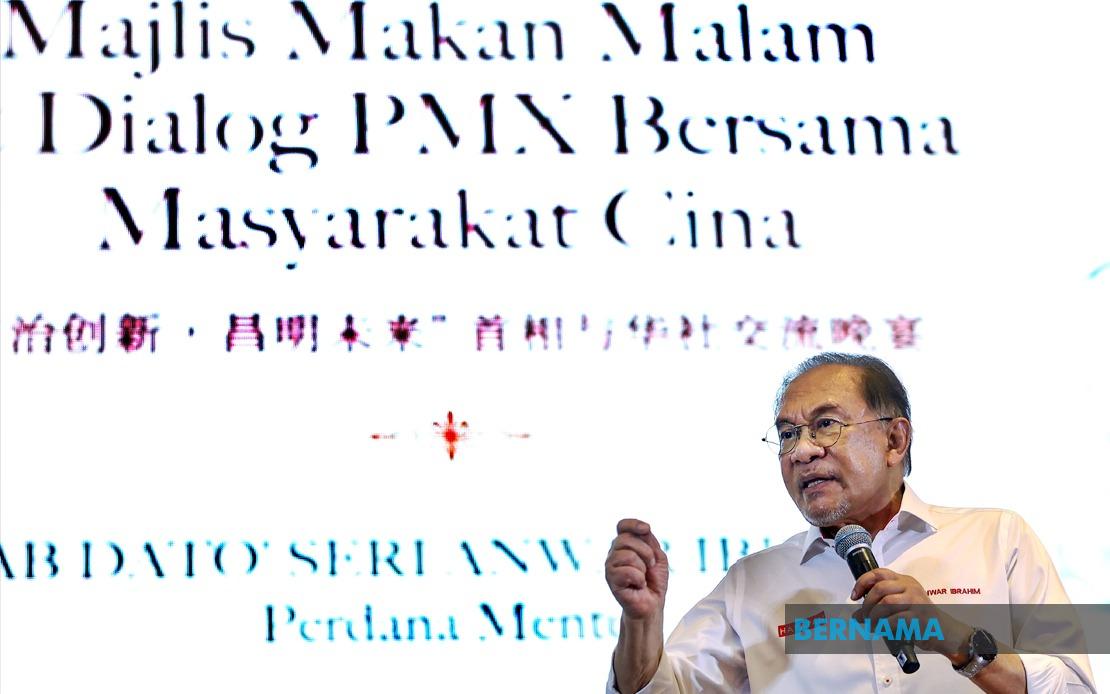
Prime Minister Datuk Seri Anwar Ibrahim reinforced his determination to guide Malaysia towards sustained growth and national achievement during an engagement with the Chinese community in Johor Bahru on July 4. The occasion provided him an opportunity to articulate his broader vision for the country and the values that will define his tenure in office.
Central to Anwar's message was the principle of inclusive leadership that transcends communal divisions. Speaking candidly to his audience, he underscored that his approach to governance prioritises connecting with all segments of Malaysian society, rejecting any notion that leadership should operate within ethnic or religious confines. This emphasis on bridging communities reflects a governing philosophy rooted in the conviction that national progress depends on genuine social cohesion and mutual respect among Malaysians of different backgrounds.
At this stage of his political career, the Prime Minister identified his primary objective as establishing a leadership legacy grounded in three pillars: fairness, cleanliness, and dedicated public service. These principles, he suggested, represent not merely abstract ideals but practical commitments that should shape daily governance and policy decisions affecting ordinary Malaysians. The invocation of clean leadership carries particular resonance in the Malaysian context, where concerns about transparency and accountability in public institutions have long shaped public discourse and electoral outcomes.
Anwar's reflections on his age and mortality introduced a personal dimension to his political messaging. By acknowledging that retirement lies ahead, he framed his current responsibilities through an explicitly legacy-conscious lens. This temporal perspective lends weight to his articulated priorities, suggesting that his focus on establishing lasting institutional and ethical standards stems from genuine conviction rather than rhetorical positioning. The acknowledgment of human finitude and succession planning also signals thoughtfulness about Malaysia's longer-term institutional health beyond any individual leader's tenure.
The Prime Minister elaborated on his governing philosophy by asserting that every citizen deserves equal consideration and respect from their elected representatives. This statement carries particular importance in a pluralistic democracy where competing community interests often dominate political discourse. By positioning universal service as a non-negotiable aspect of his role, Anwar attempted to elevate governance beyond transactional politics and communal patronage networks that have historically characterised Malaysian political practice.
Anwar's desire to be remembered as a leader who genuinely loved the Malaysian people and cultivated reciprocal affection represents an appeal to emotional resonance alongside substantive governance. This formulation suggests that political legitimacy derives not solely from policy outcomes but from authentic connection between leaders and constituents. The mutual expression of care—leaders demonstrating love for people, who in turn reciprocate that sentiment—implies a conception of governance built on human relationships rather than administrative machinery alone.
His call for Malaysians to collectively safeguard the nation as a shared possession transcends partisan or communal ownership claims. By invoking stewardship language and emphasising collective responsibility, Anwar proposed a unifying framework for national development. This approach suggests that Malaysia's challenges require consensus and collaborative problem-solving rather than zero-sum competition between different communities, a proposition that challenges conventional Malaysian political patterns but aligns with global trends toward inclusive governance models.
The presence of PKR Vice President and Selangor Menteri Besar Datuk Seri Amirudin Shari at the event underscored institutional continuity within the ruling coalition, situating Anwar's leadership philosophy within a broader political structure. Amirudin's attendance signalled PKR's alignment with the Prime Minister's stated vision while demonstrating intergovernmental coordination between federal and state levels of governance.
For Malaysian readers observing their nation's political trajectory, Anwar's remarks merit examination as indicators of governance priorities and leadership values likely to shape policy directions in coming years. The emphasis on clean administration, fair resource distribution, and cross-communal engagement speaks to persistent public concerns about government effectiveness and integrity. Whether these articulated commitments translate into concrete institutional reforms, measurable accountability improvements, and tangible policies benefiting all communities remains the crucial question that will ultimately define whether Anwar's legacy materialises as envisioned or becomes another iteration of aspiration without fulfilment.

