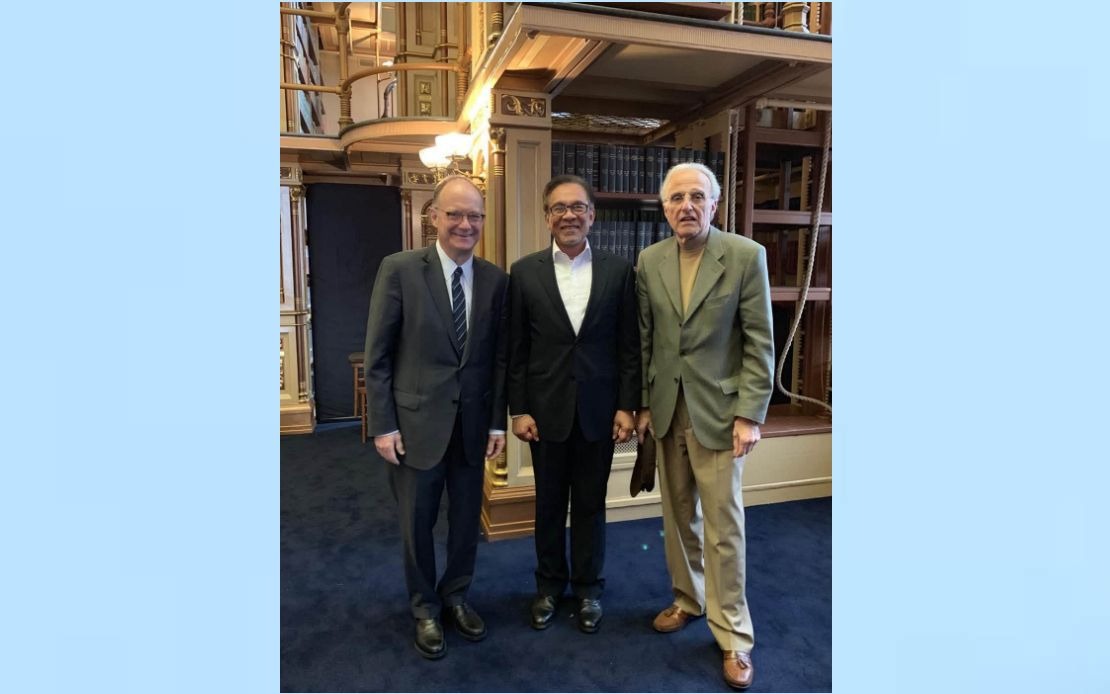
Prime Minister Datuk Seri Anwar Ibrahim has expressed his deepest condolences following the death of Professor John L. Esposito, widely recognised as one of the most influential scholars of Islam in the Western academic world. In a statement shared on social media, Anwar reflected on a friendship spanning more than half a century, with their connection tracing back to the early 1970s when they first encountered one another.
Esposito's legacy extends far beyond conventional academic boundaries. Throughout his career, he worked deliberately to dismantle stereotypes and misrepresentations of Islam that had become entrenched in Western discourse. His scholarly approach combined rigorous intellectual inquiry with an genuine commitment to fostering mutual understanding, distinguishing him from more polemical voices in the field. Anwar characterised him as someone who "built bridges where others were content to build civilisational barriers," capturing the essence of Esposito's life mission during an era marked by profound religious tensions.
The Georgetown University academic established himself as a pivotal figure through founding the Centre for Muslim-Christian Understanding, an institution that became instrumental in shaping interfaith dialogue at a crucial historical moment. Beyond institutional contributions, Esposito authored and co-authored numerous works that shaped how millions of readers globally comprehended Islamic thought and practice. His book "Makers of Contemporary Islam" remains a foundational text in Islamic studies curricula worldwide, providing students with sophisticated frameworks for understanding modern Muslim societies and intellectual movements.
Following the September 11 attacks, when anti-Muslim sentiment surged across Western societies and crude generalisations about Islam proliferated in mainstream media, Esposito's work became particularly vital. His accessible yet academically rigorous publications, including "What Everyone Needs to Know About Islam" and "Who Speaks for Islam?", reached audiences far beyond university lecture halls. These works deliberately countered simplistic narratives by grounding public discourse in evidence-based scholarship, demonstrating that nuanced Islamic understanding could still reach general readers without sacrificing intellectual integrity.
Anwar's personal recollection reveals dimensions of Esposito's character often absent from academic obituaries. The Prime Minister recalled valuing not merely Esposito's intellectual contributions but his wisdom, counsel, and unwavering loyalty across five decades of friendship. This relationship represents something deeper than professional collegial networks; it reflects a genuine human connection that transcended the vicissitudes of their respective careers and the dramatic transformations in global geopolitics that unfolded around them.
Esposito's contributions to Muslim-Christian dialogue carry particular significance for Malaysia and Southeast Asia. As a region home to substantial Muslim and Christian populations living in relative harmony, Malaysia's experience of interfaith coexistence often contrasts with the polarisation and mutual suspicion prevalent in Western contexts. Yet the intellectual frameworks and practical approaches Esposito championed remain relevant to Southeast Asian societies navigating their own religious complexities in an increasingly globalised world. His work demonstrated that genuine scholarship could bridge divides without compromising theological positions or intellectual honesty.
Anwar emphasised that Esposito distinguished himself through his generosity of spirit in both private conversation and public writing. This characterisation suggests that his influence extended through formal publications and personal mentorship, conversations, and relationships with countless scholars, policymakers, and community leaders. Such personal connections often prove more transformative than citations in academic databases, yet remain largely invisible in formal tributes.
The passing of figures like Esposito raises important questions for Malaysian society about the state of interfaith scholarship and dialogue. While Malaysia boasts its own traditions of Islamic learning and religious pluralism, the region has benefited considerably from Western scholars willing to challenge Orientalist and Islamophobic assumptions. Esposito's work implicitly argued that understanding Islam authentically required rejecting both hostile caricatures and romanticised idealisations, instead engaging with Muslim thought and experience on its own terms.
In his tribute, Anwar extended formal condolences to Esposito's wife Jean and to his extended family, colleagues, and students scattered across academic institutions worldwide. This gesture acknowledges the ripple effects of Esposito's life—the generations of scholars he trained, the countless readers whose perspectives he shaped, and the institutions he helped establish. His influence will continue through these channels long after his passing, as his published work remains in circulation and his students carry forward his methodologies and commitments to interfaith understanding.
The Prime Minister concluded his statement with a prayer that Esposito's scholarly legacy and the dialogue he devoted his life to cultivating would continue bearing fruit. This phrasing reflects recognition that intellectual and spiritual legacies outlive their originators, becoming living traditions carried forward by others. Anwar's description of Esposito as "a true friend to the Muslim world" captures an essential truth: Esposito approached Islamic studies not as a detached observer but as someone genuinely committed to the dignity, complexity, and intellectual vitality of Muslim communities and their traditions. His death represents a genuine loss for anyone committed to building understanding across religious and cultural boundaries.

