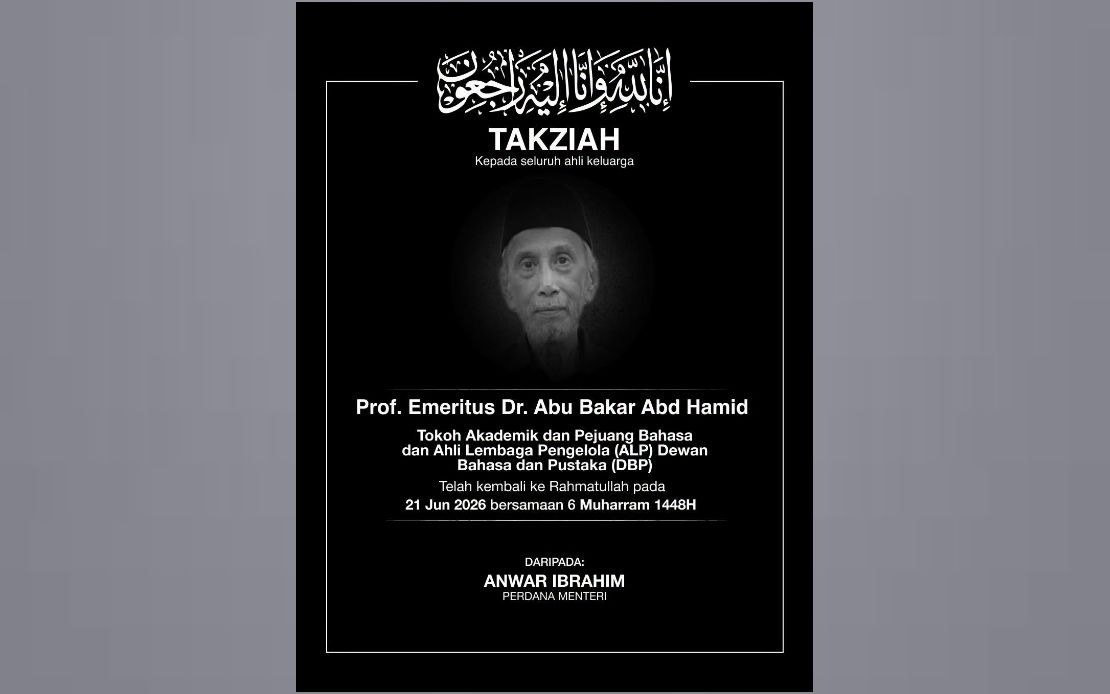
Prime Minister Datuk Seri Anwar Ibrahim has mourned the passing of Professor Emeritus Datuk Abu Bakar Abd Hamid, one of Malaysia's most significant contributors to Malay literary scholarship and academic institution-building. The renowned academic, who passed away last Sunday evening, was remembered by the Prime Minister through a Facebook tribute that highlighted both his intellectual legacy and the profound personal bond they shared as teacher and student.
In his statement, Anwar described Abu Bakar as a towering figure whose influence extended across multiple domains of Malaysian public life and culture. Beyond his direct contributions to literature itself, Abu Bakar played a foundational role in establishing some of the nation's most important higher education institutions. His involvement in creating Universiti Kebangsaan Malaysia during the formative year of 1968 positioned him as an architect of Malaysia's modern university system, a responsibility he undertook as joint secretary of the establishment committee at a critical juncture in the country's educational development.
The circumstances of Abu Bakar's death underscore the sudden nature of loss that can befall even the most accomplished figures. The 73-year-old Johorean suffered an unexpected respiratory emergency on the evening of June 21, collapsing at his residence in Petaling Jaya, Selangor, around 10:30pm. For a man whose entire life had been characterized by intellectual vigour and productive engagement with knowledge, the sudden physical crisis marked a poignant end to a remarkable career.
Anwar's reflection on his former mentor revealed the depth of emotional connection that transcended the formal academic hierarchy. He emphasized that the affection and respect Abu Bakar inspired stemmed not merely from his position as an educator, but from his authentic passion for intellectual pursuit and his genuine commitment to elevating those around him. This quality—the ability to kindle enthusiasm for knowledge in others—represents perhaps the most enduring legacy of any academic figure, one that often proves more influential than any single publication or institutional achievement.
Throughout his career, Abu Bakar accumulated numerous accolades that reflected the breadth and significance of his contributions. His appointment as Universiti Malaya's deputy vice-chancellor in 1987 represented formal institutional recognition of his scholarly standing and administrative capability. During the mid-to-late 1990s, he served as chairman of the Board of Governors of Bernama, the Malaysian National News Agency, from 1996 to 2000, a position that expanded his influence into the sphere of public information and national media governance during a transformative period for Malaysian journalism.
The literary community's recognition of Abu Bakar extended to numerous prestigious awards bestowed over many decades, each acknowledging specific achievements or lifetime contributions to Malay language and literature. These honours represented both peer acknowledgment and institutional respect for someone who had dedicated his existence to preserving, advancing, and intellectually enriching Malaysia's literary heritage at a time when such scholarship was essential for affirming national cultural identity.
Abu Bakar's role in the founding of UKM deserves particular emphasis for contemporary readers seeking to understand Malaysia's institutional landscape. The establishment of a university devoted specifically to Malay language, literature, and culture represented a deliberate national choice to create dedicated space for the systematic study and promotion of Malay civilization. As one of the architects of this institution, Abu Bakar helped shape an organization that has remained central to Malaysian intellectual life for more than five decades, training generations of scholars, authors, educators, and public figures.
The Prime Minister's personal connection to Abu Bakar—rooted in the teacher-student relationship—illustrates how Malaysia's intellectual leadership often develops through direct mentorship and personal transmission of scholarly values. Anwar's own trajectory from student to prominent public figure may well owe significant debt to the intellectual formation he received under Abu Bakar's guidance, a common pattern in academic tradition where formative influences shape lifelong perspectives and commitments.
For the broader Malaysian literary and academic community, Abu Bakar's death represents the loss of a living link to several foundational periods in modern Malaysian institutional and cultural history. He witnessed and actively shaped the transition from colonial to independent Malaysia, the establishment of a national higher education system, and the development of modern Malay literary studies as a rigorous scholarly discipline. His passing marks the end of an era in which such figures could directly guide institutional development through both intellectual and administrative roles.
The funeral proceedings, with Abu Bakar's committal at Bukit Kiara Muslim Cemetery on Monday, concluded the formal ceremonial aspects of his departure. However, his intellectual contributions—visible in curricula he helped design, scholars he mentored, literary traditions he preserved and advanced, and institutions he helped establish—will continue shaping Malaysian academia and culture for generations to come. The Prime Minister's public expression of grief acknowledged not only personal loss but also the community's broader debt to someone who invested his considerable talents in nation-building through cultural and educational work.