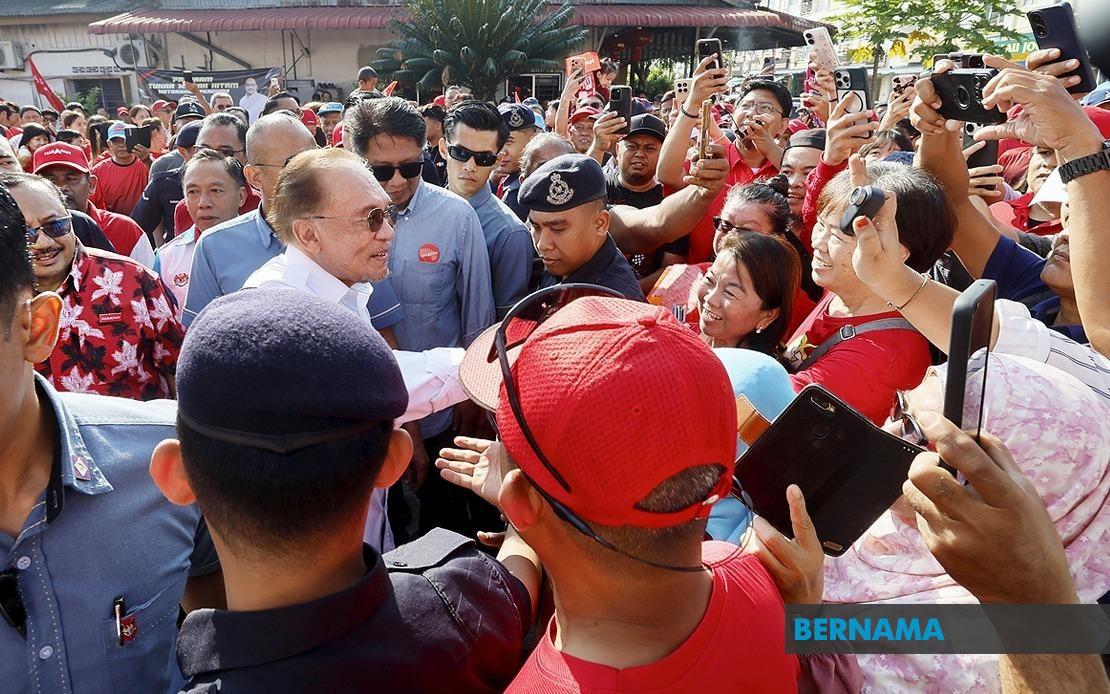
Prime Minister Datuk Seri Anwar Ibrahim took time out of his campaign schedule to personally meet an elderly couple whose determination to greet him had touched hearts across Malaysia. The reunion took place in Senggarang, Johor, where Abdul Razak Pelangga, 86, and his wife Jamilah Samsudin, 64, were brought together with the Prime Minister during the "Yok! Meriahkan Johor! Undi Harapan" programme on Tuesday.
The couple's initial encounter with Anwar had unfolded the previous Sunday when Abdul Razak pedalled his trishaw for nearly a kilometre through the streets of Senggarang to fulfil his wife's wish of meeting the Prime Minister during a breakfast stop. The heartwarming scene quickly spread across social media and news outlets, resonating with Malaysians touched by the couple's devotion and humble determination. What began as a simple desire to pay respects to the country's leader transformed into a moment that captured the essence of grassroots support and human connection.
When the Prime Minister greeted the couple at the Senggarang event, he shared light-hearted exchanges with Abdul Razak, playfully commenting on the octogenarian's pedalling prowess. The informal interaction revealed Anwar's willingness to engage personally with ordinary citizens, moving beyond formal protocol to acknowledge the couple's genuine affection and sacrifice. He took the opportunity to express gratitude for their steadfast support, a sentiment that extended beyond mere political backing to recognise the symbolic significance of their actions.
The gathering formed part of a broader campaign push in the run-up to the 16th Johor State Election, scheduled for Saturday of that week. Anwar's appearance underscored the Pakatan Harapan coalition's efforts to mobilise support across the southern state, a politically significant region where electoral performance carries implications for national politics. The presence of senior party figures at the event highlighted the importance placed on Johor, Malaysia's second-most populous state and a crucial battleground in the country's political landscape.
Among those accompanying the Prime Minister was Datuk Fahmi Fadzil, the Pakatan Harapan Communications director and Minister of Communications, whose attendance signalled the party's commitment to managing its narrative during the critical election period. The programme also featured campaign appearances from Pakatan Harapan candidates contesting for three Johor state seats: Onn Abu Bakar in Senggarang, Mohd Khuzzan Abu Bakar in Semerah, and Felicia Poh Rui Ling in Penggaram. These candidates represented the coalition's diverse slate of nominees seeking to capture voter support across different constituencies.
The reunion with Abdul Razak and Jamilah illustrated the emotional dimension of electoral politics, where personal stories and human interest narratives often prove as influential as policy platforms and partisan messaging. In an age of digital connectivity and social media amplification, the couple's viral moment transformed them into informal ambassadors for grassroots political engagement. Their willingness to undertake physical effort to meet a political leader, regardless of partisan affiliation, resonated with voters seeking authenticity and genuine connection in their representatives.
The timing of this follow-up meeting, during active campaigning just days before the state election, demonstrated strategic political awareness. By personally acknowledging the couple who had already gained public prominence, Anwar reinforced the Pakatan Harapan narrative of a leadership that values ordinary citizens and maintains accessibility to the electorate. Such symbolic gestures, while seemingly informal, carry weight in shaping public perception of political leaders and their commitment to constituent concerns.
For Malaysian observers, the episode reflected broader patterns in contemporary Asian politics where leaders increasingly seek to project approachability and connection with voters through carefully orchestrated yet genuine-seeming personal interactions. The couple's story transcended partisan divisions, appealing to universal values of determination, family devotion, and civic participation. Abdul Razak's willingness to pedal his trishaw across town embodied a form of democratic engagement that predated modern electoral machinery, rooted instead in personal conviction and simple respect.
As voters prepared for the Johor state election, such moments contributed to the broader campaign atmosphere, shaping perceptions of which coalition possessed greater authenticity and connection to ordinary Malaysians. The Pakatan Harapan coalition's strategy of highlighting the reunion positioned the party as responsive to grassroots sentiment and genuinely invested in acknowledging citizen initiative. This calculated yet sincere engagement illustrated how modern political campaigns navigate the intersection of strategy and authenticity, leveraging human interest stories to reinforce broader political messaging about representation and inclusivity.

