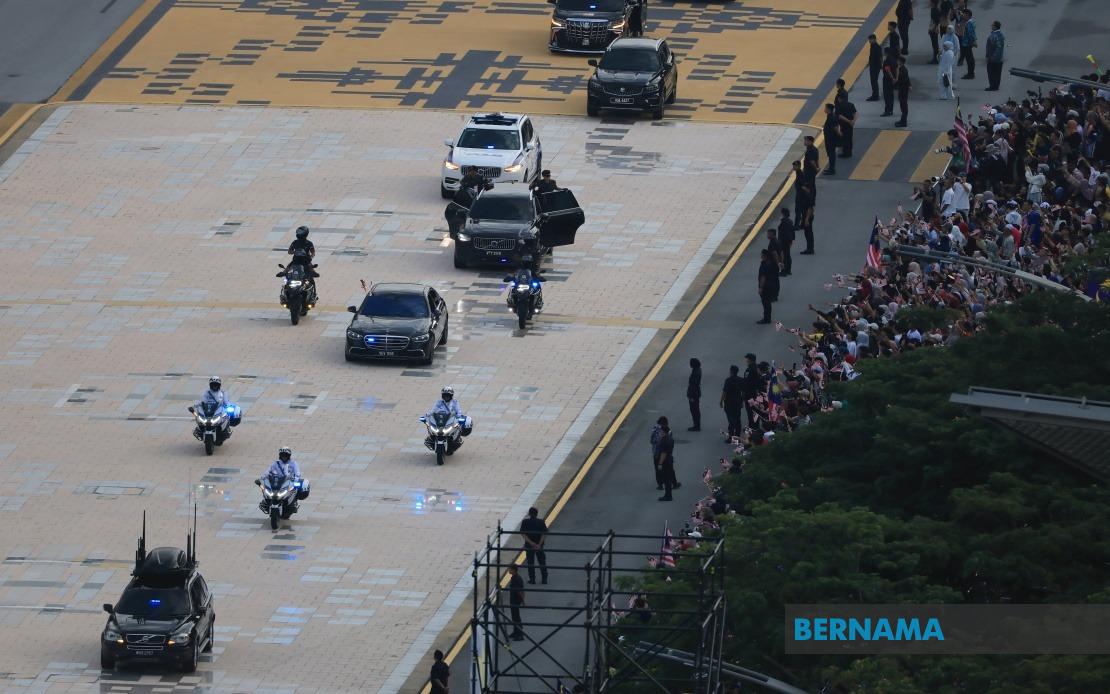
Malaysia's 69th National Day unfolded at Dataran Putrajaya on August 31 with Prime Minister Datuk Seri Anwar Ibrahim and his Cabinet team leading celebrations that drew tens of thousands of citizens and foreign dignitaries to the capital's ceremonial precinct. The scale and significance of the gathering underscored the government's commitment to renewing national pride and cohesion following a turbulent political period.
Anwar, who holds the dual portfolio of Prime Minister and Finance Minister, arrived at the royal stage at 7.53 am alongside his wife Datuk Seri Dr Wan Azizah Wan Ismail, as the traditional Hormat Perdana song provided the ceremonial backdrop. The timing and orchestration of the senior leadership's arrival reflected the structured formality expected at Malaysia's pre-eminent civic occasion. Deputy Prime Minister Datuk Seri Dr Ahmad Zahid Hamidi had preceded them, reaching Dataran Putrajaya at 7.45 am to oversee final arrangements.
The Cabinet's full representation at the event demonstrated ministerial unity around the government's development agenda. Alongside Anwar stood Communications Minister Datuk Seri Fahmi Fadzil, who chairs the main organising committee for the 2026 National Day and Malaysia Day celebrations, signalling continuity in planning for Malaysia's future commemorative milestones. Home Minister Datuk Seri Saifuddin Nasution Ismail and Defence Minister Datuk Seri Mohamed Khaled Nordin also graced the occasion, their presence reflecting the security and administrative dimensions essential to national celebrations.
This year's National Day carried the thematic banner "Malaysia MADANI: Kesejahteraan Dinikmati"—a frame emphasising shared prosperity and national civilisational values. The choice of theme resonates with the government's broader messaging around inclusive development and social cohesion, positioning the celebration as more than ceremonial pageantry but rather a statement of national direction and shared identity.
The logistical scope of the celebration was extraordinary by any standard. Organisers mobilised 10,819 participants drawn from 76 separate contingents, reflecting the breadth of Malaysian society participating in national commemoration. Twenty-two marching bands provided musical accompaniment throughout the programme, while eleven specially decorated vehicles processed through the ceremonial route. The deployment of 328 assets spanning land, sea, and air components showcased Malaysia's security and defence apparatus, underscoring the connection between national celebration and national strength.
The incorporation of 112 working animals and 22 electric vehicle assets into the parade reflected evolving approaches to national pageantry that balance tradition with environmental consciousness and modern technology. This fusion of heritage and innovation aligns with Malaysia MADANI's positioning as a forward-looking developmental paradigm.
Diplomatic representation extended the celebration beyond domestic audiences. Foreign delegates attended the festivities, providing an international dimension to Malaysia's self-presentation at a time when the nation seeks to reinvigorate its regional leadership credentials. The presence of external observers added ceremonial weight and conveyed Malaysia's openness and confidence in engaging the global community.
Deputy ministers and various government dignitaries populated the official attendance roster, ensuring comprehensive representation across government hierarchies. Their participation reinforced the whole-of-government nature of National Day observance, signalling to citizens that national celebration commands commitment across all administrative levels.
National Day celebrations in Malaysia carry particular significance as markers of national resilience and unity. The August 31 occasion commemorates the nation's independence declaration in 1957, making it fundamentally tied to Malaysian identity and sovereignty. Hosting such elaborate ceremonies at Dataran Putrajaya—the administrative heart of government—anchors the celebration firmly within the institutions and structures of state, reinforcing the legitimacy and permanence of the nation-state.
For Malaysian readers, particularly those engaged in civic and political life, the scale and ministerial participation in this year's celebrations conveyed several messages: government stability despite recent political transitions, commitment to forward-looking development under the Malaysia MADANI banner, and confidence in national direction. The comprehensive participation by defence and security apparatus, meanwhile, communicated consistent attention to territorial integrity and social order.
The event also served as a capstone moment for Anwar's government in its first year of consolidated authority. His prominent positioning at the celebration—arriving with ceremonial fanfare and flanked by senior colleagues—marked the government's consolidation and offered symbolic reassurance regarding political continuity and institutional strength during a period when Malaysia has experienced considerable political flux.
For the broader Southeast Asian region, Malaysia's National Day remains a significant point of reference. The celebration demonstrates continuity in Malaysian governance and commitment to national commemoration despite internal political realignments, suggesting stability for regional partners and investors seeking predictability in the country's institutional and political life.
The 2026 National Day and Malaysia Day planning already underway, with Communications Minister Fahmi at the helm of organising committees, indicates the government's intent to make future commemorations even more spectacular and inclusive. This forward-planning signals confidence in sustained political stability and budgetary capacity to invest in nation-building ceremonies.

