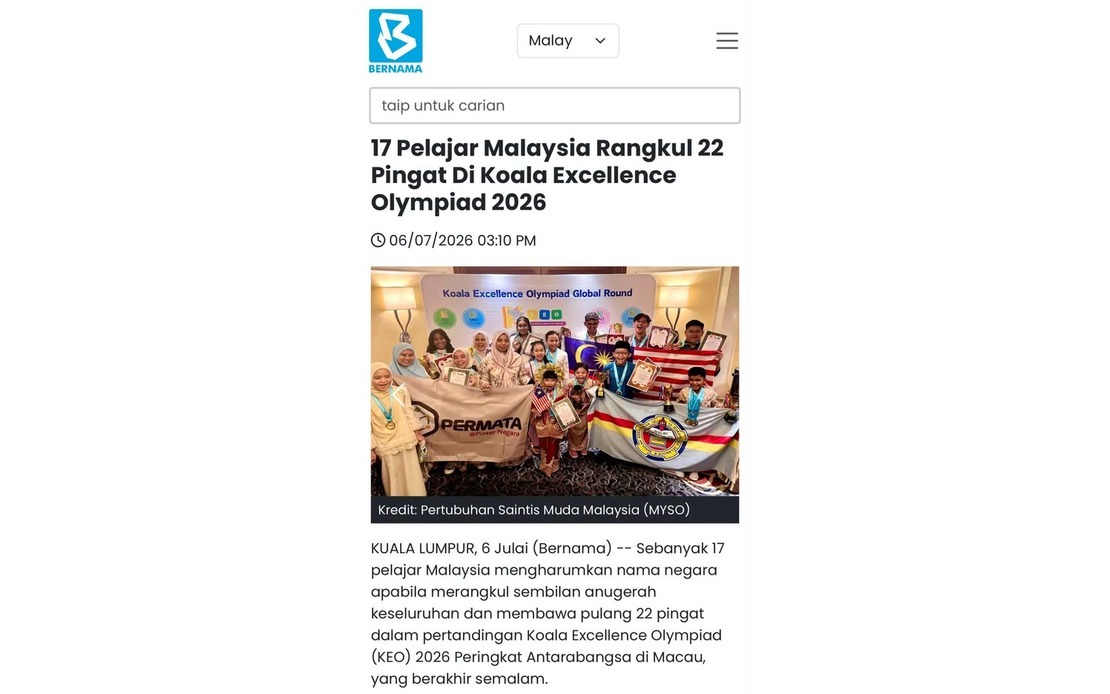
Prime Minister Datuk Seri Anwar Ibrahim has extended his congratulations to a contingent of 17 Malaysian students following their commendable results at the 2016 Koala Excellence Olympiad (KEO) Global Finals held in Macau. The event concluded this week with Malaysia's young scholars capturing an impressive haul of medals across multiple competitive categories, reflecting the nation's commitment to nurturing academic talent and excellence at the international level.
Through a message posted on social media platform X, the Prime Minister acknowledged the students' accomplishments and encouraged them to maintain their pursuit of excellence. His statement underscored the government's recognition of youth achievement in academic competitions and the importance placed on developing Malaysia's intellectual capital through participation in global forums.
According to Aidah Misran, the coordinator of the Malaysia Young Scientists Organisation (MYSO) and head of the Malaysian delegation sent to Macau, the contingent achieved a total medal count of 22 across three categories. The breakdown of their success included five gold medals, six silver medals, and eleven bronze medals, demonstrating balanced performance across the various competition formats. These results came with the team also securing nine overall awards, indicating recognition beyond individual medal achievements.
The KEO competition represents a significant platform for international academic competition, bringing together students from multiple nations to test their abilities across four distinct disciplines: English, Mathematics, Science, and Arts. This multi-subject approach ensures that participating students can showcase their talents across a broad spectrum of academic knowledge, rather than focusing on a single specialized field. The international nature of the competition means Malaysian students gain exposure to educational standards and approaches from peers around the world, facilitating cultural exchange and intellectual development.
The Koala Excellence Olympiad itself was established by a consortium of Australian educational specialists and alumni who sought to create a comprehensive competition platform covering the four core academic disciplines. Since its inception, KEO has grown into a recognized international event that attracts competitors from various countries, each seeking to demonstrate their nation's educational strengths. The platform represents a modern approach to academic competition, moving beyond traditional single-subject olympiads to encompass a holistic assessment of student capabilities.
In Malaysia, the competition is coordinated by the Malaysia Young Scientists Organisation in partnership with KEO and the Miss Man International Group. This collaborative arrangement has enabled local students to access participation opportunities in a major international academic forum. The coordination by MYSO reflects the organization's broader mission of fostering scientific literacy and academic excellence among Malaysian youth, extending beyond traditional science competitions to encompass the wider sphere of intellectual development.
The success of Malaysian students at KEO 2026 carries particular significance for the region. Southeast Asia has been increasingly emphasizing STEM and academic excellence as key components of national development strategies. Malaysia's strong showing demonstrates the caliber of talent being cultivated within the country's educational system and the capacity of Malaysian youth to compete effectively on international stages. Such achievements serve to elevate the region's profile in global academic competitions and inspire other students to pursue similar avenues for intellectual growth.
The participation of Malaysian students in international olympiads provides valuable benefits beyond medal accumulation. Exposure to standardized international assessments allows both individual students and educational policymakers to gauge how Malaysian educational standards compare with global benchmarks. Furthermore, the international networking opportunities created through such competitions can establish connections that benefit students throughout their academic and professional careers.
The government's public acknowledgment of these achievements, through the Prime Minister's statement, signals an institutional commitment to recognizing and supporting youth participation in academic competitions. Such recognition can have multiplier effects, encouraging other students to engage in similar pursuits and prompting educational institutions to invest resources in preparing competitive teams. The visibility generated by official commendation can also help sustain interest and funding for programs that develop young academic talent.
For Malaysian families and educational institutions, the results provide concrete evidence that local students possess the capability to succeed in highly competitive international forums. This can serve to motivate students who might otherwise hesitate to test themselves against international peers, fostering a culture of academic ambition. Educational administrators may use such successes to advocate for enhanced resources and support for gifted student programs.
Looking forward, maintaining and building upon these achievements will require sustained commitment from educational bodies, students, and supportive institutions. The infrastructure developed to prepare students for participation in events like KEO 2026 should be continuously refined to ensure that talented individuals receive appropriate guidance and preparation. As Malaysia positions itself as a knowledge-based economy, success in international academic competitions contributes meaningfully to that broader national objective.

