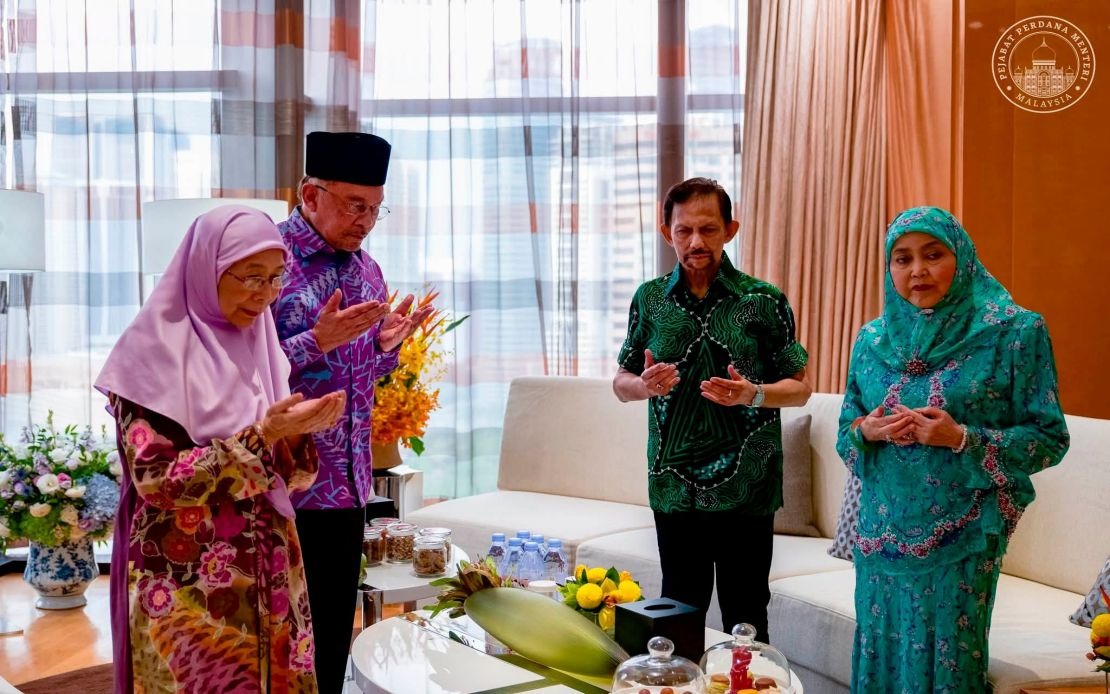
Prime Minister Datuk Seri Anwar Ibrahim has extended Malaysia's official congratulations to Sultan Hassanal Bolkiah of Brunei on reaching his 80th birthday, underscoring the warm diplomatic relations between the two neighbouring nations. The greeting, delivered via a social media post on July 15, carries symbolic weight in the context of regional bilateral partnerships and the personal respect accorded to one of Southeast Asia's most venerable leaders.
Anwar's message, articulated on behalf of both the Malaysian Government and its people, transcended ceremonial formality by invoking both constitutional reverence and aspirational language. He expressed hopes that the Sultan would persist in governing Brunei Darussalam with the wisdom and prudence that have characterised his decades-long tenure. Such phrasing reflects the traditional Malaysian approach to acknowledging senior regional monarchs whilst simultaneously affirming shared values of good governance and judicious leadership that resonate across ASEAN societies.
Crucially, Anwar's statement pivoted toward substantive bilateral concerns, emphasising the importance of strengthening institutional and economic ties between Malaysia and Brunei. This focus on deepening cooperation signals Kuala Lumpur's continued commitment to nurturing relations with its smaller neighbour, a relationship that carries historical significance given their shared maritime borders, cultural affinities, and mutual stakes in regional stability. The invocation of blessing—"Insya-Allah"—anchors the sentiment in Islamic solidarity, a unifying cultural element across both nations.
Sultan Hassanal Bolkiah's life arc represents a remarkable span of modern Asian history. Born on July 15, 1946, in what was then called Bandar Brunei, he entered a world still shaped by colonial administration and post-war reconstruction. His ascension to the throne in 1967 coincided with Brunei's transition toward greater autonomy within the British Commonwealth, placing him at the centre of a nation navigating decolonisation and modernisation simultaneously. Nearly six decades of continuous reign have positioned him as a stabilising force in a region occasionally roiled by political uncertainty and economic volatility.
The Sultan's claim to the title of world's longest-reigning living monarch—a status he inherited following Queen Elizabeth II's death in September 2022—bestows additional international prominence on his milestone birthday. This distinction carries profound symbolic resonance, particularly in Commonwealth circles and across the wider international diplomatic community. For Malaysia, honouring a neighbour who holds such globally recognised status reflects both regional pride and diplomatic sophistication, reinforcing ASEAN's image as a bloc of stable, institutionally mature states governed by leaders of international standing.
Brunei's strategic position in Southeast Asia cannot be understated. Situated on the island of Borneo and commanding significant hydrocarbon reserves, the sultanate exercises influence disproportionate to its modest population of around 460,000 residents. Malaysia's cultivation of strong ties with Brunei serves multiple interests: securing maritime cooperation, ensuring stability along shared borders, and maintaining harmony within ASEAN's inner circles. The Sultan's long stewardship has enabled Brunei to maintain political continuity and economic prosperity, factors that directly benefit regional equilibrium.
From a domestic Malaysian perspective, Anwar's public felicitations underscore Kuala Lumpur's diplomatic priorities under his administration. His emphasis on strengthened cooperation with neighbouring states reflects a broader strategic vision of Southeast Asian integration and multilateral engagement. For Malaysian readers, such gestures carry practical implications: robust Malaysia-Brunei relations facilitate cross-border commerce, labour mobility, and cultural exchange that touch ordinary citizens' lives through trade and connectivity.
The timing of the congratulatory message also merits attention. Coming at a moment when regional tensions occasionally surface over maritime disputes, resource competition, and divergent political systems, Anwar's warm acknowledgment of the Sultan demonstrates ASEAN's commitment to transcending differences through dialogue and mutual respect. This approach contrasts sharply with more confrontational diplomatic postures that some regional powers have occasionally adopted, positioning Malaysia as a voice for continuity and cooperation.
Sultan Hassanal Bolkiah's reign has witnessed Brunei's transformation from a modest oil-producing state into a more diversified economy, though hydrocarbon revenues remain central to national prosperity. His longevity on the throne has provided the institutional stability that allows long-term economic planning and strategic positioning. For Malaysia and ASEAN, the Sultan's steady leadership has meant a reliable, predictable partner in regional affairs—an increasingly valuable commodity in an era of geopolitical flux and great-power competition for influence in Southeast Asia.
Looking forward, the Sultan's continued presence as a regional elder statesman carries implications for ASEAN's internal dynamics and its external positioning. His experience and institutional memory prove invaluable during periods of regional challenge, whether confronting climate change, managing sea-lane security, or negotiating with powerful external actors. Malaysia's explicit recognition of his milestone birthday through high-level government acknowledgment reinforces these bonds whilst signalling to the broader international community that ASEAN values institutional continuity and respects its senior figures.

