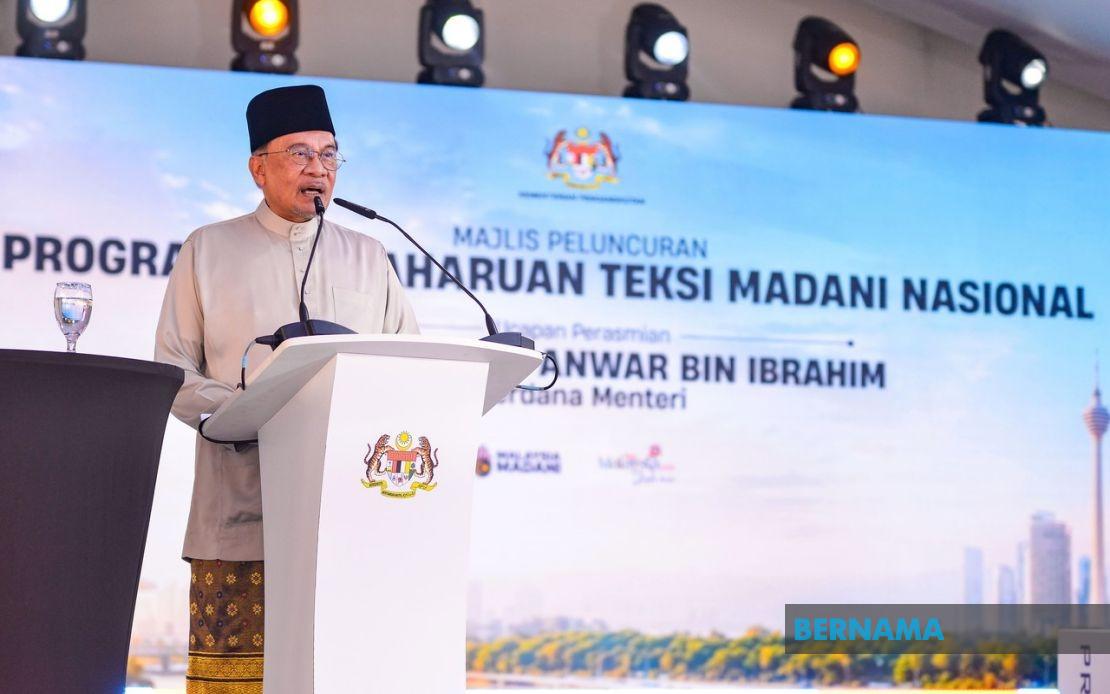
Prime Minister Datuk Seri Anwar Ibrahim has committed an additional RM10 million to accelerate the replacement of ageing vehicles in Malaysia's taxi fleet, signalling the government's determination to modernise a sector long plagued by maintenance costs and driver hardship. Speaking at the launch of the National MADANI Taxi Reform Programme at Dataran Merdeka on July 3, Anwar, who simultaneously holds the Finance portfolio, emphasised that the extra funding reflects unusually strong uptake of the initial RM10 million earmarked in Budget 2026 for the Vehicle Replacement Matching Grant Programme.
The dual allocation represents a significant shift in how the government approaches the taxi industry's structural challenges. Rather than waiting to assess demand before committing fresh resources, the swift approval of additional funds demonstrates confidence in the reform agenda and recognition that the sector's needs extend beyond initial projections. For taxi operators across the country, particularly those struggling with vehicles that routinely fail roadworthiness inspections or consume excessive fuel, the announcement offers tangible relief from financial barriers that have long prevented fleet renewal.
Central to the reform push is a newly forged agreement between the government, Proton, and the Transport Ministry to establish a dedicated financing mechanism for taxi drivers interested in purchasing the Proton S70. This arrangement removes a critical impediment that has historically deterred drivers from upgrading—the difficulty of securing favourable loan terms for commercial vehicle purchases. By creating a bespoke financing pathway, the initiative seeks to make the transition from older vehicles to a locally-made model more commercially viable for operators already stretched by operational costs.
The Proton S70, a mid-range sedan with growing market penetration in Malaysia, represents a practical choice for the taxi sector. Its affordability relative to imported competitors, combined with Proton's expanding service network across the country, positions it as an accessible option for drivers seeking reliable transport that minimises downtime and repair expenses. The inclusion of a local automotive manufacturer in the reform strategy also bolsters domestic industry objectives while providing drivers with a product backed by local warranty and after-sales support.
Anwar's comments underscoring the "very encouraging" response to the initial budget allocation suggest that demand for vehicle replacement assistance far exceeds the first tranche of funding. This pattern reflects years of accumulated need within the taxi community, where many operators have deferred replacement decisions due to capital constraints. The decision to frontload an additional RM10 million capitalises on this momentum, ensuring that interest translates into actual fleet upgrades rather than cooling as administrative delays mount.
The presence of Transport Minister Anthony Loke, Minister in the Prime Minister's Department (Federal Territories) Hannah Yeoh, and Chief Secretary to the Government Tan Sri Shamsul Azri Abu Bakar at the programme launch underscores the cross-ministerial coordination underpinning the reform. This alignment suggests that implementation will benefit from streamlined approvals and coordinated support across finance, transport regulation, and urban governance—critical for a sector operating primarily in cities and their surrounding areas.
For Malaysian taxi drivers and fleet operators, the scheme addresses one of the sector's most persistent vulnerabilities. Vehicles operating beyond their optimal lifespan consume more fuel, require costlier repairs, and fail safety inspections more frequently, squeezing already-thin profit margins. The matching grant model, which typically requires drivers to contribute a portion of upgrade costs, encourages fiscal responsibility while government support bridges the affordability gap. This structure has proven effective in other developed economies where government-supported fleet modernisation programmes have successfully accelerated vehicle turnover.
The timing of the announcement carries broader implications for Malaysia's transport ecosystem. As ride-hailing services and digital booking platforms reshape urban mobility, the traditional taxi sector faces mounting pressure to demonstrate reliability and safety standards. A modernised fleet, equipped with newer vehicles that meet contemporary emissions and comfort expectations, strengthens taxis' competitive position against private-hire alternatives. This dimension of competitiveness may be particularly important in maintaining employment for the thousands of taxi drivers who depend on the sector for their livelihoods.
From a fiscal perspective, the RM20 million total commitment across both allocations represents a moderate but meaningful investment in a labour-intensive industry. When spread across multiple driver uptake, the per-vehicle subsidy remains modest, requiring meaningful co-investment from operators themselves. However, the cumulative benefit materialises through reduced operating costs across the fleet, lower accident rates associated with newer vehicles, and improved service quality that can justify fare structures in competitive urban markets.
The partnership with Proton also signals confidence in domestic automotive capacity to serve transport sector needs. By channeling reform procurement toward a local manufacturer, the government supports industrial policy objectives while ensuring that vehicle supply remains predictable and maintenance costs remain manageable through established dealer networks. This approach avoids creating dependency on imported vehicles where spare parts and service accessibility might prove problematic for dispersed operators.
Implementation details remain to be clarified, including eligibility criteria, the pace of fund disbursement, and the mechanics of the Proton financing arrangement. These operational aspects will ultimately determine whether the announced allocation translates into meaningful fleet renewal or becomes another well-intentioned programme hampered by bureaucratic complexity. Clear communication to drivers about application processes and timeline expectations will be essential for maximising uptake.
The announcement also positions the government's transport reform agenda as responsive to grassroots sector feedback. By demonstrating willingness to supplement initial allocations when demand exceeds expectations, the government signals openness to evidence-based policy adjustment—a posture that may encourage other struggling industries to engage constructively with reform proposals. For the taxi sector specifically, this initial success may establish momentum for addressing additional structural challenges, from driver welfare protections to dispute resolution mechanisms.

