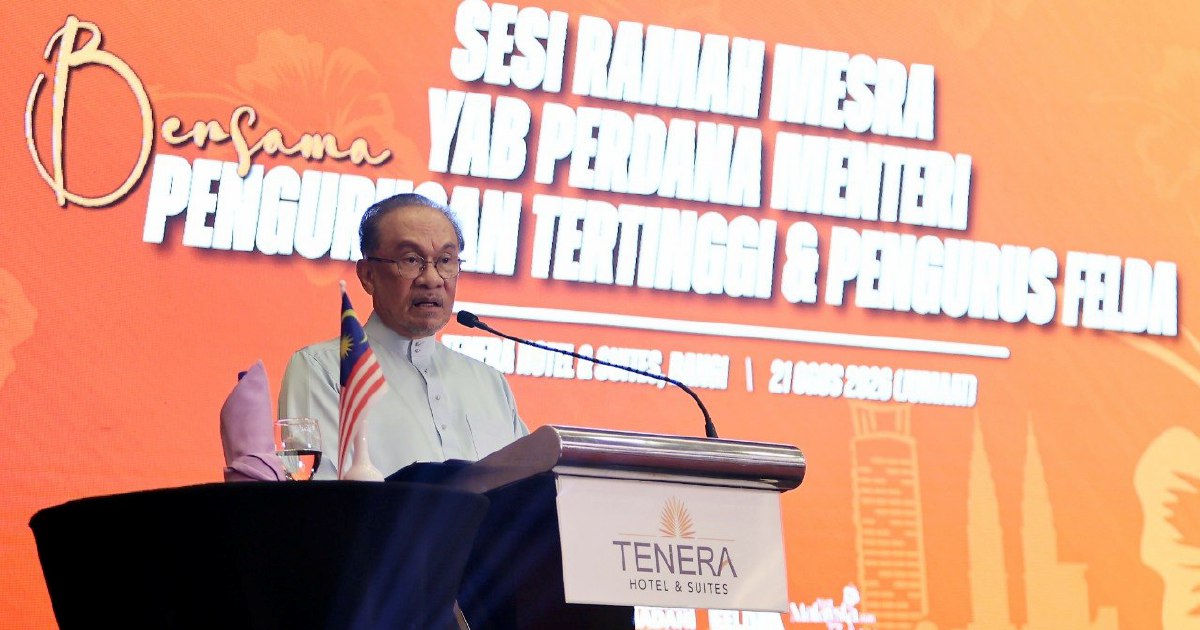
Prime Minister Datuk Seri Anwar Ibrahim confirmed today that a specially-constituted task force has initiated its investigation into various issues affecting the Federal Land Development Authority (Felda), signalling the government's commitment to addressing long-standing concerns within the statutory body. Speaking in Bangi, the Prime Minister indicated that the task force would release its findings publicly once the investigation concludes, underscoring a commitment to transparency in how such institutional matters are handled.
The formation of this dedicated task force represents a significant development for Felda, which has faced mounting scrutiny over governance, financial management, and the welfare of settler communities in recent years. The move reflects growing political pressure to address accumulated grievances from smallholder farmers, land settlers, and stakeholders who have expressed dissatisfaction with the authority's direction and operational effectiveness.
Felda, established in 1956 as a cornerstone institution for rural development and agricultural modernisation, has been central to Malaysia's post-independence development strategy. However, the organisation has increasingly come under critical examination following allegations of mismanagement, opaque decision-making processes, and declining profitability that has undermined dividend payments to settlers who form the backbone of the scheme's legitimacy.
The timing of this investigation initiative coincides with broader scrutiny of state-linked entities and government agencies under the current administration, which has prioritised institutional accountability and good governance reforms. The appointment of a task force signals that senior policymakers view the issues within Felda as sufficiently serious to warrant dedicated investigative resources, rather than relying on routine internal reviews or parliamentary oversight mechanisms alone.
Settlers within the Felda scheme, particularly in peninsular Malaysia where the authority manages extensive plantation holdings, have raised persistent concerns about diminishing returns from their land parcels, transparency in estate management decisions, and their representation in governance structures. These complaints have become increasingly vocal across social media and through settler associations, creating political pressure for intervention at the highest levels.
The investigation's scope likely encompasses questions regarding asset management, land utilisation strategies, the integration of Felda Holdings Berhad (the publicly-listed investment vehicle established through corporate restructuring), and the alignment of Felda's business operations with its original mandate to uplift rural communities. These are complex issues that require careful examination of decades of accumulated corporate records and governance decisions.
For Malaysian policymakers, the Felda situation exemplifies broader challenges facing developmental state institutions that were created to serve specific socio-economic objectives but have evolved into complex corporate entities operating within competitive market environments. The tension between maintaining settler-centric policies and pursuing commercial viability has created inherent contradictions that management has struggled to reconcile effectively.
Regional observers note that Felda's trajectory mirrors experiences of similar land settlement schemes across Southeast Asia, where institutional drift, demographic changes, and market pressures have complicated the delivery of their original development mandates. How Malaysia resolves these issues may offer lessons for neighbouring countries managing comparable programmes.
The outcome of this task force investigation could have implications extending beyond Felda itself, potentially influencing how the government approaches reform of other large statutory bodies and government-linked companies. If the investigation uncovers systemic governance weaknesses or misallocation of resources, it may prompt broader institutional audits across the public sector.
Prime Minister Anwar's decision to make public the commencement of this task force investigation, rather than conducting it discreetly, signals confidence that the process will yield credible findings and recommendations. The emphasis on eventual public disclosure also reflects recognition that Felda's legitimacy depends on settler and public confidence in institutional integrity.
The investigation's success will largely depend on the task force's composition, access to comprehensive documentation, and political insulation from factional pressures that may seek to influence its direction or conclusions. Previous institutional investigations in Malaysia have sometimes been complicated by competing political interests, making the independence and credibility of this effort particularly important.
Settler communities will be watching closely for what the task force investigation reveals and, more importantly, what remedial actions the government implements based on its recommendations. Any findings that validate longstanding complaints about mismanagement could strengthen calls for more fundamental structural reforms within the authority, potentially including changes to leadership, governance structures, or strategic direction.

