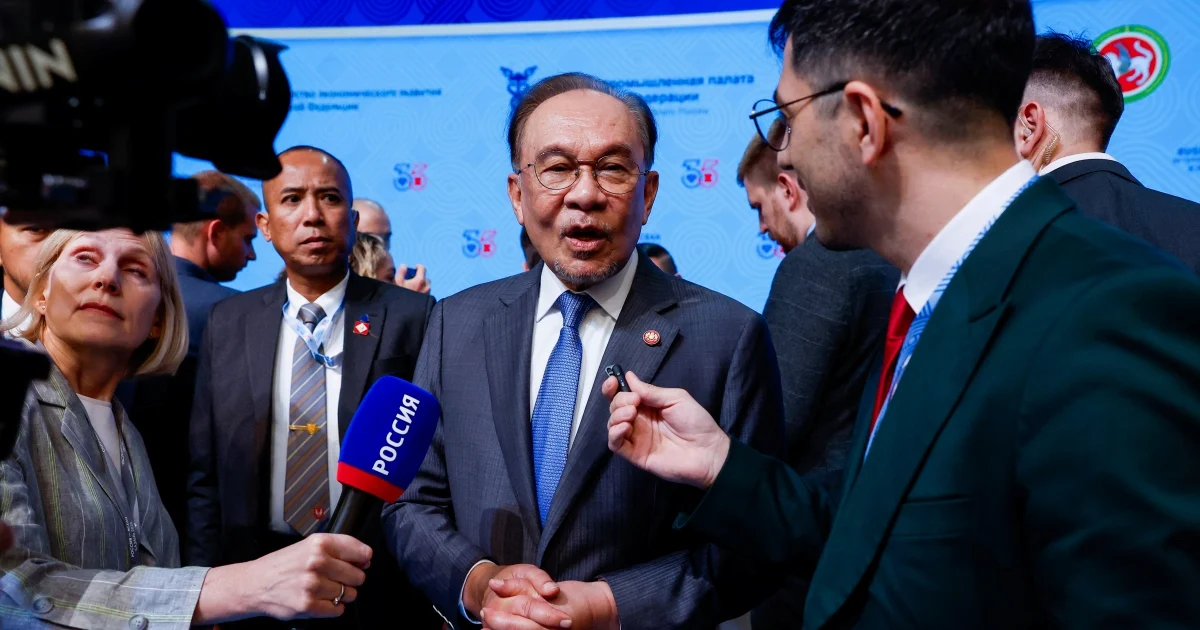
Prime Minister Datuk Seri Anwar Ibrahim travelled to Kazan and took the opportunity to articulate an often-overlooked dimension of Malaysia's foreign policy: the centrality of cultural bridges in maintaining strong international relationships. His remarks underscored a personal affinity for Russian artistic traditions, particularly music and literature, reflecting a broader diplomatic philosophy that extends engagement beyond commercial and strategic calculations into the realm of shared human expression.
Anwar's appreciation for Russian culture speaks to the multilayered nature of contemporary international relations, where soft power—the capacity to attract rather than coerce—increasingly shapes how nations build lasting partnerships. By publicly declaring his fondness for Russian compositions and literary works, the Prime Minister signalled Malaysia's openness to the broader intellectual and aesthetic dimensions that characterise Russian civilisation. This approach resonates particularly well in Moscow's diplomatic circles, where cultural heritage remains central to national identity and pride.
The distinction Anwar drew between economic cooperation and cultural exchange carries significant weight in Southeast Asian diplomacy. While Malaysia-Russia trade relationships and defence partnerships have grown in recent years, the Prime Minister's emphasis on music and literature suggests a recognition that mutual understanding rooted in artistic appreciation creates deeper, more resilient foundations for bilateral relations than transactional arrangements alone. Cultural affinity tends to cultivate goodwill among populations rather than merely between governments, potentially strengthening political ties across generational cycles.
Russian literature, with its philosophical depth and psychological complexity found in works spanning from classical authors to modern writers, presents intellectual territory that appeals to educated audiences worldwide. By positioning himself as an admirer of this tradition, Anwar implicitly invited Russian counterparts to engage with Malaysia not merely as a trading partner or regional player, but as a nation whose leadership appreciates the universality of human creative expression. This positioning carries diplomatic value, particularly when establishing rapport with Russian officials who themselves typically value intellectual discourse.
The musicological dimension of Anwar's comments warrants particular attention given the role of musical exchange in diplomatic history. Russian classical music—from Tchaikovsky's symphonies to contemporary compositions—represents centuries of artistic refinement and cultural memory. When a Malaysian Prime Minister publicly acknowledges appreciation for such works, it transmits a message of respect for Russian civilisational contributions that transcends geopolitical considerations. In an era marked by great power competition and regional tensions, such cultural acknowledgments function as subtle instruments of bridge-building.
Anwar's remarks also reflect Malaysia's broader strategic positioning in a multipolar world. As Kuala Lumpur seeks to maintain balanced relations across multiple power centres, investing in cultural diplomacy with Russia provides an avenue for engagement that does not necessarily entail political alignment on contentious issues. Cultural appreciation permits nations to cooperate and demonstrate respect without requiring agreement on all foreign policy matters—a particularly valuable approach for Malaysia, which must navigate between Western and Eastern spheres of influence.
The timing of these comments in Kazan, Russia's major cultural and scientific hub, amplifies their diplomatic resonance. Kazan itself represents a space where diverse cultural traditions intersect, given the city's Tatar heritage alongside its Russian character. By making cultural affinity statements in such a location, Anwar positioned Malaysia as a nation comfortable engaging with cultural pluralism and synthesis—themes that resonate throughout Southeast Asia, where multicultural societies remain the regional norm.
From a Malaysian perspective, elevating cultural exchange in bilateral relations aligns with contemporary trends in national diplomacy. Malaysia's government has increasingly recognised that the nation's multicultural character and diverse artistic traditions represent valuable soft power assets. By demonstrating receptiveness to other cultures' artistic contributions, Malaysian leadership encourages reciprocal interest in Malaysian culture and creativity, potentially opening pathways for cultural institutions, artists, and intellectuals to forge direct connections across borders.
The assertion that cultural exchanges carry equal or comparable weight to economic cooperation reflects a more sophisticated understanding of international relations than purely transactional frameworks would suggest. Literature and music create emotional connections and aesthetic understanding that persist independent of market fluctuations or trade negotiations. These cultural bonds often withstand political disagreements and economic downturns, providing continuity in relationships during periods of tension or difficulty. Anwar's public endorsement of such thinking positions Malaysia as a nation capable of sustained, nuanced diplomatic engagement.
Looking forward, such cultural emphasis could inform Malaysia's approach to bilateral engagement across multiple partnerships. By valorising artistic and literary exchange, Anwar has essentially suggested a template for how Malaysia might deepen relationships with other nations—one emphasising mutual respect, intellectual engagement, and appreciation for distinct cultural traditions. For Malaysia, a country with its own rich artistic heritage spanning indigenous traditions, Islamic influences, and multicultural synthesis, this philosophy provides substantial foundation for expanding cultural diplomacy initiatives throughout the region and beyond.