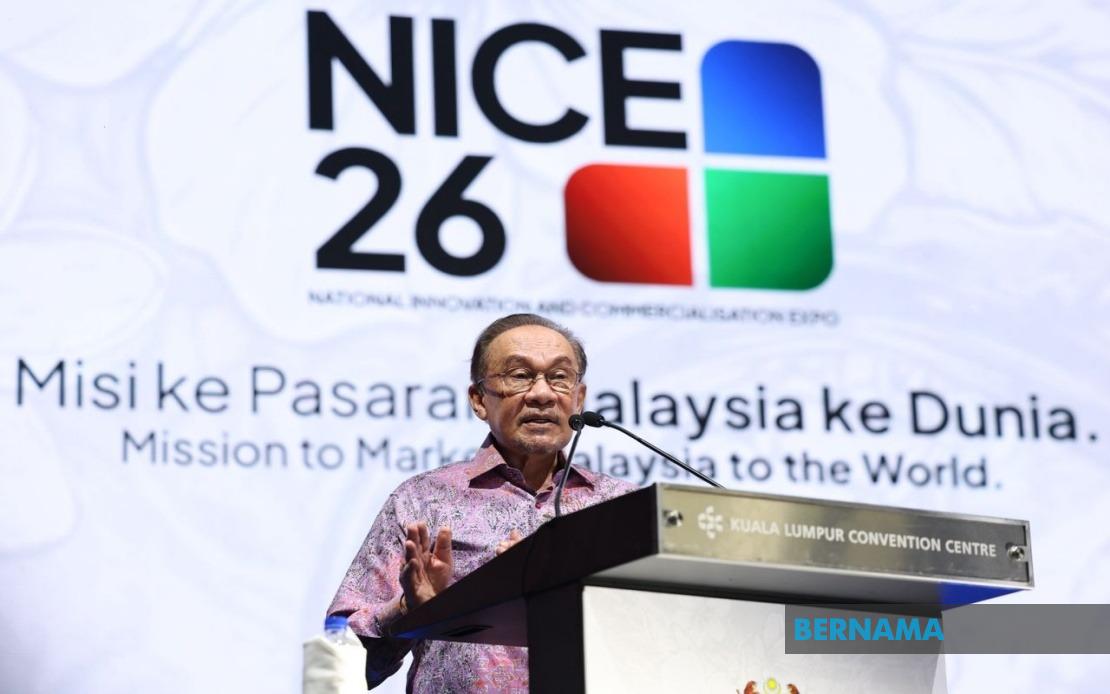
Prime Minister Datuk Seri Anwar Ibrahim has sounded an urgent alarm about the stranglehold that entrenched bureaucratic procedures are placing on Malaysia's ability to innovate and remain internationally competitive. Speaking at the National Innovation and Commercialisation Expo (NICE) 2026 held at the Kuala Lumpur Convention Centre (KLCC), he argued that traditional administrative frameworks were fundamentally incompatible with the pace demanded by contemporary technological advancement and the commercialisation imperative facing the nation.
The Prime Minister's critique touches on a persistent tension within Malaysia's public sector: while institutional structures provide oversight and accountability, they often operate on timescales that bear no resemblance to the velocity of global innovation cycles. Anwar emphasised that the contemporary landscape of technological development—particularly in fields such as Artificial Intelligence, biotechnology, and advanced manufacturing—requires administrative agility that conventional approval mechanisms simply cannot deliver. He characterised the tension as one between institutional caution and competitive necessity, framing the choice not as one between governance and innovation, but as a matter of survival in an increasingly technology-driven global economy.
To illustrate his point, Anwar highlighted a concrete success achieved through accelerated processes: the establishment of Artificial Intelligence faculties at several Malaysian universities completed within a three-month timeframe. This compressed timeline stands in stark contrast to the conventional route, which would typically consume up to twelve months of procedural navigation involving multiple senate sessions, council meetings, and departmental approvals. The Prime Minister presented this comparison not merely as a matter of efficiency, but as evidence that reformed procedures could produce the same rigorous outcomes while dramatically reducing deployment delays. The implications are significant: if universities can launch cutting-edge AI programmes in quarterly cycles rather than annual ones, Malaysia's academic institutions could theoretically respond more dynamically to emerging technological domains and workforce demands.
The underlying tension that Anwar identifies reflects a broader challenge facing Southeast Asian governments attempting to position themselves within the knowledge economy. Traditional university governance structures, inherited from colonial-era models and reinforced through decades of institutional practice, were designed to ensure deliberative consensus-building rather than rapid responsiveness. Committee-based decision-making, multiple layers of approval, and formal documentation requirements serve legitimate purposes in institutional governance. However, when these mechanisms extend timelines for launching degree programmes addressing technologies that evolve on monthly rather than annual cycles, the cumulative effect is strategic disadvantage. Countries that can mobilise academic resources and launch programmes faster gain advantages in attracting talent, securing research funding, and positioning their graduates for emerging opportunities.
Anwar's directive specifically targets the Ministry of Science, Technology and Innovation (MOSTI) and other relevant government agencies, urging them to acknowledge and embrace the requirements of what he termed the "post-normal world." This framing is significant: he is not merely asking for marginal improvements in processing speed, but rather for fundamental recognition that the context in which Malaysia operates has fundamentally changed. The traditional bureaucratic velocity that may have sufficed in previous decades when technological cycles extended over multiple years has become a liability. His language suggests that this is not a request for negotiation but a clear policy mandate requiring immediate cultural and procedural reorientation among government technocrats and administrators.
The timing of this intervention, delivered at a flagship innovation exposition, carries symbolic weight beyond the immediate policy message. NICE 2026 functions as Malaysia's showcase for technological ambition and commercial promise. By using this platform to criticise bureaucratic impediments, Anwar was simultaneously signalling to both domestic innovators and international investors that the government recognises existing constraints and is committed to removing them. This public commitment increases political accountability for follow-through, potentially strengthening the hand of reformers within government agencies seeking to pilot new approval mechanisms.
The practical implications for Malaysian institutions are substantial. Universities considering new technology-focused programmes face a choice between navigating traditional bureaucratic channels—which could consume valuable time and market windows—or advocating for expedited pathways similar to those that produced the three-month AI faculty launches. Research institutions seeking to establish innovation zones, technology transfer mechanisms, or industry partnership programmes will likely find greater flexibility in approval processes if Anwar's directives are implemented systematically. However, the success of this approach depends entirely on whether government agencies genuinely embrace procedural reform or merely pay lip service to the Prime Minister's intentions.
For Southeast Asia more broadly, Malaysia's attempt to modernise its innovation governance structure reflects competition among the region's governments to attract technology talent and investment. Singapore and South Korea have long operated with institutional flexibilities that Malaysian bodies currently lack. Thailand and Vietnam are also experimenting with administrative reforms designed to accelerate technology deployment. Malaysia's competitive position in this regional race partly depends on its ability to match the responsiveness that other jurisdictions now offer. By publicly committing to bureaucratic modernisation, Anwar is attempting to reposition Malaysia as an agile innovation destination rather than one hampered by administrative inertia.
The specific challenge of implementing such reforms should not be underestimated. Government bureaucracies resist structural change partly because existing procedures reflect accumulated compromises, legal requirements, and institutional traditions. Even with prime ministerial backing, implementing genuinely faster approval pathways requires rethinking approval criteria, training administrators in new processes, establishing clear accountability frameworks for expedited decisions, and ensuring that speed does not genuinely compromise quality or governance standards. The three-month AI faculty timeline suggests such acceleration is possible, but scaling it across multiple institutions and technology domains presents logistical challenges.
Looking forward, the effectiveness of Anwar's directive will be measured not by rhetoric but by concrete changes in how government agencies process applications for new programmes, research facilities, and technology initiatives. If MOSTI and related ministries establish genuinely expedited pathways that become standard rather than exceptional, Malaysian universities and research institutions will gain meaningful competitive advantage in launching technology-focused initiatives. If the announcement becomes merely symbolic without substantive procedural reform, it will represent another instance of policy rhetoric outpacing implementation capacity.

