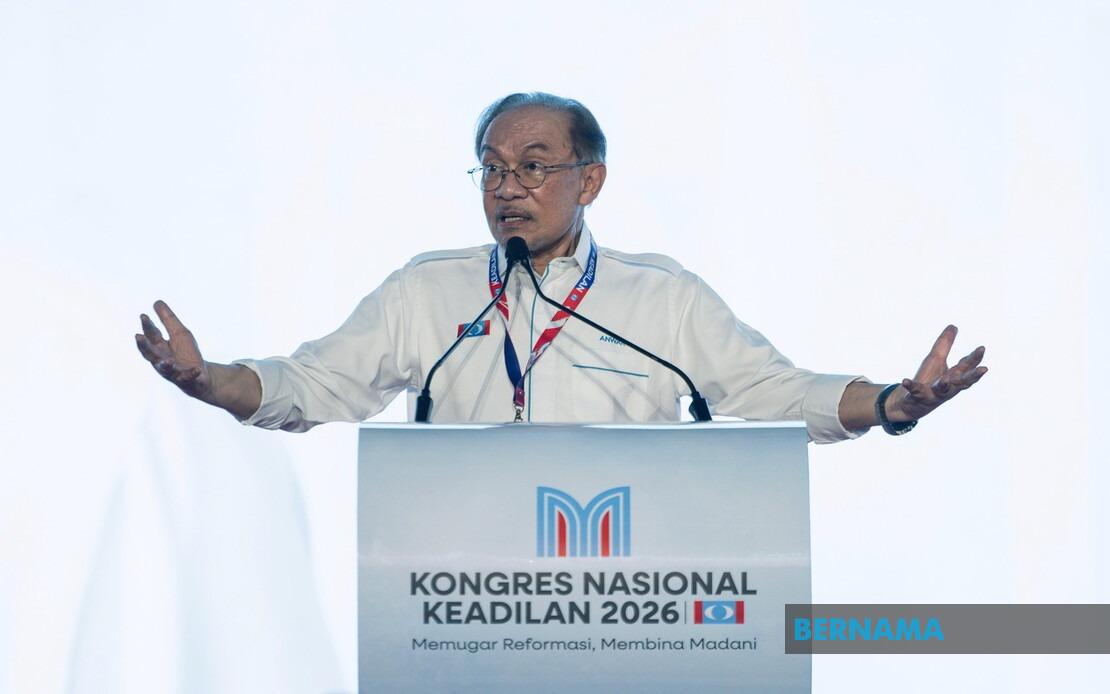
Prime Minister Datuk Seri Anwar Ibrahim has unveiled a fresh injection of development funds aimed at strengthening direct assistance to communities across Malaysia. Announced during his winding-up speech at the 2026 PKR National Congress at the Melaka International Trade Centre, the additional RM1 million allocation per parliamentary constituency represents the MADANI Government's latest effort to translate economic gains into tangible benefits at the community level. This move underscores a deliberate strategy to bypass cumbersome administrative channels and place resources directly in the hands of those tasked with addressing immediate local concerns.
The timing of this announcement carries significance in Malaysia's political landscape. With the government constantly balancing multiple competing demands from constituencies nationwide, a per-constituency allocation offers a standardised approach that theoretically ensures equitable distribution across urban and rural areas alike. By ringfencing funds specifically for grassroots-level interventions, the administration signals confidence in local representatives' capacity to identify and respond to neighbourhood priorities, whether these involve upgrading community facilities, supporting welfare initiatives, or tackling basic amenity gaps that residents encounter daily.
Anwar, speaking in his dual capacity as Prime Minister and Finance Minister, framed the initiative within the government's broader poverty-reduction agenda. He highlighted that the hardcore poverty rate has been reduced to 0.09 per cent, a figure the administration frequently cites as evidence of its economic management. The RM1 million additional funding complements the government's existing cash assistance schemes: the Sumbangan Tunai Rahmah and Sumbangan Asas Rahmah programmes, which together command RM16 billion in annual commitments. Together, these interventions form a multi-layered safety net designed to cushion lower and middle-income households from inflationary pressures.
The announcement reflects an acknowledged gap between national economic performance and household-level satisfaction. Despite Malaysia's recovery from the pandemic and sustained GDP growth, many Malaysians report persistent concerns about affordability. Groceries, utilities, and housing remain expensive relative to incomes, particularly for B40 households earning below RM2,300 monthly and even many in the M40 bracket. By decentralising fund allocation, the government appears to acknowledge that one-size-fits-all national programmes may not address hyper-local variations in need—a fishing village's priorities differ from a suburban township's, for instance.
For parliamentary representatives, the additional funding creates both opportunity and obligation. District chiefs and locality leaders now possess expanded discretion to commission small infrastructure projects, bolster community organisations, or fund assistance schemes without seeking higher-level approval. This devolution potentially accelerates decision-making and reduces the lag between identifying a need and implementing a solution. However, it also places greater responsibility on local political machinery to identify genuine priorities and deploy resources efficiently. In competitive constituencies, representatives will likely face scrutiny over how judiciously these funds are deployed and whether tangible improvements materialise.
The Malaysian context makes this announcement particularly relevant given the federation's constitutional structure and the periodic tensions between federal and state governments. While parliamentary constituencies are federal demarcations, their actual governance involves state, district, and local council authorities. The effectiveness of RM1 million per constituency depends partly on coordination between these layers—a challenge that has historically complicated development initiatives. Constituencies crossing state boundaries or operating in areas with fragmented local administration may find it harder to mobilise these allocations coherently.
Anwar's emphasis on reducing bureaucratic friction speaks to persistent public frustration with administrative delays. Malaysians frequently complain that accessing government assistance or funding for community projects requires navigating multiple agencies and lengthy approval cycles. By promising direct allocation to constituencies, the government pledges to flatten this architecture. In theory, elected representatives can rapidly commission works once needs are identified. Whether this translates to practice depends on whether the government provides clear guidelines, reliable fund disbursement, and accountability mechanisms without reimposing the very red tape it aims to eliminate.
The broader policy context reveals the government's pivot toward targeted assistance over universal subsidies. Rather than subsidising fuel or food prices across the board—an expensive and economically distortionary approach—the MADANI administration has opted for means-tested transfers and locally responsive spending. The RM1 million per-constituency mechanism fits this paradigm. It allows resources to concentrate where community leaders identify greatest need rather than dispersing them uniformly. This approach theoretically maximises welfare impact per ringgit spent, though it requires local stakeholders to exercise sound judgment.
For Southeast Asian observers, Malaysia's strategy offers lessons on balancing centralised fiscal control with devolved decision-making. Thailand, the Philippines, and Indonesia have all grappled with similar tensions between national development priorities and local demands. Malaysia's approach—maintaining central revenue collection and overall fiscal discipline while granting constituencies direct allocative authority—represents a middle path worth monitoring. Success would validate decentralisation as poverty-reduction strategy; failure would suggest that local discretion without adequate oversight risks duplication and inefficiency.
Anwar's call for party machinery and grassroots leaders to communicate these initiatives to citizens hints at an implementation challenge often underestimated in policy discussions. Announcing programmes and ensuring residents know about and access them are distinct undertakings. Across Asia, means-tested assistance frequently underutilises available funds because eligible households remain unaware. The Prime Minister's exhortation to local representatives to actively publicise government offerings acknowledges this gap. Effective communication requires resources, planning, and sustained engagement—factors that vary significantly across constituencies depending on local capacity and political saturation.
The announcement also reflects electoral consideration, though not necessarily cynical calculation. With general elections potentially approaching within the next 18 months, demonstrating government responsiveness to local concerns carries obvious political weight. However, the per-constituency mechanism itself—treating all constituencies equally regardless of population—suggests a genuine commitment to ensuring even sparsely populated or politically marginal areas receive adequate resources. Whether this principle survives implementation will become evident as constituencies report on fund deployment over coming months.
Looking forward, the success of this initiative depends on multiple factors beyond the government's direct control. Local representative capacity, inter-agency coordination, and community participation all influence outcomes. The RM1 million allocation, while substantial in absolute terms, must stretch across diverse needs—some constituencies may require substantial infrastructure investment, others may prioritise welfare assistance or service provision. How flexibly the government permits fund reallocation between categories will significantly impact its effectiveness. Additionally, long-term sustainability matters; Malaysian voters are accustomed to populist spending announcements that prove temporary. Establishing this as a permanent, indexed allocation rather than a one-off gesture would signal genuine commitment to grassroots-level empowerment.

