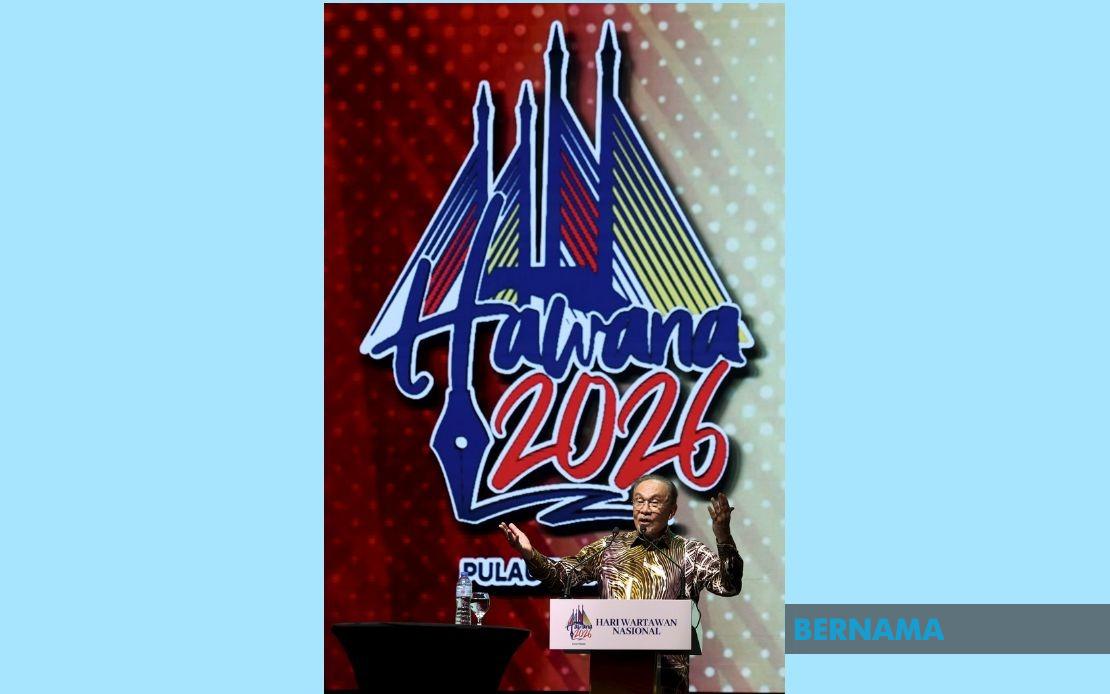
Prime Minister Datuk Seri Anwar Ibrahim has committed an additional RM1 million to bolster the Tabung Kasih@HAWANA fund, reaffirming the government's dedication to safeguarding the wellbeing of Malaysia's media workforce. The announcement came during the opening ceremony of National Journalists' Day (HAWANA) 2026 in Butterworth on June 20, where Anwar, who doubles as Finance Minister, outlined the fresh allocation for the current year as evidence of sustained governmental backing for the sector.
The injection of capital reflects mounting recognition within policy circles that media practitioners—often working under demanding conditions with modest remuneration—require institutional safety nets. Since its inception alongside HAWANA 2023 celebrations, the fund has distributed assistance totalling RM2.26 million across 773 eligible recipients nationwide, demonstrating tangible reach into the profession's lower and middle income brackets. The new RM1 million augmentation signals confidence that demand for such support remains substantial and warrants expansion of available resources.
Tabung Kasih@HAWANA operates as a multipurpose welfare mechanism, extending beyond straightforward cash grants to encompass medical expense reimbursement, family assistance schemes, and supplementary support tailored to individual circumstances. This comprehensive architecture acknowledges that financial hardship among journalists stems from diverse sources—illness, accident, family crisis, or simply insufficient baseline earnings—rather than a single root cause. By diversifying assistance modalities, the fund addresses vulnerabilities that conventional salary structures often fail to mitigate.
The timing of this announcement carries symbolic weight within Malaysia's broader media landscape. Coming at a gathering attended by over 1,000 journalists from Malaysia and neighbouring countries including Timor-Leste, Cambodia, and Laos, the commitment positions Malaysia as a regional exemplar of state support for press welfare. This posturing matters geopolitically; as Southeast Asian democracies wrestle with press freedom pressures and journalist safety concerns, demonstrating concrete investment in media worker wellbeing enhances Malaysia's standing among regional journalism associations and international media freedom monitors.
The HAWANA 2026 event itself convened under the banner "Media Integrity Strengthens Credibility," a thematic choice underscoring official emphasis on ethical journalism standards and institutional robustness. The presence of high-ranking officials—including Penang Chief Minister Chow Kon Yeow and Communications Minister Datuk Fahmi Fadzil—alongside senior figures from the Malaysian National News Agency (Bernama) underscored institutional consensus that media support merits priority positioning within government spending architectures.
For Malaysia's journalism community, the fund's expansion carries practical implications. Financial precarity has long driven capable journalists from the profession, with many departing for corporate communications roles, public relations, or international media outlets offering superior compensation packages. While the RM1 million supplement cannot single-handedly reverse this brain drain, it signals that government acknowledges journalism's public interest value and recognises that sustainable reporting quality depends upon economically viable careers. This recognition, once embedded in budgetary allocations, can gradually shift professional incentive structures.
The fund's establishment also reflects lessons learned from earlier periods when media practitioners faced acute vulnerability with minimal institutional safety mechanisms. By formalising welfare provisions through dedicated budgetary channels, the government institutionalises support rather than leaving it dependent upon episodic charitable initiatives or individual patronage. Institutionalisation ensures predictability and reaches applicants who might otherwise feel embarrassed accessing ad-hoc assistance schemes.
Regionally, Malaysia's approach may influence neighbouring countries evaluating journalist welfare frameworks. Thailand, Indonesia, and the Philippines all contend with understaffed newsrooms and underpaid reporters; visibility of Malaysia's systematic fund could prompt comparable initiatives elsewhere in Southeast Asia. This potential spillover effect extends Malaysia's soft power influence, particularly if the fund demonstrates measurable success in improving journalist retention and morale.
However, sustainability questions linger. While RM1 million annually represents meaningful commitment, it remains modest relative to broader government spending. As media practice evolves—digital transformation, precarious freelance workforces, the contraction of traditional newsroom employment—demand for welfare assistance may intensify faster than budgetary allocations expand. Long-term viability depends upon securing bipartisan political support insulating the fund from electoral cycles and factional disputes that sometimes affect discretionary spending.
The Communications Ministry's central coordination role, evidenced by secretary-general Datuk Abdul Halim Hamzah and other senior officials' participation, suggests administrative infrastructure exists to manage fund distribution and prevent corruption or favouritism. Nevertheless, transparency mechanisms deserve continuous attention; publishing disaggregated data on assistance recipients, disbursement categories, and application processing timelines would strengthen public confidence and discourage perceptions of political selectivity.
Moving forward, integrating the Tabung Kasih@HAWANA with broader media industry sustainability initiatives—such as journalist training programmes, digital skills development, and newsroom productivity enhancements—could maximise welfare spending's effectiveness. When economic support couples with professional development opportunities, recipients gain not merely temporary relief but improved long-term economic positioning.
Ultimately, Anwar's announcement represents incremental progress within Malaysia's evolving media ecosystem. By allocating fresh resources to journalist welfare, the government acknowledges that press freedom and media quality depend upon practitioners' financial stability and professional morale. Whether this commitment deepens through subsequent budgetary cycles, and whether complementary structural reforms follow, will determine whether the fund becomes merely symbolic or genuinely transformative for Malaysia's journalism profession.
%22%2F%3E%3C%2Fpattern%3E%3C%2Fdefs%3E%3Crect%20width%3D%22100%25%22%20height%3D%22100%25%22%20fill%3D%22url(%23ph5mojig)%22%2F%3E%3Crect%20width%3D%22100%25%22%20height%3D%22100%25%22%20fill%3D%22url(%23ph5mojip)%22%2F%3E%3Ctext%20x%3D%2250%25%22%20y%3D%2250%25%22%20text-anchor%3D%22middle%22%20dominant-baseline%3D%22central%22%20fill%3D%22rgba(255%2C255%2C255%2C0.95)%22%20font-family%3D%22Georgia%2C%20'Times%20New%20Roman'%2C%20serif%22%20font-weight%3D%22700%22%20font-size%3D%22320%22%20letter-spacing%3D%22-0.02em%22%3EPM%3C%2Ftext%3E%3C%2Fsvg%3E)
%22%2F%3E%3C%2Fpattern%3E%3C%2Fdefs%3E%3Crect%20width%3D%22100%25%22%20height%3D%22100%25%22%20fill%3D%22url(%23phgab1g)%22%2F%3E%3Crect%20width%3D%22100%25%22%20height%3D%22100%25%22%20fill%3D%22url(%23phgab1p)%22%2F%3E%3Ctext%20x%3D%2250%25%22%20y%3D%2250%25%22%20text-anchor%3D%22middle%22%20dominant-baseline%3D%22central%22%20fill%3D%22rgba(255%2C255%2C255%2C0.95)%22%20font-family%3D%22Georgia%2C%20'Times%20New%20Roman'%2C%20serif%22%20font-weight%3D%22700%22%20font-size%3D%22170%22%20letter-spacing%3D%22-0.02em%22%3EMalaysia%3C%2Ftext%3E%3C%2Fsvg%3E)
%22%2F%3E%3C%2Fpattern%3E%3C%2Fdefs%3E%3Crect%20width%3D%22100%25%22%20height%3D%22100%25%22%20fill%3D%22url(%23ph1tju4g)%22%2F%3E%3Crect%20width%3D%22100%25%22%20height%3D%22100%25%22%20fill%3D%22url(%23ph1tju4p)%22%2F%3E%3Ctext%20x%3D%2250%25%22%20y%3D%2250%25%22%20text-anchor%3D%22middle%22%20dominant-baseline%3D%22central%22%20fill%3D%22rgba(255%2C255%2C255%2C0.95)%22%20font-family%3D%22Georgia%2C%20'Times%20New%20Roman'%2C%20serif%22%20font-weight%3D%22700%22%20font-size%3D%22170%22%20letter-spacing%3D%22-0.02em%22%3EMalaysia%3C%2Ftext%3E%3C%2Fsvg%3E)