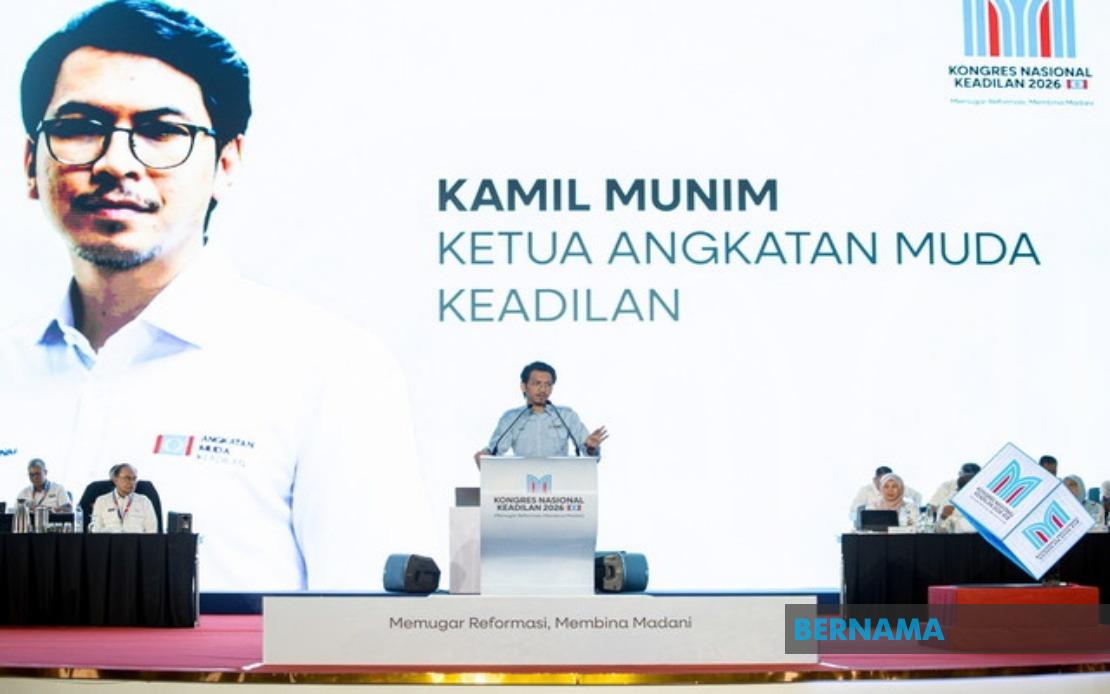
The rejuvenation of opposition politics in Malaysia hinges on the ability of political parties to connect authentically with younger voters, a challenge PKR Youth chief Muhammad Kamil Abdul Munim underscored during the party's national congress in Melaka. Speaking on the second day of proceedings at the Melaka International Trade Centre, Abdul Munim delivered a candid assessment that the party machinery requires substantial recalibration following disappointing results in the Johor and Negeri Sembilan state elections. His remarks signal a broader reckoning within PKR about why the party, despite being a crucial component of the Pakatan Harapan coalition, has struggled to translate government performance into electoral gains.
The demographic reality underpinning Abdul Munim's call is stark and unavoidable. Voters aged 45 and below now constitute the largest voting cohort in Malaysia's electoral roll, a fact that carries profound implications for any party seeking to maintain or expand its political influence. This demographic shift means that campaigns crafted for older generations may no longer resonate effectively with the electorate. The challenge for PKR is particularly acute because younger voters typically demand different forms of engagement, exhibit lower party loyalty, and often prioritize issues distinctly different from those that motivated their parents' generation. Without a fundamental restructuring of how the party presents itself and articulates its message, PKR risks becoming increasingly irrelevant to those voters who will determine Malaysian politics for the next two decades.
Abdul Munim's acknowledgment that the party needs to move beyond administrative matters and strengthen leadership capabilities reflects a sophisticated understanding of grassroots political work. Administrative efficiency—managing party structures, organizing local branches, handling paperwork—can create an illusion of activity without generating genuine connection with communities. What younger voters increasingly demand is evidence of authentic engagement with their concerns, whether these relate to employment prospects, housing affordability, environmental sustainability, or personal freedoms. PKR's grassroots leaders, he suggested, must develop deeper insight into what actually troubles people in their constituencies, particularly in rural and small-town areas where party presence is often weakest.
The tension between government performance and electoral outcomes presents a particularly vexing problem for a ruling coalition party. By most objective measures, feedback regarding the MADANI Government's performance has been constructive, yet this apparent approval has not translated into electoral success during recent state elections. This gap between ministerial competence and voter confidence suggests that something more fundamental may be at work—possibly voter fatigue with the status quo, dissatisfaction with governance implementation despite policy soundness, or simply the traditional Malaysian tendency to provide opposition parties with checks and balances. Understanding this disconnect requires precisely the kind of granular community engagement that Abdul Munim emphasized, moving beyond national-level assessments to understand specific local grievances.
Direct community engagement, particularly in smaller groups within rural settings, emerged as Abdul Munim's primary prescription for party renewal. Such engagement offers multiple benefits beyond mere intelligence-gathering. It rebuilds emotional connections between party leadership and ordinary members, demonstrates genuine concern for local issues, and creates opportunities to identify solutions tailored to specific community contexts rather than imposing national-level policy templates. For younger voters especially, who have grown accustomed to direct access to information and personalized service delivery, this approach aligns better with their expectations of political engagement than traditional hierarchical structures.
The party faces an urgent need to identify and address what Abdul Munim termed the "void" existing among the people—the gap between government promises and lived experience, between policy announcements and actual implementation on the ground. This void becomes particularly pronounced in constituencies where voters have grown accustomed to broken promises or ineffective governance regardless of which party holds power. Filling this void requires more than better communication; it demands genuine problem-solving capacity and demonstrated commitment to following through on commitments. For a party that includes members in government, this places special responsibility on those holding office to ensure that their administrative work translates into visible improvements in their constituencies.
Historical perspective offers both encouragement and caution for PKR's current predicament. The party's ability to engineer significant political surprises roughly once per decade—denying Barisan Nasional its parliamentary supermajority in 2008 and leading Pakatan Harapan to federal government in 2018—demonstrates capacity for mobilization and message resonance when conditions align. However, those victories emerged under specific circumstances: a population hungry for change, effective coalition-building, and compelling electoral narratives. The question facing PKR now is whether similar conditions exist today, or whether the party must rely on incremental constituency-by-constituency work rather than transformative national shifts. Younger voters, in particular, may require demonstration that the party has genuinely learned from governance failures in the 2018-2020 period rather than simply offering promises of future reform.
The timing of Abdul Munim's call takes on additional significance given his explicit reference to the next general election drawing progressively nearer. Malaysia's electoral cycle, shaped by constitutional provisions and political negotiation, typically permits governments to contest elections at times of their choosing within a five-year window. PKR's preparation for that contest cannot begin when the election date is announced; it requires the kind of sustained foundation-building and strategic repositioning that Abdul Munim described. This means the window for achieving the necessary paradigm shift—a term he specifically employed—is substantially shorter than the timeline suggests. Every month without effective younger voter engagement represents ground ceded to competing parties and alternative political movements that may offer stronger appeals to this demographic.
The implications for Malaysian politics extend beyond PKR's fortunes. Whether opposition parties can successfully engage younger voters and build sustainable coalitions around them will shape the entire competitive landscape. If PKR and other Pakatan Harapan components fail in this effort, the political consequences could be dramatic, potentially facilitating a resurgence of Barisan Nasional or emergence of new political forces. Conversely, if opposition parties successfully harness younger voters' energy and idealism, they could create entirely new political equations. For regional observers, Malaysia's experience offers instructive lessons about how political parties in established democracies adapt to demographic change and shifting voter expectations—a challenge facing parties throughout Southeast Asia and beyond as populations age unevenly and younger cohorts exercise growing electoral power.

