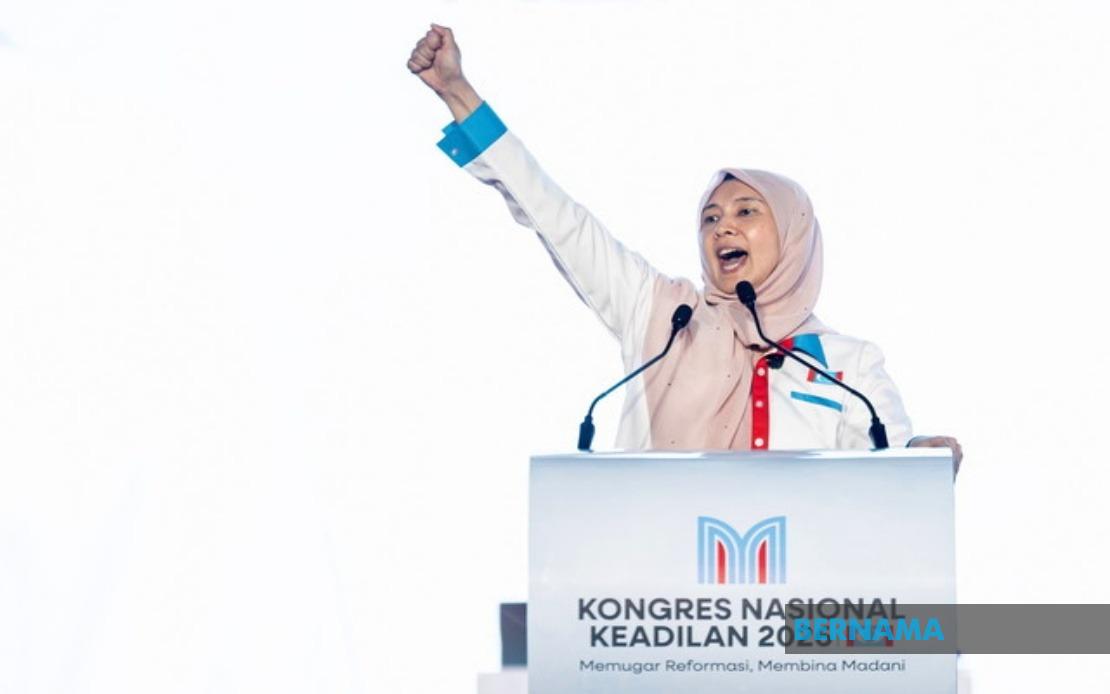
PKR deputy president Nurul Izzah Anwar has urged the party to maintain its commitment to systematic reform across government structures and policymaking, arguing that the struggle that gave birth to the party should not diminish simply because it now holds executive office. Speaking at the PKR 2026 National Congress in Melaka, she emphasised that reform must become an enduring legacy passed down to subsequent generations rather than a campaign objective abandoned upon attaining power.
The message carries particular weight given PKR's electoral trajectory. The party emerged from the reform movement that gripped Malaysia in the late 1990s and has since become a central component of the ruling coalition. This positioning creates both opportunity and risk—opportunity to translate long-held policy positions into reality, but also risk of losing the reformist edge that defined its identity during its opposition years. Nurul Izzah's call addresses this tension directly, insisting that institutional change must accelerate rather than stall now that the party has governing authority.
One concrete example she cited involves the Universities and University Colleges Act (AUKU) 1971, a piece of legislation that PKR had consistently targeted during its time outside government. The fact that this reform remains incomplete despite PKR's current ministerial presence suggests that translating campaign promises into legislation requires sustained internal pressure and political capital. Her emphasis on this particular issue underscores that major structural changes demand continued mobilisation and priority-setting, not merely parliamentary votes.
The broader context involves Malaysia's economic performance under the MADANI Government. While officials point to robust growth figures, Nurul Izzah shifted focus to whether ordinary Malaysians experience tangible improvements in their material circumstances. This distinction matters significantly for Southeast Asian economies, where headline growth figures often mask uneven distribution of gains across income groups and sectors. She specifically highlighted the need for genuine wage increases that reflect productivity improvements, suggesting concerns that nominal growth has not translated proportionally into improved living standards for workers.
Her remarks about employment creation and opportunities for small and medium enterprises (SMEs) reflect broader anxieties across the region about economic transition and skill demands. Malaysia's shift toward higher-value manufacturing and services requires not only job creation but deliberate expansion of pathways for smaller businesses to participate meaningfully in modern supply chains. Similarly, her emphasis on expanding women's and young people's participation in mainstream economic activity acknowledges demographic and social realities that demand proactive policy responses rather than passive market forces.
The structural wage reform agenda she outlined represents a departure from purely demand-side stimulus or sectoral initiatives. By framing the issue as requiring architectural changes to salary structures themselves, she suggests that incremental adjustments and periodic minimum wage reviews prove insufficient for achieving equitable economic outcomes. This approach has gained traction globally but remains contested in Southeast Asia, where business competitiveness concerns frequently override labour-focused policy objectives.
Nurul Izzah's warning against viewing governmental positions as personal property rather than held in trust carried philosophical weight but also reflected practical concerns about patronage, cronyism, and the accumulation of personal wealth through public office. These issues have plagued Malaysian politics repeatedly across decades, eroding public confidence and creating cycles of anticorruption crusades followed by renewed misconduct. Her invocation of legacies outlasting individual names suggests a deliberate effort to orient PKR cadres toward institutional rather than personal ambitions.
For Malaysian and regional observers, this speech matters because it reveals internal PKR discussions about sustaining momentum and purpose. Political parties in government frequently shift toward consolidating power and distributing benefits to supporters, gradually abandoning ideological moorings. Nurul Izzah's public emphasis on continuous reform suggests that at least some senior PKR figures recognise this danger and are attempting to countermand it through internal messaging and norm-setting among the membership.
The timing at a national congress also carries significance. Such gatherings serve to reinforce party discipline, signal priorities to the broader membership, and establish narratives that filter into public discourse. By positioning reform continuation as a central expectation rather than an optional commitment, leadership attempts to build accountability mechanisms within the party structure itself. This approach acknowledges that external checks alone—whether from opposition parties, civil society, or media scrutiny—prove insufficient without internal institutional culture supporting reformist impulses.
However, substantial obstacles remain. Government ministries operate under budget constraints, competing priorities, and bureaucratic inertia that slow implementation of structural changes. Additionally, coalition partners within the ruling government may resist specific reforms if they conflict with their own political bases or policy preferences. Nurul Izzah's public call for continued reform pressure therefore serves partly as an internal rallying cry and partly as a signal to coalition partners that PKR intends to prioritise certain agenda items regardless of other pressures.
The sustainability of PKR's reform commitment ultimately depends on whether the party maintains distinct policy positions within government or gradually converges toward a broader ruling coalition consensus that emphasises stability over transformation. Her speech suggests tension between these trajectories, with leadership attempting to preserve the former. For Malaysian stakeholders interested in economic restructuring, institutional accountability, and expanded opportunity, the outcome of this internal PKR dynamic carries implications well beyond party politics, potentially shaping the pace and direction of national reform efforts across multiple policy domains.

