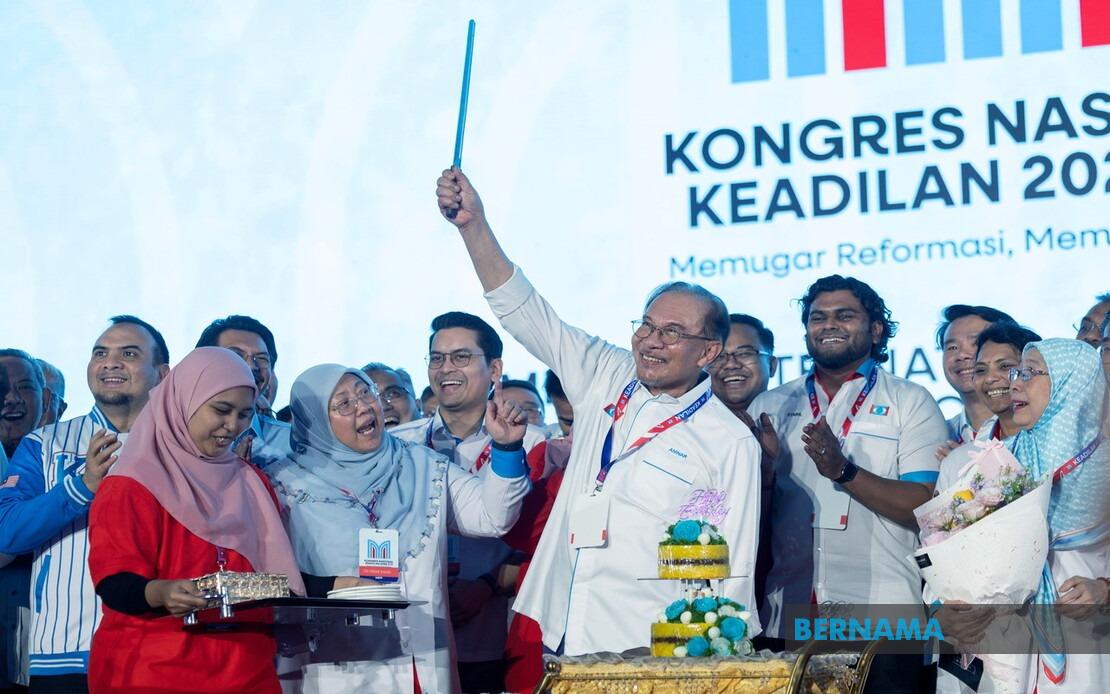
The PKR National Congress 2026, held in Melaka, concluded with the party reinforcing its dual commitment to maintaining the political equilibrium that underpins Malaysia's current governance structure whilst simultaneously advancing the progressive reforms that have long defined its political identity. Party president Datuk Seri Anwar Ibrahim, in his closing address, underscored the importance of preserving the Unity Government framework as essential to securing both political stability and sustained economic prosperity for ordinary Malaysians. This balance represents a central tension within PKR's contemporary political positioning, caught between the pragmatic demands of governing and the ideological imperatives that initially mobilised its support base.
Anwar's remarks carried particular weight given his dual roles as Prime Minister and Pakatan Harapan chairman. He articulated a clear position: PKR would continue championing the Unity Government coalition, though he candidly acknowledged that the sustainability of this partnership ultimately rested with UMNO and Barisan Nasional's leadership decisions. This framing subtly deflects responsibility for any potential future deterioration whilst simultaneously signalling PKR's own commitment to maintaining the arrangement. The Prime Minister issued a pointed warning to all coalition partners against taking provocative actions that might destabilise the government, characterising the Unity Government not as a temporary political convenience but as a deliberate construct rooted in national interest and political maturity rather than opportunistic calculations.
The challenge of reconciling governance participation with transformative ambitions emerged as a central preoccupation throughout the congress. PKR deputy president Nurul Izzah Anwar emphasised that the party's reform mandate must persist despite its shift from opposition to government participation. She articulated a vision wherein institutional reforms, administrative improvements, and policy shifts could simultaneously reinforce governmental stability and serve as the party's enduring legacy for subsequent generations. This philosophical position suggests PKR envisions itself not merely as a government component but as an agent of systemic change operating from within the machinery of state power.
The repeal of the Universities and University Colleges Act (AUKU) 1971 was cited as the most tangible manifestation of this reform approach. This legislative achievement represented a significant concession from the coalition government, lifting restrictions on student political expression and association that had remained in place for decades. Anwar provided further assurances that the government harbours no intention of reintroducing similarly restrictive legislation under alternative nomenclature. He contended that existing criminal and general law provisions offer sufficient legal instruments to address problematic student behaviour, placing student conduct within the broader framework of citizen responsibility rather than treating higher education institutions as zones of exceptional control. This position carries considerable symbolic weight within Malaysian politics, where university freedoms have historically served as a barometer of democratic space.
The congress also centred substantial attention on organisational preparedness and internal party strengthening. Rather than awaiting parliamentary dissolution or formal candidate announcements, PKR leadership signalled that the party must maintain a continuous state of political readiness to navigate whatever electoral or coalition scenarios might emerge. This forward-looking posture reflects an awareness that political configurations remain fluid, and excessive complacency risks disadvantaging the party in any sudden shifts to the political terrain.
Gender representation and women's leadership emerged as priority areas within PKR's renewed strategic vision. Education Minister and PKR Wanita chief Fadhlina Sidek called for substantially expanded opportunities for women to occupy senior positions in both party and governmental hierarchies. Beyond symbolic representation, she stressed the necessity for party and government leaders to cultivate institutional cultures genuinely receptive to criticism and committed to continuous governance improvement. This emphasis on internal accountability and openness represents an implicit acknowledgement that even parties with progressive credentials require deliberate mechanisms to prevent hierarchical ossification and insular decision-making.
Youth mobilisation and intergenerational concerns received considerable emphasis from Angkatan Muda Keadilan, the party's youth wing. The youth body articulated a comprehensive platform addressing issues salient to Generation Z and young workers, extending well beyond traditional labour issues. Recognition of the gig economy as a legitimate employment category reflects acknowledgement of Malaysia's rapidly evolving labour market, where conventional employment relationships increasingly share space with more fluid and decentralised work arrangements. The wing's emphasis on social protection mechanisms, professional skills development pathways, and mental health support reflects broader contemporary concerns about economic precarity and psychological wellbeing amongst younger demographics.
Particularly noteworthy was AMK's focus on ensuring Bumiputera participation in cutting-edge technological sectors including artificial intelligence, semiconductors, and biotechnology. This positioning suggests PKR seeks to square a circle by promoting both inclusive technology advancement and community-rooted affirmative action principles. For Malaysian readers and the broader Southeast Asian context, this reflects an attempt to align progressive inclusion policies with the technological transformation reshaping regional economies. The approach implicitly rejects false choices between equity and innovation, positing instead that demographic representation strengthens rather than compromises technological capability.
The congress's conclusions regarding political stability warrant careful examination given Malaysia's recent political history. The repeated emphasis on maintaining Unity Government equilibrium contrasts sharply with the coalition's fragility demonstrated by periodic defections and competing interests. PKR's framing of stability as foundational to reform implementation suggests the party views the current arrangement as instrumentally necessary despite ideological tensions with certain coalition partners. This pragmatic positioning may ultimately determine whether PKR can successfully translate its reform agenda into substantive policy outcomes or whether governing compromises progressively dilute transformative ambitions.
The overall congress narrative suggests PKR leadership believes it can maintain simultaneous commitment to both coalition participation and progressive transformation. Whether this represents achievable political strategy or an increasingly strained contradiction depends substantially on developments beyond PKR's direct control, particularly UMNO and BN's own political calculations and the durability of elite consensus around the Unity Government framework. For observers across the region, PKR's navigation of these tensions offers instructive lessons about how progressive parties operate within coalition arrangements and the practical constraints governing transformative politics in systems where power remains distributed across multiple actors.

