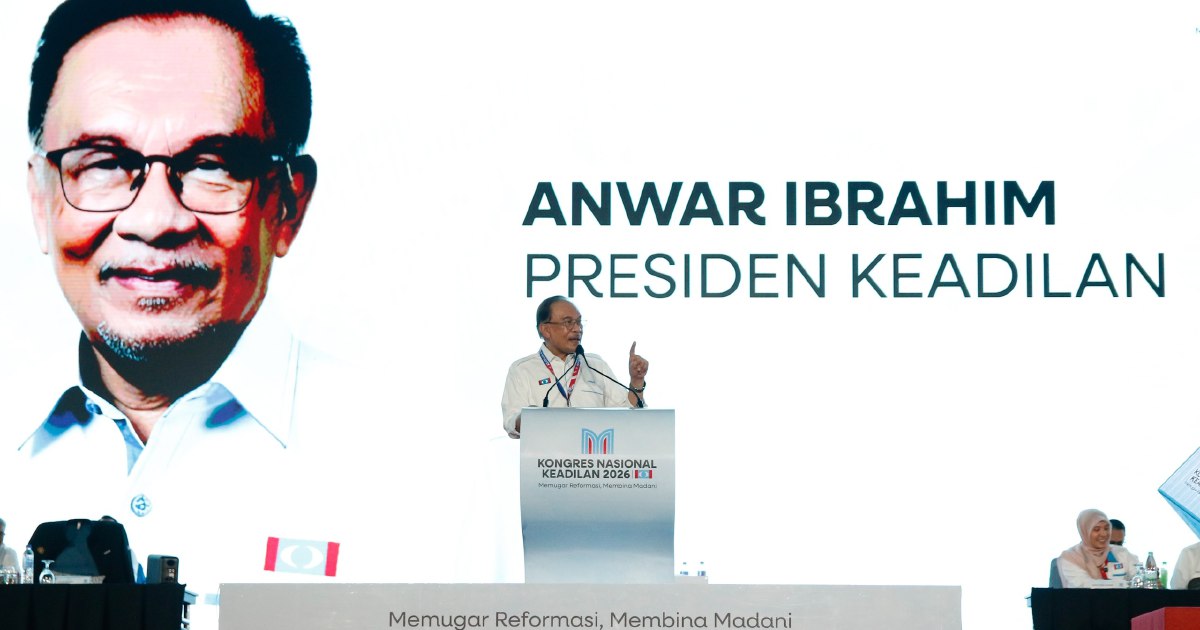
At a gathering in Ayer Keroh, PKR president Datuk Seri Anwar Ibrahim reaffirmed his party's commitment to a carefully balanced political arrangement that keeps the government stable at the national level whilst maintaining the coalition partnerships that have defined Malaysia's political landscape since 2018. The clarification addresses mounting speculation about the durability of Malaysia's unusual multi-coalition governance model, where competing political blocs work together to ensure parliamentary stability.
Anwar's statement underscores PKR's central position in Malaysian politics, where the party serves as a bridge between the Barisan Nasional-Umno establishment and the reform-oriented Pakatan Harapan alliance. Since the formation of the current administration, this arrangement has proven delicate, requiring careful management of competing interests and the prevention of coalition tensions from escalating into government collapse. PKR's willingness to work across traditional partisan divides reflects both its pragmatic leadership approach and the precarious nature of Malaysia's current parliamentary mathematics.
The decision to remain aligned with both groupings carries significant implications for state-level governance, where Pakatan Harapan continues to control several key states including Selangor, Penang, and Melaka. In these territories, PKR maintains strong positions within elected state governments alongside DAP and Amanah partners, making coordination between federal and state political interests essential for the party's coherence. Any fracturing of either the federal or state alliances could create administrative conflicts that hamper policy implementation across the country.
For Barisan Nasional and Umno, the assurance of PKR's continued federal cooperation provides essential parliamentary support that enables the government to pass legislation and budgets without constant uncertainty about backbench rebellions or sudden coalition withdrawals. The arrangement has allowed the government to navigate several critical votes since 2022, when the political realignment took shape following Muhyiddin Yassin's departure from office. This stability has been crucial for Malaysia's economic management during a period of regional uncertainty and inflationary pressures.
However, the sustainability of this dual-alignment strategy faces inherent tensions. DAP and Amanah must balance their ideological commitments to reform and anti-corruption agendas with the practical reality that PKR, their coalition partner, works alongside former Barisan Nasional members at the federal level. This tension occasionally surfaces in public statements from Pakatan leaders but has not yet reached the breaking point that would force a fundamental realignment. Managing these sensitivities requires sophisticated political communication from all parties involved, particularly PKR as the pivotal centrist force.
The regional dimension adds further complexity to Malaysia's coalition architecture. Several Southeast Asian democracies have experimented with multi-party coalitions and cross-partisan cooperation arrangements, though few have achieved the longevity that Malaysia's current system has demonstrated. Thailand's coalition governments have proven notoriously unstable, whilst Indonesia's Joko Widodo administration managed a large coalition through careful patronage and power-sharing. Malaysia's experience may offer valuable lessons about how multiparty systems can function when the alternative is political gridlock or repeated electoral cycles.
Anwar's reiteration of loyalty to both camps also signals PKR's confidence in its ability to manage the internal party dynamics that such an arrangement demands. Party members, particularly those aligned with reform agendas or heavily invested in DAP and Amanah partnerships, must accept that federal cooperation with Umno represents strategic necessity rather than ideological compromise. PKR has worked to frame this positioning as pragmatic governance that prioritises Malaysia's economic stability and development over the partisan ideology that might otherwise dominate the political agenda.
International observers and foreign investors monitoring Malaysia's political trajectory have shown increasing comfort with the current arrangement, recognising that it has prevented the kind of governmental instability that plagued the region in prior years. The relative predictability of Malaysia's current system, despite its complexity, has positive implications for business confidence, foreign direct investment, and the country's standing within regional economic frameworks. The continuity of economic policy under this coalition model has permitted sustained efforts at fiscal consolidation and growth initiatives that might have been derailed by constant political upheaval.
Looking forward, Anwar's statement signals that PKR sees no imminent reason to alter its fundamental political strategy. The party will continue leveraging its position as the central coalition member to extract concessions from both BN-Umno and Pakatan Harapan whilst maintaining the parliamentary arithmetic necessary to govern. This approach requires constant recalibration as circumstances change, particularly as state-level elections approach in various jurisdictions and as economic conditions continue to evolve across Malaysia and the region.

