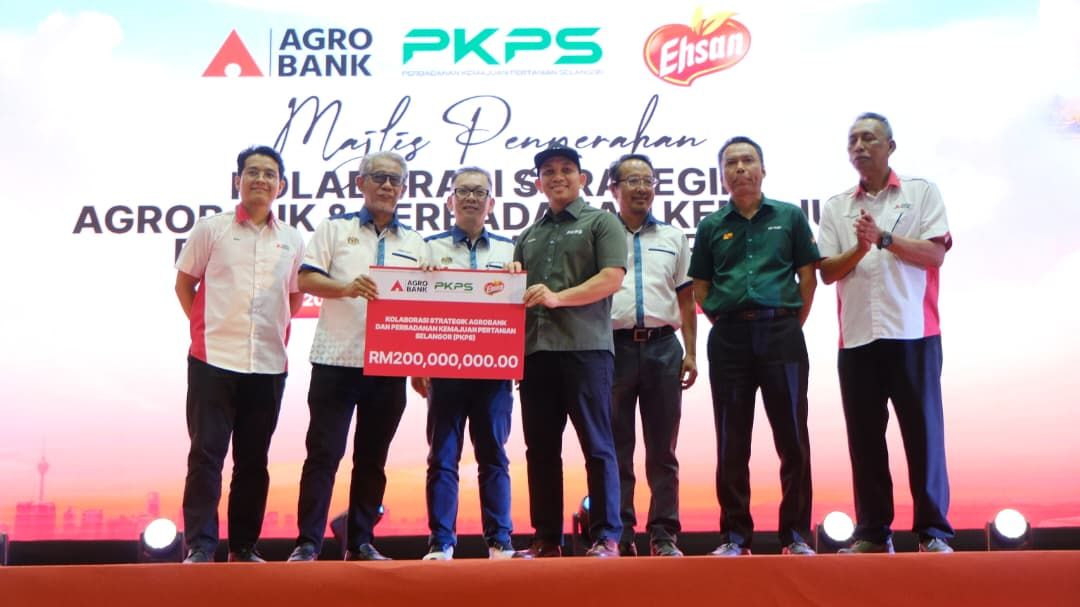
The Selangor Agricultural Development Corporation (PKPS) has entered into a landmark RM200 million financing agreement with Agrobank, marking a significant step forward in bolstering the state's agricultural infrastructure and food security capabilities. The partnership was formally announced during the Malaysia Agriculture, Horticulture and Agrotourism Exhibition (MAHA) 2026 at Malaysia Agro Exposition Park (MAEPS) Serdang on August 29, with Agrobank group president and chief executive officer Datuk Tengku Ahmad Badli Shah Raja Hussin presenting a symbolic cheque to PKPS group chief executive officer Datuk Dr Mohamad Khairil Mohamad Razi in the presence of Deputy Agriculture and Food Security Minister Datuk Chan Foong Hin.
This strategic collaboration represents a comprehensive approach to modernizing Selangor's agrifood ecosystem by combining infrastructure investment, operational support, and research initiatives under a single financing framework. The RM200 million trade facility has been structured to accommodate multiple dimensions of agricultural development, from tangible asset creation to human capital enhancement and innovation activities. The arrangement is designed to address both immediate working capital requirements for PKPS and longer-term capital needs for transformative infrastructure projects that will reshape how the state produces, processes, and distributes food commodities.
The flagship initiative emerging from this partnership is the construction of a dedicated halal food warehouse in Selangor, which will function as a strategic storage and logistics node supporting the state's entire food supply chain network. This facility is critical for a state like Selangor, which serves as Malaysia's primary food production region and must ensure efficient movement of agricultural products from farms to retailers and consumers. By establishing a purpose-built halal-certified warehouse with modern logistics capabilities, PKPS aims to reduce post-harvest losses, improve inventory management, and create a competitive advantage for local producers in an increasingly quality-conscious market.
Beyond the warehouse project, the financing facility will underpin development of several complementary infrastructure assets designed to create an integrated agrifood processing and distribution network. A halal chicken processing centre will enable local producers to capture higher-value segments of the poultry market by offering processed products that meet stringent halal standards. Simultaneously, an Ehsan product processing centre will handle value-added transformation of agricultural raw materials into consumer-ready items, leveraging Selangor's established Ehsan brand for agricultural products. The construction and strategic upgrading of central distribution warehouses across all districts in Selangor will ensure that improved logistics capabilities reach far beyond the capital region, strengthening food availability in both urban and rural areas throughout the state.
The facility's scope extends significantly beyond physical infrastructure to encompass operational investments and research activities that will drive long-term competitiveness and resilience. PKPS will utilize portions of the financing to develop ready-to-eat and ready-to-heat food products under the Ehsan brand, responding to consumer demand for convenient, quality food options in Malaysia's increasingly time-pressed urban markets. This product development initiative represents an important shift toward higher-margin, value-added production that can differentiate Malaysian agricultural products in regional and international markets. The investment acknowledges that modern food security depends not merely on commodity production volumes but on the ability to deliver products that match contemporary consumer preferences and purchasing patterns.
Innovation and capacity-building form equally important components of the partnership framework. The financing will support ongoing operations at the Ehsan Agricultural Research Centre, which conducts specialized research into smart agriculture methodologies suited to Malaysia's tropical environment and constraints. This research dimension is particularly significant given global trends toward precision agriculture, controlled-environment farming, and data-driven crop management that can substantially improve yields while reducing resource consumption. By combining production infrastructure with research capacity, the partnership creates feedback loops where practical farming challenges can be systematically studied and addressed through evidence-based solutions adapted to local conditions.
Human capital development receives dedicated attention through the Ehsan Agricultural Training Centre, which will prepare the next generation of agricultural professionals equipped with modern technical knowledge and business acumen. Malaysia's agricultural sector faces persistent challenges in attracting younger workers and retaining skilled personnel, particularly in technical roles requiring specialized expertise. By investing in structured training programs within the financing facility, PKPS can build a talent pipeline while simultaneously upgrading productivity across the entire supply chain. Training investments yield particularly strong returns in agriculture, where knowledge about pest management, sustainable practices, processing techniques, and market dynamics directly influences both profitability and resource sustainability.
The partnership also encompasses development of agritourism experiences at the Ehsan Resort and Convention Centre, reflecting evolving perspectives on agriculture's role in modern economies. Agritourism generates direct revenue while building consumer awareness of local food production systems and fostering appreciation for agricultural work. For Selangor specifically, agritourism can diversify rural incomes, support farm viability in areas facing urban encroachment, and create employment opportunities complementary to traditional farming. The inclusion of agritourism within the financing framework signals recognition that sustainable agricultural development increasingly depends on multiple revenue streams and community engagement beyond commodity sales.
The facility becomes operational in March 2027, following formal regulatory and procedural completion. Disbursement mechanisms have been designed to follow rigorous project-based procedures, with funding released according to verified project progress milestones rather than lump-sum allocations. This structured approach protects financial discipline while ensuring consistent cash flow management throughout the partnership period. Such arrangements typically appeal to development banks like Agrobank because they align funding releases with demonstrated progress, reducing risks associated with project delays or cost overruns that plague agricultural development initiatives in Southeast Asia.
This partnership directly advances the overarching theme of MAHA 2026, "Value Creation for Food Security," by demonstrating how coordinated investment in sustainable infrastructure, technological adoption, and institutional capacity can strengthen food systems from production through consumer access. For Malaysia more broadly, the initiative carries significance beyond Selangor's borders. The state's agricultural performance substantially influences national food security metrics, and improvements in Selangor's production efficiency and supply chain sophistication create templates that other states may adapt. The partnership also showcases how development finance institutions like Agrobank can mobilize capital for agricultural transformation when paired with capable state development corporations like PKPS that possess operational expertise and political backing to execute complex projects.
The timing of this announcement carries strategic weight, linking major financing commitments to MAHA 2026, a platform where agricultural stakeholders across Malaysia and regional partners gather to assess sector trends and forge partnerships. By formalizing the RM200 million commitment during this high-visibility event, both PKPS and Agrobank signal confidence in Selangor's agricultural potential while demonstrating concrete progress toward food security objectives outlined in national and state development strategies. The partnership represents precisely the type of institutional collaboration and long-term capital commitment that agricultural development typically requires, moving beyond project-by-project funding toward sustained, integrated investment in supply chain resilience and modernization.

