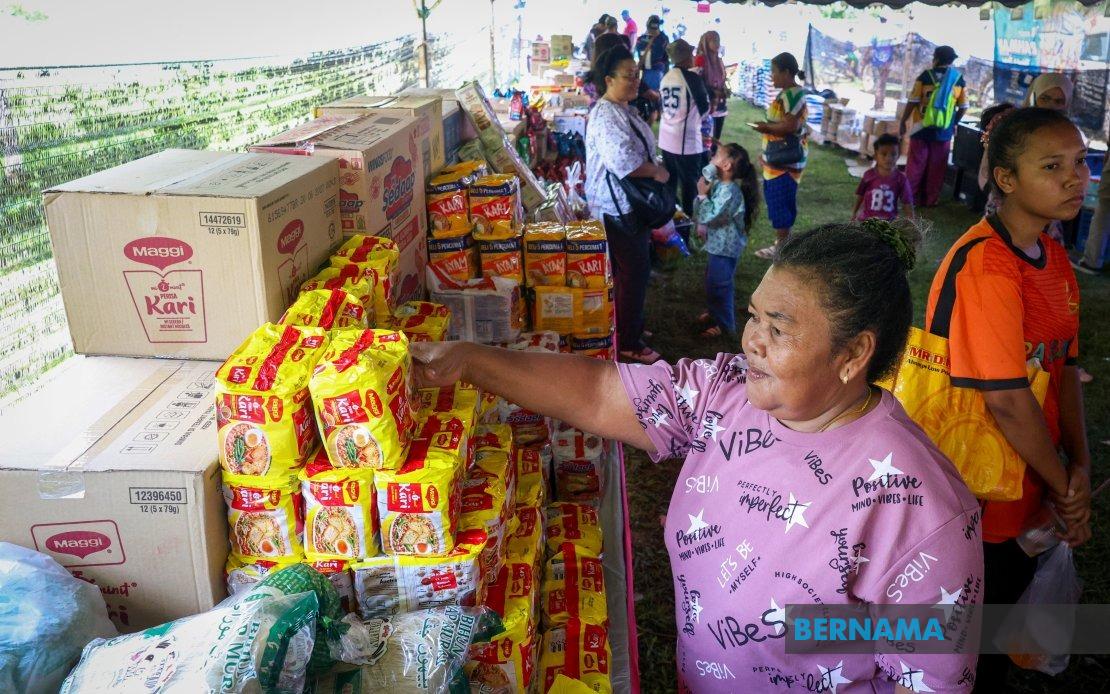
Over 1,000 Temiar Orang Asli residents living at the Pasik Resettlement Scheme in Gua Musang can now access subsidised essential goods through the Rahmah MADANI Sales Programme, or PJRM, a government initiative designed to ease the burden of rising living costs in remote communities. The programme allows residents to purchase rice, cooking oil, sugar and other necessities at significantly reduced prices using SARA credit available on their MyKad, marking an important expansion of retail access to marginalised populations in the interior.
Previously, obtaining affordable goods required residents to undertake arduous journeys. Kampung Ayong resident Ramli Chimbong, 51, described how trips to Kampung Jerek—approximately two and a half hours away—became necessary to access the PJRM, incurring substantial expenses. The costs extended beyond fuel and transportation alone; residents spent at least RM600 per trip when accounting for vehicle rental, meals and miscellaneous expenses, effectively negating whatever savings they achieved through the subsidised prices. For families living on tight budgets, such journeys represented a significant proportion of monthly income and remained accessible only occasionally.
The difference in pricing highlights why rural residents previously endured such inconvenient travel. A nine-kilogramme bag of rice sold for up to RM40 at local village shops—a steep markup reflecting transport costs and limited competition—but costs only RM29 through PJRM. This RM11 difference on a single item demonstrates how accessibility disparities translate into sustained financial hardship for rural Orang Asli communities. Ramli noted that having the programme operate within the settlement made purchasing not merely convenient but economically viable for regular household needs.
SMS Maju Solution, the company operating the PJRM outlet at Pasik, supplied approximately 100 different product categories during the inaugural session. The inventory included 300 bags of rice, 300 trays of eggs and 300 chickens—quantities suggesting serious planning based on community needs assessment. Residents began arriving before 9 am, indicating strong pent-up demand and genuine appreciation for local access to subsidised goods. The early turnout reflected how remoteness compounds ordinary shopping challenges, making convenience nearly as valuable as price reductions.
A striking observation emerged regarding existing SARA balances. Many residents retained substantial credit—between RM300 and RM800—accumulated through the government's earlier distribution of support funds to vulnerable populations. Few residents had depleted their balances to minimal levels, suggesting either weak previous awareness of the PJRM or practical inability to access distant outlets. The programme's arrival at Pasik essentially converted dormant electronic credits into usable purchasing power, converting government support from theoretical benefit into tangible household relief.
The logistics of serving remote settlements proved challenging. A vehicle carrying supplies encountered a burst tyre due to the rocky and muddy road conditions typical of Orang Asli settlements, underscoring infrastructure inadequacies that contribute to service delivery gaps. These physical obstacles help explain why private retailers rarely establish competitive operations in such areas; profit margins cannot sustain the operational costs and risks involved. Government programmes like PJRM succeed precisely because they operate beyond pure commercial logic.
Nenggiri assemblyman Mohd Azmawi Fikri Abdul Ghani framed the initiative as addressing living cost pressures facing rural communities. He advocated for expanding the programme across all Orang Asli settlements, recognising that dispersed indigenous populations across Peninsular Malaysia likely face similar access problems. Scaling the programme would require coordination across multiple administrative boundaries and sustained commitment to reaching low-density communities where commercial viability remains questionable.
The Pasik expansion illustrates a fundamental policy challenge in developing Malaysia: geographic remoteness creates persistent inequality in consumer prices and goods availability, directly affecting purchasing power. Families earning identical incomes face radically different real living costs depending on settlement location. Without deliberate intervention through subsidised programmes, rural Orang Asli communities experience a hidden tax on their incomes through geographic disadvantage alone. PJRM represents targeted government response to this structural inequality.
For Southeast Asian context, Malaysia's experience demonstrates how indigenous and remote populations across the region typically struggle with retail access and pricing disparities. Similar challenges affect Orang Asli in Perak and Selangor, aboriginal peoples in Thailand's northeast, and hill communities across the greater Mekong region. PJRM's local deployment offers a replicable model combining subsidy mechanisms with physical outreach, though sustained success depends on reliable transportation networks and community coordination.
The programme's reliance on existing SARA credit balances represents efficient deployment of previously distributed support. Rather than replacing subsidies, the programme activates existing entitlements by improving redemption accessibility. This approach maximises impact from existing government spending while addressing both price and convenience barriers simultaneously. Future expansions could adopt similar leveraging of dormant benefit balances across multiple schemes.
However, sustainable scaling faces practical limits. Operating PJRM across dozens of scattered Orang Asli settlements requires substantial logistical infrastructure and recurring operational costs. Government must decide whether such investments represent appropriate prioritisation relative to other rural development needs. Additionally, infrastructure improvements—particularly road quality and telecommunications—could enable commercial providers to serve these communities independently, potentially providing more sustainable long-term solutions than ongoing subsidy programmes.
The Pasik initiative ultimately reflects both the successes and limitations of targeted retail subsidies. It demonstrably improves immediate household economics and validates that purchasing power constraints, not merely preference, prevented remote residents from accessing cheaper goods. Yet true equality in consumer access requires addressing underlying infrastructure deficits that generate geographic pricing disparities initially. PJRM effectively treats symptoms while underlying structural causes persist.

