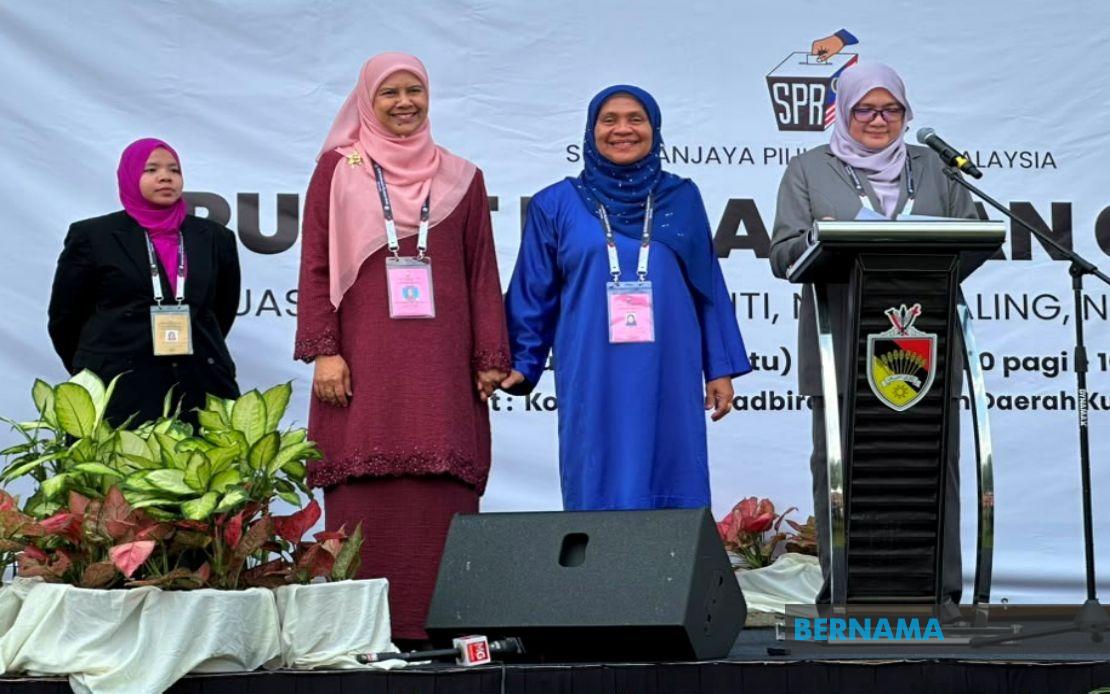
The Pilah state seat in Negeri Sembilan is poised for a landmark all-female electoral contest in the 16th state election, with incumbent Datuk Noorzunita Begum Mohd Ibrahim representing Pakatan Harapan set to defend her position against Barisan Nasional's S. Leza Md Yasin. The nomination closure on July 18 confirmed the two-candidate race following the filing of nomination papers at the Kuala Pilah District and Land Office, with Noorzunita Begum submitting her candidacy at 9.03 am and S. Leza following nine minutes later. The direct contest reflects evolving political dynamics within the Negeri Sembilan electorate and underscores the growing prominence of female representation in state-level politics across Malaysia.
The broader 16th Negeri Sembilan State Election will present a diverse battleground across five contested seats. Beyond the Pilah straight fight, three-cornered contests will dominate four other constituencies, demonstrating the fragmented political landscape in the state. In Juasseh, Pakatan Harapan's Mohd Aidil Abdullah will face Barisan Nasional's defending candidate Datuk Ismail Lasim alongside Bersatu's Mohd Zuhami Md Yusof, establishing a multi-cornered battle that reflects the persistent three-way split in Malaysian politics following recent political realignments. Similarly, Seri Menanti will witness a three-way contest featuring Pakatan Harapan's Mohd Kamarul Arifin Mohd Wafa against Barisan Nasional incumbent Muhammad Sufian Maradzi and Bersatu's Datuk Seri Megat D. Shahriman Zaharuddin.
The Senaling state seat introduces another three-cornered race involving Pakatan Harapan's Mohd Hanis Mohd Alimin, Barisan Nasional's Mohamad Qayyum Abd Jalil, and Bersatu's Mohd Izzafi Khan. These multiple three-way contests underscore how Malaysian state elections have become increasingly complex affairs, with the rise of Bersatu as a political force fragmenting what were traditionally two-coalition battles. For electoral strategists and political observers, these competitions will test campaign machinery in an environment where vote-splitting could prove decisive. The presence of multiple credible candidates in each contest means margin-of-victory calculations have become substantially more unpredictable than in earlier bipolar electoral contests.
Johol presents the exception to this pattern, offering a conventional straight fight between Pakatan Harapan's Mohd Zailan Mohd Munawar and Barisan Nasional's defending incumbent Datuk Saiful Yazan Sulaiman. This two-candidate race mirrors the Pilah configuration and suggests that in certain constituencies, political consolidation remains strong enough to limit the number of serious contenders. The variation in contest configurations across different seats indicates that local political circumstances, candidate strength, and community preferences continue to shape nomination patterns, even within a single state election.
The campaign witnessed visible high-level support from both major coalitions during the nomination filing process. Accompanying Pakatan Harapan candidates was PKR Wanita chief Fadhlina Sidek, who holds the Education Minister portfolio, signalling the coalition's investment in the election outcomes. Angkatan Muda Keadilan vice-chief Dr Mohammed Taufiq Johari, serving as Youth and Sports Minister, and Deputy Investment, Trade and Industry Minister Sim Tze Tzin reinforced the government's mobilization efforts, reflecting how state elections command attention from federal-level leaders.
Barisan Nasional's campaign presence proved equally substantial, with Deputy Home Minister and UMNO Supreme Working Council member Datuk Seri Dr Shamsul Anuar Nasarah coordinating candidate support. The participation of Perak Menteri Besar Datuk Seri Saarani Mohamad, who also chairs Perak UMNO, added cross-state political weight to the nomination proceedings. Such coordinated displays of senior leadership involvement highlight how state elections function as crucial opportunities for testing political narratives and organizational capacity, particularly for coalition members preparing for potential federal-level contests.
The election timeline established by the Election Commission provides campaigns with a compressed but manageable schedule. Early voting has been designated for July 28, offering opportunities for voters with scheduling constraints, while polling day is set for August 1. This two-week campaign window between nomination closure and election day represents a relatively brief period for candidates to connect with constituents, conduct ground operations, and refine messaging. In contemporary Malaysian electoral contexts, such timeframes have become standard, requiring campaigns to operate with sophistication in digital outreach alongside traditional ground mobilization.
For Negeri Sembilan voters, the August 1 election carries significance beyond local concerns. State elections frequently serve as barometers for broader national political sentiment, providing early indicators of electoral mood that can influence timing calculations for federal-level contests. The composition of the Negeri Sembilan state assembly resulting from this election will potentially affect coalition dynamics at the national level, particularly if either Pakatan Harapan or Barisan Nasional experiences significant gains or losses. Political analysts will closely monitor results across these five seats to assess whether patterns of support evident in previous federal elections remain stable or have shifted.
The all-female matchup in Pilah specifically merits attention within broader conversations about gender representation in Malaysian politics. While female candidates have contested elections previously, direct head-to-head contests between two women remain relatively uncommon at the state level. This configuration potentially creates distinct campaign dynamics, as traditional patterns of candidate presentation and voter engagement may operate differently when gender is not a differentiating factor between contenders. Voters must evaluate candidates primarily on their policy positions, track records, and constituency service capabilities rather than demographic categories, theoretically enabling more substantive electoral discourse.
The nomination process itself proceeded smoothly across all constituencies, with returning officer Nawal Mohammed Amin confirming the completion of filing by 10 am on July 18. This orderly administration of candidate registration, following recognized procedures, demonstrates institutional capacity for managing electoral mechanics. The Election Commission's management of nomination processes reflects Malaysia's relatively established systems for conducting periodic elections, despite occasional controversies surrounding electoral boundaries, voter registration, or campaign fairness.
As campaigns intensify over the following fortnight, party machinery across both coalitions will deploy resources toward these five constituencies. The stakes extend beyond simply controlling Negeri Sembilan's state assembly; results will inform national political calculations and provide evidence of constituency-level preferences that may influence future electoral strategies. The diverse nature of contest configurations—from the historic all-female Pilah straight fight to multiple three-cornered battles—ensures that the August 1 election will present a complex tapestry of electoral outcomes, each potentially carrying different implications for Malaysia's evolving political landscape.

